
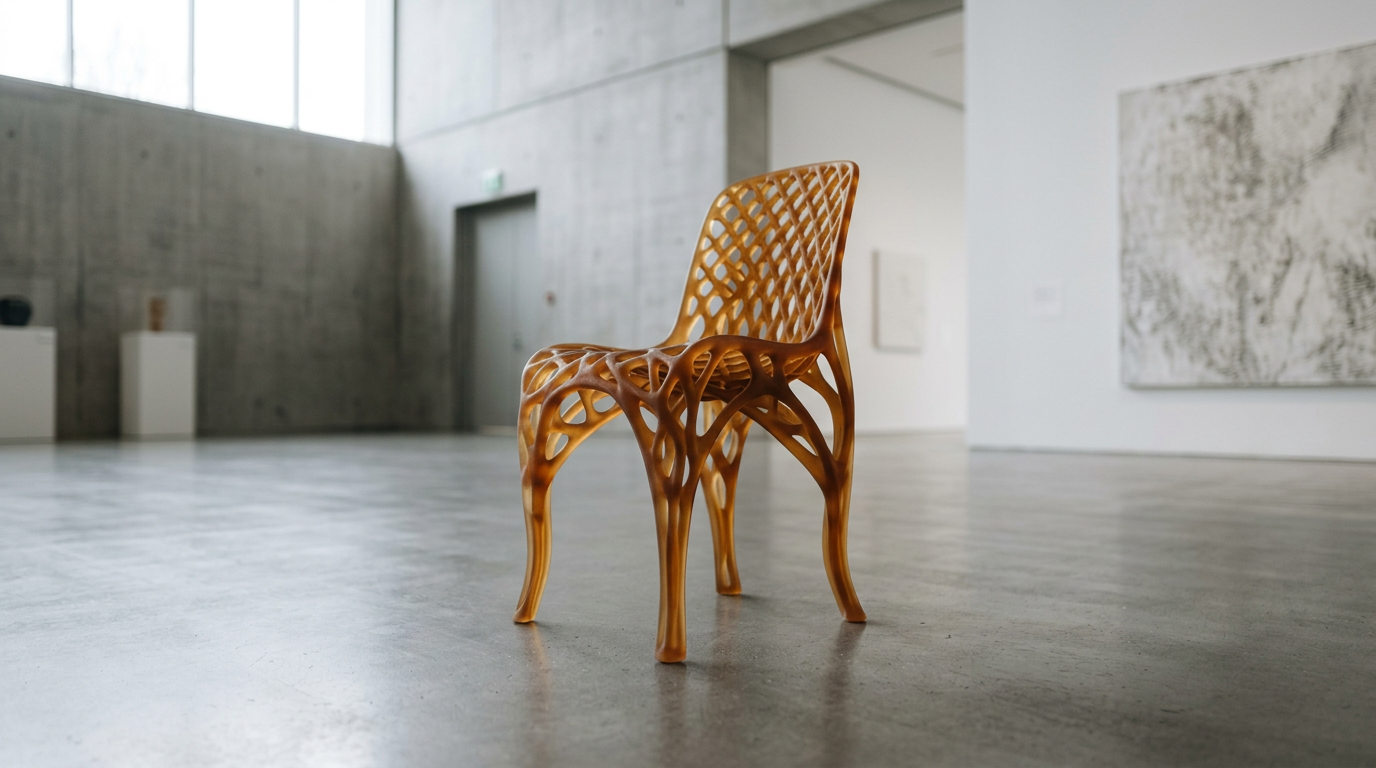
Stockholm Design Week 2026 delivered one of its most transformative showcases yet — a bold, future-leaning exhibition where artificial intelligence stepped out of the “concept lab” and fully into the world of tangible design. For the first time, AI-designed furniture wasn’t just a novelty shown in a corner installation; it stood shoulder-to-shoulder with traditional Scandinavian craftsmanship, challenging the very definition of creativity, authorship, and construction.
This year’s theme was clear: Nordic design is evolving into a hybrid discipline where human sensibility meets computational intelligence. The result? Furniture pieces that appear impossibly precise, beautifully organic, or structurally daring — forms once limited by human iteration but now expanded through machine-generated possibilities.
The 2026 edition offered everything from algorithm-sculpted chairs to modular AI-generated shelving systems, lighting informed by digital biomimicry, and even furniture created through real-time collaboration between designers and GenAI platforms. Below, we explore the standout pieces that captured attention, sparked conversation, and set the tone for the next era of Scandinavian design.
AI in Scandinavian Design: Why Stockholm Design Week 2026 Became a Turning Point
AI’s role in design has been growing globally, but in Sweden — where craftsmanship, sustainability, and minimalism form the design DNA — AI found a distinct path. Rather than replacing artisanship, it amplified it.
Stockholm Design Week 2026 emphasized three major directions:
AI as a co-creator — Designers used machine intelligence to explore new forms, textures, and ergonomics faster than traditional prototyping ever allowed.
Moreover, AI as a sustainability enabler — Generative models analyzed material constraints, carbon footprints, and durability to produce eco-optimized furniture.
AI as a craftsmanship partner — Instead of fully automating production, AI worked alongside human makers, providing sketches, variations, and structural insights while artisans brought emotional warmth and finishing intuition.
Against this backdrop, the top AI-designed pieces stood out not only for their technological sophistication but for their soul — a distinctly Nordic quality preserved even in machine-created forms.
The Top AI-Designed Pieces of Stockholm Design Week 2026
The “Infinite Loop Chair” – A Masterclass in Algorithmic Ergonomics
Perhaps the most talked-about piece, the Infinite Loop Chair, was the result of a collaboration between a Swedish furniture lab and a GenAI modeling engine. The chair’s form flowed in a continuous, unbroken curve designed to mimic spinal movement.
AI analyzed over 9,000 posture datasets to shape the seat’s curvature, resulting in a structure that adapts naturally to weight shifts without mechanical adjustments.
Crafted from laminated ash and flax fiber, it was a fusion of sustainable thinking and computational accuracy — the kind of harmony Scandinavian design pursues at its core.
The “Aurora Table” – Structure Generated by Northern Light Patterns
Inspired by the aurora borealis but generated entirely through AI interpretation of real atmospheric data, the Aurora Table turned heads with its sculptural legs and iridescent resin top.
Designers fed years of aurora movement patterns into a generative model, which then translated light behavior into structural formations. The final form looked both futuristic and poetic — an intersection of natural phenomena and mathematical precision.
The table symbolized a broader SWD 2026 trend: AI used not to imitate nature, but to interpret it in new dimensional ways.
ModulAI Shelving System – Adaptive, Intelligent, and Circular
This modular AI-designed shelving system was a hit for commercial buyers. Not only was every unit generated according to the customer’s space dimensions, but AI optimized the amount of plywood needed and suggested configurations that minimized waste.
Each shelf could be reorganized, reassembled, or expanded, following the AI’s recommended structural paths. For apartments, studios, and offices, this system promised hyper-efficient space use — all while maintaining the clean, warm Scandinavian aesthetic.
The “Pulse Lounge Chair” – AI Biomimicry Meets Organic Comfort
A soft, asymmetrical lounge chair designed through AI biomimicry algorithms, the Pulse Chair mimicked the natural growth patterns of mycelium networks. This resulted in a fluid, cocoon-like structure that felt alive.
What made it truly futuristic was its dynamic seating shape: AI modeled micro-support zones in the cushion based on average Nordic body proportions and circulation patterns. The result offered support in places where typical lounge chairs often fail.
Upholstered in algae-based fabric, the chair also pushed sustainability into new territory — a signature theme of SWD 2026.
AI-Generated Light Sculpture “Horizon 08”
One of the most photographed installations, Horizon 08 was a ceiling-hung light sculpture generated through an AI system trained on Scandinavian coastlines. The form resembled an abstract floating landscape, and its soft gradient lighting shifted based on real-time environmental data — wind speed, daylight, humidity.
This blurred the boundary between furniture and responsive architecture, offering a glimpse of homes that emotionally adapt to their surroundings.
AI in Craftsmanship: Human Hands Still Matter
One message rang loud in Stockholm this year: AI did not diminish the role of artisans — it amplified it. Every showcased piece had human finishing, intuition, and contextual understanding behind it.
Designers described AI as a “supercharged sketch partner”, producing hundreds of iterations in minutes, allowing them to curate, refine, and humanize the outputs. Woodworkers emphasized that AI suggested possibilities, but the warmth, sanding, joining, and detailing still required human mastery.
In this sense, Sweden presented a model for AI-assisted craftsmanship that other countries may soon follow — thoughtful, ethical, and rooted in preserving identity rather than replacing it.
Industry Reactions: Why This Showcase Felt Like a Creative Revolution
Design critics and interior architects at the event agreed that Stockholm Design Week 2026 marked:
- the first time AI-designed pieces felt market-ready
- a departure from AI as a gimmick
- a confident merging of computational precision and Scandinavian emotional minimalism
- the start of a new design category — Algorithmic Nordic Craft
Buyers from hotels, tech offices, and residential brands showed strong interest, especially in adaptive AI furniture that could be customized at scale without long prototyping cycles.
Most importantly, this year signaled a creative shift: AI is no longer a tool for speed — it is a tool for expanding aesthetic imagination.
Conclusion
Stockholm Design Week 2026 will be remembered as the year AI stopped being a background tool and became a central collaborator in Scandinavian furniture design. The pieces unveiled showcased a rare balance: the mathematical intelligence of algorithms paired with the emotional depth of Nordic craftsmanship.
AI didn’t erase human creativity — it widened its field. It generated forms beyond the constraints of traditional sketching, optimized materials with sustainability at the forefront, and empowered artisans to push boundaries they hadn’t imagined before.
As the design world watches Sweden’s bold leap, one thing is certain: AI-designed furniture is not a trend — it’s the new frontier of interior innovation. The pieces shown this year are only the beginning, hinting at a future where homes, offices, and public spaces feature intelligent forms shaped by both human intuition and digital imagination.




