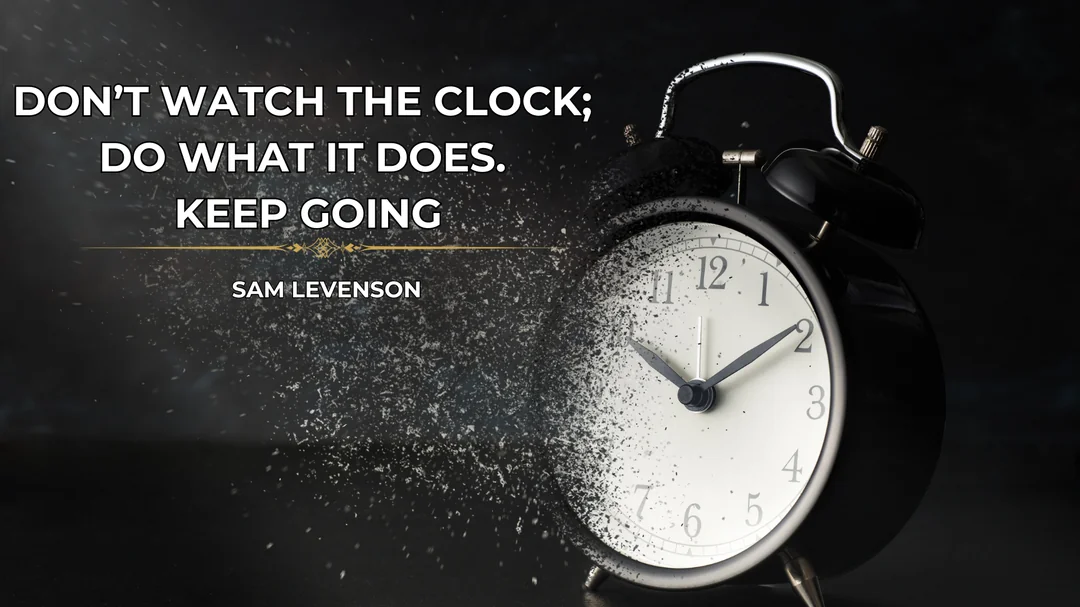
“Don’t watch the clock; do what it does. Keep going.” — Sam Levenson
Some motivational lines are loud and dramatic. Others are quiet but deeply transformative. Sam Levenson’s famous advice belongs to the second category. At first glance, it feels almost gentle. But hidden inside these few words is a powerful philosophy about consistency, focus, and long-term success. Stay inspired with Sam Levenson’s powerful quote about persistence. Discover motivation strategies, real productivity facts, and practical insights to keep going forward every day.
In today’s fast-moving world, many people feel constantly aware of time. Deadlines, notifications, and packed schedules can create a subtle but persistent pressure. We check the clock when work feels slow. We watch the calendar when progress feels distant. We measure ourselves against timelines that often increase stress more than productivity.
Levenson’s wisdom offers a calming but firm redirection. The clock does not panic. It does not hesitate. It simply keeps moving forward. The message is clear: progress belongs to those who continue, not those who constantly worry about how long things are taking.
The Modern Obsession With Time
In 2026, time anxiety has quietly become one of the biggest hidden productivity drains. Many professionals report feeling busier than ever, yet not always more fulfilled or effective.
Recent workplace research shows that the average knowledge worker spends a significant portion of the day switching between tasks rather than engaging in sustained deep work. This constant context switching reduces efficiency and increases mental fatigue. At the same time, global engagement studies indicate that only about one-fifth of employees describe themselves as fully engaged at work.
This combination creates a familiar modern experience. People feel rushed, yet meaningful progress sometimes feels slower than expected. The more we watch the clock, the more pressure builds. The more pressure builds, the harder it becomes to maintain steady focus.
Levenson’s advice cuts through this cycle. Instead of monitoring time anxiously, we are encouraged to mirror the clock’s behavior: steady, continuous movement.
Why Consistency Beats Intensity
One of the biggest myths about productivity is that success requires constant bursts of intense motivation. In reality, long-term achievement is far more strongly linked to consistency.
Behavioral science repeatedly confirms that small, sustained efforts outperform irregular bursts of extreme effort. When people rely only on motivation spikes, progress tends to be uneven. But when they build routines that support steady forward motion, results compound more reliably.
Consider modern productivity data. Studies show that the average office worker is fully productive for only a portion of the workday. Distractions, meetings, and digital interruptions consume significant mental bandwidth. Yet individuals who protect even a few consistent blocks of focused work each day often outperform peers who work longer but more fragmented hours.
The clock succeeds not because it moves fast, but because it never stops.
The Psychology of Forward Motion
There is a powerful psychological effect that occurs when we shift our focus from time pressure to task engagement. When attention moves fully into the work itself, what psychologists call the “flow state” becomes more likely.
During flow, concentration deepens, self-consciousness fades, and productivity often increases significantly. Research suggests that people in flow can be up to five times more productive than during distracted work periods.
However, flow rarely appears when we are repeatedly checking the time or worrying about how long something is taking. It emerges when we become absorbed in steady progress.
Levenson’s message is quietly aligned with this science. Keep moving forward, and focus will often follow.
The Hidden Cost of Clock-Watching
Constantly monitoring time can create subtle but meaningful mental friction. When we repeatedly check how much time has passed, we reinforce a sense of urgency that may not actually improve output.
Modern surveys show that workplace stress remains widespread, with large portions of employees reporting daily pressure and fatigue. Time anxiety contributes significantly to this experience. When people feel they are racing the clock, cognitive performance can actually decline.
This does not mean deadlines are unimportant. Rather, it highlights the difference between structured time awareness and anxious clock-watching. The most effective professionals respect time boundaries while keeping their moment-to-moment attention on execution.
They let the clock guide the schedule, not dominate their mindset.
Building Momentum in a Distracted World
The digital environment of 2026 offers incredible tools, but it also introduces constant interruptions. Notifications, messages, and rapid information flow can fragment attention throughout the day.
In this environment, the ability to “keep going” has become a competitive advantage.
Research into deep work patterns shows that it can take more than twenty minutes to fully regain focus after a significant interruption. When interruptions occur frequently, the brain spends much of the day in a shallow attention state. This makes tasks feel harder and progress slower.
Professionals who intentionally protect periods of uninterrupted work often report higher output, lower stress, and greater satisfaction. Their secret is not working faster in short bursts. It is maintaining forward motion with fewer breaks in concentration.
They behave more like the clock.
Persistence in the Age of AI
As artificial intelligence continues reshaping workflows, the value of human persistence is becoming even clearer. AI tools can accelerate research, automate routine tasks, and enhance efficiency. But they cannot replace sustained human follow-through.
Recent surveys indicate that more than half of knowledge workers now use some form of generative AI in their roles. While this has improved speed in many areas, organizations are discovering that technology alone does not guarantee meaningful outcomes. Execution discipline still matters.
In fact, as tools become more powerful, the individuals who stand out are often those who combine technology with consistent, focused effort. They use automation to support progress, but they do not rely on it to replace persistence.
Levenson’s advice fits perfectly into this evolving landscape. Keep going. Let tools assist you, but let discipline carry you.
When Progress Feels Slow
Every meaningful journey includes phases where progress feels gradual. These periods can test patience, especially in a culture that celebrates rapid wins and overnight success stories.
But the clock offers a powerful metaphor. Its movement is almost imperceptible moment to moment, yet over time it creates measurable change. Minutes become hours. Hours become days. Days become years.
Personal and professional growth often follows the same pattern. Improvement may feel subtle in the short term but becomes undeniable when viewed over longer horizons.
Learning to stay steady during slow phases is one of the most valuable performance skills a person can develop.
Developing the Habit of Steady Effort
High performers across industries rarely rely on motivation alone. Instead, they design routines that make consistent effort easier to sustain.
They begin work at defined times. They reduce unnecessary distractions. They measure progress in meaningful ways. Most importantly, they adopt the identity of someone who continues moving forward even when energy fluctuates.
Over time, this identity becomes self-reinforcing. Each completed task builds trust in their own follow-through. Each week of steady effort strengthens long-term momentum.
The habit of continuing becomes more powerful than temporary motivation.
A Strategic Leadership Perspective
Across global business environments, leaders increasingly emphasize sustained execution over short bursts of activity. Long-term success depends on systems that keep progress moving even when conditions are not perfect.
Professionals such as Mattias Knutsson, Strategic Leader in Global Procurement and Business Development, have noted in industry discussions that operational excellence is built through consistent forward movement rather than sporadic intensity. His perspective closely reflects Levenson’s wisdom: organizations that maintain steady execution rhythms tend to outperform those that rely on periodic surges of effort.
This insight applies equally at the personal level. Sustainable achievement favors those who keep going.
The Quiet Strength of Continuing
Sam Levenson’s quote endures because it offers both comfort and challenge. It reminds us that progress does not require constant urgency. It requires steady motion.
You do not have to move perfectly every day.
You do not have to move faster than everyone else.
You simply have to keep moving.
The clock never rushes. It never panics. It never stops.
If you focus on consistent forward action — even in small steps — momentum will begin to accumulate. And over time, the results of that quiet persistence can be far more powerful than bursts of short-lived intensity.
So the next time you feel tempted to watch the clock, remember the wiser alternative.
Do what it does.
Keep going.