Summary
OpenAI’s reported discussions with Helion Energy for up to 5 gigawatts of fusion power by 2030 have sparked global attention because they combine two of the most ambitious technological pursuits of the modern era: artificial intelligence and commercial fusion energy. The proposed framework could eventually scale to 50 GW by 2035, making it one of the largest future energy agreements ever associated with the AI industry.
However, the central question remains unresolved: can Helion actually deliver?
While Helion has achieved several important technical milestones, including record plasma temperatures and progress with its Polaris prototype, commercial fusion power remains unproven. Significant scientific, engineering, economic, and infrastructure challenges still stand between laboratory success and large-scale electricity production.
Key Takeaways
- Helion is pursuing a unique fusion technology approach that differs from traditional tokamak reactors.
- The company recently reported achieving 150 million degrees Celsius plasma temperatures and measurable deuterium-tritium fusion reactions through its Polaris system.
- Commercial fusion power has not yet been demonstrated anywhere in the world at grid scale.
- The biggest challenge is not producing fusion reactions but producing more usable electricity than the system consumes.
- OpenAI’s reported energy strategy reflects growing concern about the future power requirements of advanced AI infrastructure.
- Even if Helion succeeds technically, scaling to 5 GW by 2030 remains one of the most ambitious industrial goals in modern energy history.
Helion has made meaningful progress toward commercial fusion energy, but reaching OpenAI’s reported 5 GW target by 2030 remains highly uncertain. The company has demonstrated important scientific milestones and continues developing its Polaris reactor platform, yet fusion power has not achieved sustained commercial electricity generation. Success will depend on overcoming scientific breakeven challenges, engineering reliability issues, manufacturing scalability, regulatory approvals, and infrastructure deployment at unprecedented speed.
Why Is OpenAI Betting on Fusion Energy Instead of Traditional Power Sources?
Artificial intelligence is rapidly becoming one of the most energy-intensive industries in the world.
Only a few years ago, the primary conversation surrounding AI focused on algorithms, machine learning breakthroughs, and advanced chips. Today, a different challenge is emerging. Companies are beginning to realize that future AI growth may depend just as much on electricity as on software innovation.
Training large language models requires enormous computing clusters operating continuously for extended periods. Once deployed, these systems continue consuming power every second they serve users, process data, generate content, or perform reasoning tasks.
As AI becomes integrated into healthcare, education, finance, manufacturing, defense, research, and enterprise operations, demand for computing infrastructure is expected to increase dramatically.
This explains why OpenAI is reportedly exploring long-term energy strategies rather than relying solely on traditional utility contracts. The reported discussions with Helion suggest that OpenAI is thinking years ahead, preparing for a future in which AI systems may require power at scales rarely seen in the technology industry.
How Does Fusion Energy Actually Work?
Fusion energy is often described as the “holy grail” of clean power because it replicates the same fundamental process that powers stars.
In simple terms, fusion occurs when lightweight atomic nuclei collide and merge under extreme temperatures and pressures. When this happens, a small amount of mass is converted into a tremendous amount of energy.
Unlike nuclear fission, which powers today’s nuclear plants by splitting atoms apart, fusion combines atoms together. The result is potentially enormous energy output with significantly reduced long-term radioactive waste and virtually no direct carbon emissions.
The challenge is that fusion requires extraordinary conditions.
Scientists must create temperatures exceeding those found in the center of the sun while simultaneously controlling unstable plasma that naturally wants to escape confinement. Maintaining those conditions long enough to produce useful energy has been one of the most difficult scientific challenges ever attempted.
For decades, fusion remained largely theoretical from a commercial perspective. Researchers could produce fusion reactions, but generating more energy than consumed by the system remained elusive.
Recent breakthroughs across the industry have increased optimism, but commercial viability remains the ultimate test.
What Makes Helion Different from Other Fusion Companies?
Most fusion discussions focus on massive tokamak reactors, which use giant magnetic fields to confine plasma inside donut-shaped chambers.
Helion takes a different approach.
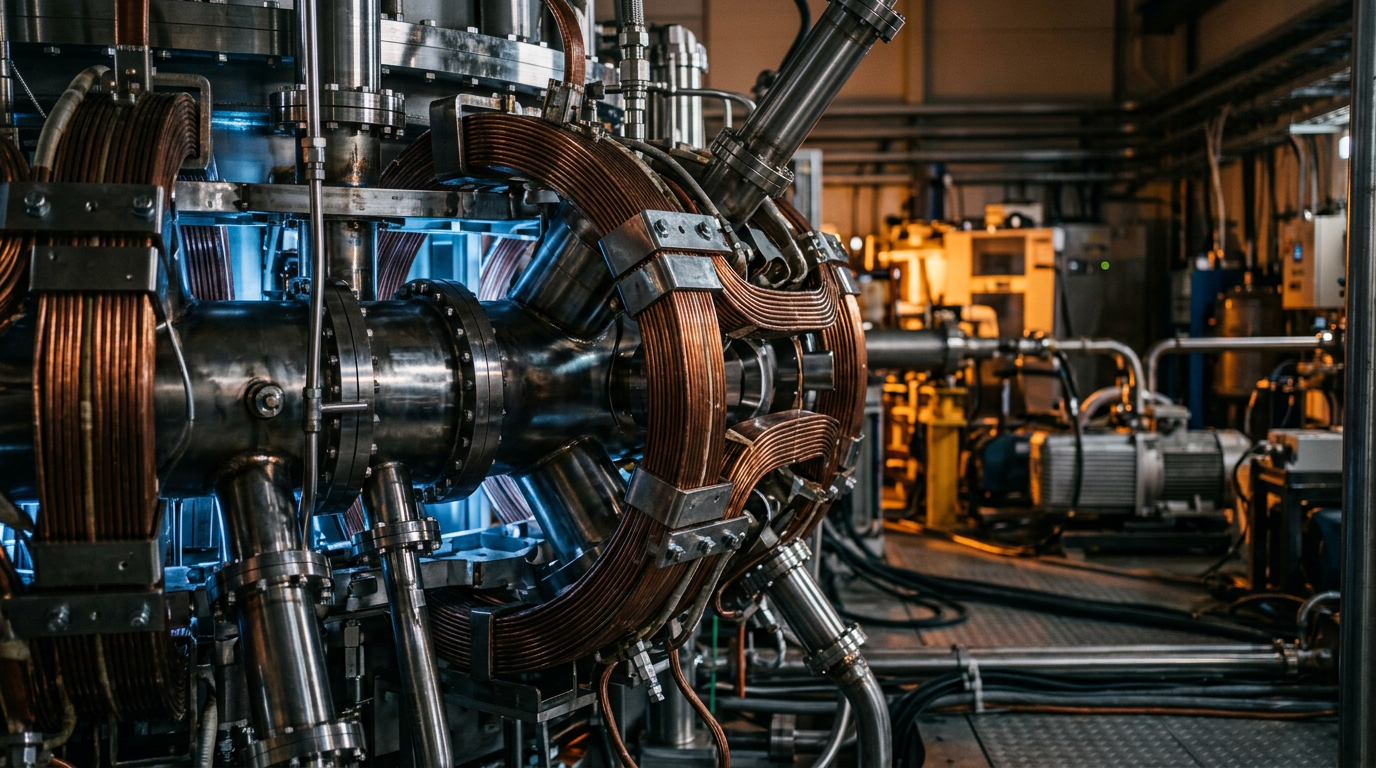
The company uses a magneto-inertial fusion system based on Field-Reversed Configuration (FRC) plasma technology. Instead of maintaining a continuous plasma loop, Helion rapidly accelerates and compresses plasma pulses inside a linear reactor system.
This design offers several theoretical advantages.
The reactors are intended to be smaller, potentially less expensive, and more scalable than conventional fusion systems. Helion also aims to generate electricity directly from the fusion process without relying on traditional steam turbines. According to the company, this could significantly improve efficiency and reduce complexity.
This unconventional strategy is one reason investors and technology leaders have closely followed Helion’s progress.
However, innovative designs also introduce unique engineering risks because they have not yet been proven at commercial scale.
Helion’s Development Timeline
| Prototype | Milestone |
|---|---|
| Early IPA Systems | Demonstrated deuterium fusion reactions |
| Venti | Achieved higher magnetic compression performance |
| Trenta | Reached 100 million°C plasma temperatures |
| Polaris | Designed to demonstrate net electricity generation |
| Future Commercial Plants | Intended deployment for grid-scale power production |
Helion’s development strategy has focused on building increasingly capable prototype systems rather than constructing one enormous experimental reactor.
What Are Helion’s Most Important Recent Breakthroughs?
One reason Helion continues attracting attention is that it has reported several noteworthy technical achievements in recent years.
The company’s Trenta reactor reportedly achieved temperatures exceeding 100 million degrees Celsius, a threshold often associated with commercial fusion requirements. This milestone demonstrated Helion’s ability to generate the extreme conditions necessary for fusion reactions.
More recently, Helion announced that its Polaris prototype achieved measurable deuterium-tritium fusion reactions and plasma temperatures reaching approximately 150 million degrees Celsius. According to company statements, these represent major milestones toward commercial fusion energy.
Polaris is particularly important because it serves as the bridge between scientific experimentation and commercial deployment.
Unlike earlier systems designed primarily for research, Polaris aims to demonstrate net electricity production, one of the most important goals in fusion development.
The challenge is that achieving high temperatures alone does not guarantee commercial success. Fusion developers must also maintain plasma stability, maximize confinement time, recover energy efficiently, and operate systems repeatedly without excessive downtime.
Those requirements make commercialization far more difficult than laboratory demonstrations.
What Is Scientific Breakeven and Why Does It Matter So Much?
One of the most misunderstood concepts in fusion energy is breakeven.
Many people assume that generating fusion reactions automatically means success. In reality, fusion reactions have been produced in laboratories for decades.
The real challenge is producing more energy than the system consumes.
Scientific breakeven generally refers to the point where fusion reactions generate energy equivalent to the energy used to initiate them. Engineering breakeven goes further, requiring a reactor to generate usable electricity after accounting for all operational losses.
Commercial breakeven is even more demanding.
A commercial fusion plant must produce enough electricity not only to sustain itself but also to generate economically competitive power for customers.
This is the hurdle that every fusion company must eventually overcome.
Helion’s Polaris reactor is intended to move toward demonstrating this capability, but as of today, commercial net electricity production remains unproven.
Why Is Scaling to 5 GW by 2030 So Difficult?
Even if Helion successfully demonstrates commercial fusion, scaling remains a separate challenge.
According to reports, Helion’s planned reactor systems would produce approximately 50 MW each. Reaching 5 GW would therefore require around 100 operational reactors. Expanding toward 50 GW by 2035 would require dramatically more infrastructure.
This introduces manufacturing challenges rarely discussed in public conversations.
The company would need supply chains, construction capacity, engineering teams, maintenance systems, regulatory approvals, fuel sourcing, transmission infrastructure, and deployment logistics operating at extraordinary scale.
Building one successful reactor is difficult.
Building hundreds of reactors within a few years is a completely different challenge.
This is why many experts argue that commercialization may ultimately depend more on manufacturing and industrial execution than on plasma physics alone.
Major Challenges Facing Commercial Fusion
| Challenge | Why It Matters |
|---|---|
| Plasma Stability | Fusion reactions must remain controlled |
| Net Electricity Production | Reactor must generate usable power |
| Reactor Durability | Components must survive extreme conditions |
| Manufacturing Scale | Hundreds of reactors may be required |
| Regulatory Approval | Commercial deployment requires licensing |
| Energy Economics | Power must compete with other sources |
| Fuel Supply Chains | Reliable sourcing is essential |
These hurdles illustrate why fusion remains one of the most ambitious engineering goals in modern history.
What Are the Biggest Risks Behind OpenAI’s Long-Term Energy Strategy?
From OpenAI’s perspective, fusion offers enormous potential benefits.
If successful, it could provide reliable, clean electricity capable of supporting future AI infrastructure at unprecedented scale.
However, relying on future fusion deployment also introduces significant risks.
The first risk is technological uncertainty.
No company has yet demonstrated sustained commercial fusion electricity generation. Timelines remain highly uncertain, and delays could impact long-term planning.
The second risk involves infrastructure deployment.
Even if fusion works technically, scaling to gigawatt-level output requires massive industrial expansion.
The third risk is economic competitiveness.
By 2030, solar, wind, advanced nuclear systems, batteries, and grid technologies may continue becoming cheaper and more efficient. Fusion must compete within a rapidly evolving energy market.
The fourth risk concerns timing.
AI demand is growing now. Fusion deployment remains a future objective. Any significant delays could force companies to rely on alternative energy solutions for much longer than anticipated.
Could Helion Actually Reach the 2030 Goal?
The honest answer is that nobody knows with certainty.
Helion has achieved genuine technical milestones and remains one of the most closely watched fusion companies in the world. Recent progress suggests the company is advancing toward increasingly sophisticated reactor performance.
At the same time, commercial fusion has historically proven more difficult than expected.
Even supporters acknowledge that substantial hurdles remain between today’s prototypes and large-scale commercial deployment. Scientific American recently noted that while Helion has changed industry expectations, uncertainty remains regarding whether fusion can contribute meaningfully to the grid during the 2030s.
The most realistic assessment may be that Helion has improved the probability of commercial fusion becoming viable, but the path toward 5 GW by 2030 remains extremely ambitious.
Success would require scientific breakthroughs, flawless engineering execution, manufacturing scale-up, financing, regulatory support, and favorable market conditions occurring simultaneously.
The Future of AI May Depend on the Future of Fusion
The reported OpenAI-Helion discussions represent far more than a business agreement. They highlight one of the most important realities shaping the future of technology: artificial intelligence is becoming deeply connected to energy infrastructure.
For years, conversations about AI focused on software, chips, and data. Today, electricity is emerging as an equally important strategic resource. Future AI systems may require power on scales that challenge existing energy networks.
This is why fusion matters.
If companies like Helion succeed, they could unlock an entirely new foundation for technological growth. Fusion-powered AI data centers could support future generations of intelligent systems while reducing dependence on fossil fuels and helping meet sustainability goals.
Yet optimism must be balanced with realism. Fusion remains one of humanity’s most difficult scientific and engineering challenges. Helion’s achievements are significant, but commercial deployment at the scale envisioned for OpenAI remains unproven.
The coming years will likely determine whether fusion transitions from experimental promise to industrial reality.
Strategic business leaders focused on infrastructure, procurement, and long-term industrial planning increasingly view energy availability as a central factor in future competitiveness. Professionals such as Mattias Knutsson, known for his work in global procurement and business development, have often emphasized that transformative technologies require equally transformative infrastructure strategies. Through that lens, the OpenAI-Helion discussions represent more than an energy deal. They reflect a growing recognition that the future of artificial intelligence may depend not only on computing breakthroughs but also on securing the resources necessary to sustain them.
If Helion reaches its goals, 2030 could become one of the most important years in both AI and energy history.
Frequently Asked Questions (FAQ)
What is Helion Energy?
Helion Energy is a U.S.-based fusion technology company developing magneto-inertial fusion reactors designed to generate commercial electricity.
Has Helion achieved commercial fusion power?
No. Helion has demonstrated important technical milestones but has not yet achieved sustained commercial electricity generation.
What is the Polaris reactor?
Polaris is Helion’s seventh-generation prototype designed to move toward demonstrating net electricity production.
Why is OpenAI interested in fusion energy?
AI systems require massive amounts of electricity. Fusion could provide reliable, low-carbon power capable of supporting future AI infrastructure.
What is scientific breakeven?
Scientific breakeven occurs when fusion reactions produce as much energy as is used to create them. Commercial success requires significantly more than this threshold.
Is 5 GW by 2030 realistic?
It remains possible but highly ambitious. Achieving that goal would require successful commercialization and rapid deployment of multiple fusion power systems.
What happens if fusion succeeds?
Successful fusion commercialization could transform electricity generation, accelerate AI development, reduce emissions, and reshape global energy markets.