A power plant is only as reliable as its fuel supply. For fusion, the fuel chain is unusual: one ingredient is nearly free, another must be manufactured inside the plant, and a third may one day be mined off-planet. This article maps what is known about each link.
Link 1: Tritium, made rather than bought
Most near-term fusion designs burn deuterium and tritium. Tritium is radioactive with a 12.3-year half-life and is found in nature only in trace amounts (ITER). Today’s civilian supply comes as a by-product of CANDU-type fission reactors. ITER has put that supply at roughly 20 kg a year globally, and its own estimate for a commercial fusion reactor is on the order of 100–200 kg a year (ITER).
The gap can only be closed by breeding. When a fusion neutron strikes lithium-6, it produces helium and tritium. ITER will test six experimental breeding blanket modules for this purpose (ITER). Because tritium decays at roughly 5.5% a year, stockpiling is not a long-term strategy; supply has to be continuous.
Link 2: Lithium-6, a niche inside a large market
Lithium-6 makes up about 7.5% of natural lithium (ITER). Breeding blankets may need lithium enriched in this isotope, which means isotope-separation capacity becomes part of the fusion supply chain alongside ordinary lithium mining. For suppliers, this is a specialised market distinct from battery-grade lithium.
Link 3: Public infrastructure for fuel technology
Governments are starting to fund the fuel cycle directly. The UK’s 2026 fusion strategy allocates £180 million to LIBRTI, a facility to develop fusion fuel technology for power plants (GOV.UK funding breakdown). UK Fusion Energy says its STEP prototype is designed to breed its own tritium fuel (UK Fusion Energy strategy).
Handling tritium also requires regulatory permission. Helion says it was the first company to receive regulatory approval to possess and use tritium to demonstrate fusion energy production, and that its Polaris machine ran on deuterium–tritium fuel in early 2026 (Helion).
Link 4: Helium-3, the speculative branch
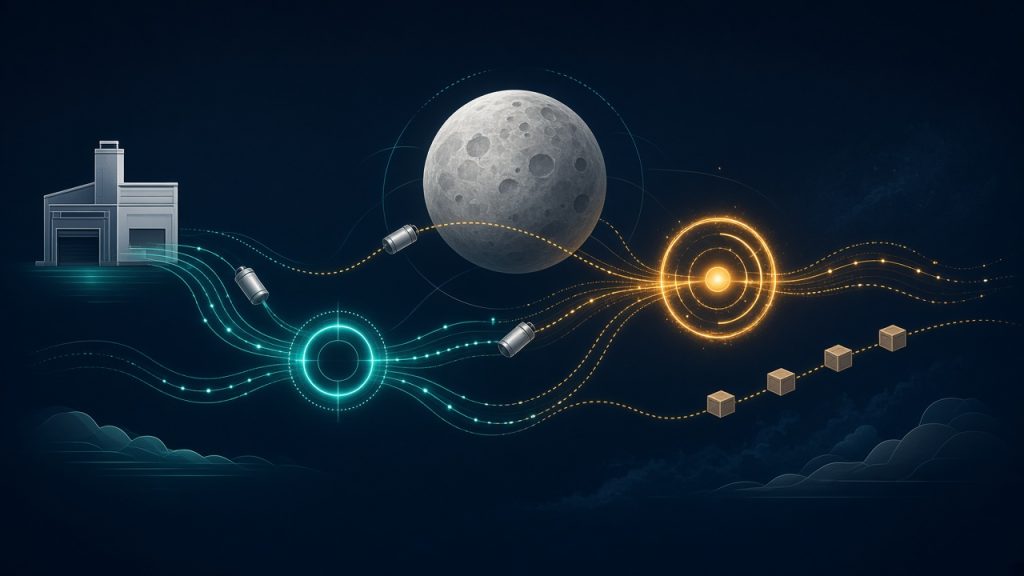
Some developers, including Helion for its commercial plants, plan to use deuterium–helium-3 (Helion). Helium-3 is extremely rare on Earth; it accounts for only about 0.000137% of atmospheric helium (CIAAW). Two companies have announced supply contracts with the US Department of Energy Isotope Program for lunar helium-3: Interlune for three litres with delivery no later than April 2029 (Interlune), and Black Moon Energy, which did not disclose quantity or timing (Black Moon Energy). These are pilot-scale commitments, not a fuel market.
Supply-chain summary
| Input | Current source | Scale-up route | Main uncertainty |
|---|---|---|---|
| Deuterium | Seawater | Existing heavy-water industry | Low |
| Tritium | By-product of CANDU reactors | Breeding in fusion blankets | Breeding performance at scale |
| Lithium-6 | Natural lithium (~7.5%) | Isotope enrichment | Enrichment capacity |
| Helium-3 | Very limited terrestrial supply | Lunar extraction (proposed) | Technical and economic feasibility |
Table: BusinessCraft summary based on the sources linked in this article.
What to watch
Breeding-blanket test results, enrichment capacity announcements, national fuel-cycle facilities such as LIBRTI, and whether any lunar helium-3 delivery actually takes place before the end of the decade.
Key figures
| Figure | Value | Source |
|---|---|---|
| Tritium half-life | 12.3 years | ITER |
| Global CANDU tritium by-product supply | ≈ 20 kg per year | ITER |
| Tritium need, commercial reactor | ≈ 100–200 kg per year | ITER |
| Lithium-6 share of natural lithium | ≈ 7.5% | ITER |
| UK funding for LIBRTI fuel-cycle facility | £180m | GOV.UK |
| Interlune lunar He-3 order (DOE) | 3 litres, by April 2029 | Interlune |
Figures as published by the linked sources; table compiled by BusinessCraft.
Related reading
- Beyond Deuterium–Tritium: The Fuel Choices Behind Fusion’s Business Models
- Aneutronic Fusion Under the Microscope: Five Tests p–B11 and D–He3 Still Have to Pass
- Fusion in 2026 by the Numbers: Records, Money and the Distance Still to Go
Sources
- ITER Newsline: Tritium – changing lead into gold
- GOV.UK: Funding breakdown for fusion energy (UK Fusion Strategy 2026)
- GOV.UK: UK Fusion Energy Ltd Strategy
- Helion: Polaris milestones (13 Feb 2026)
- CIAAW: helium isotopic abundance
- Interlune: DOE Isotope Program helium-3 purchase (7 May 2025)
- Black Moon Energy: DOE contract for lunar helium-3 (18 Mar 2026)