

Geopolitical risk is often discussed in impressions. The Uppsala Conflict Data Program (UCDP) at Uppsala University offers something firmer: a consistent count of organised violence going back to 1946. Its figures for 2025, published in 2026, are the best starting point for thinking about conflict exposure this year.
What UCDP counts
UCDP defines a state-based armed conflict as a contested incompatibility over government or territory, where armed force between two parties, at least one of them a state, causes at least 25 battle-related deaths in a calendar year (UCDP definitions). A conflict reaching 1,000 battle-related deaths in a year is classed as a war.
The 2025 picture
According to Uppsala University’s summary of the 2025 data (Uppsala University, 9 June 2026):
- 65 state-based conflicts were active, the highest number since records began in 1946.
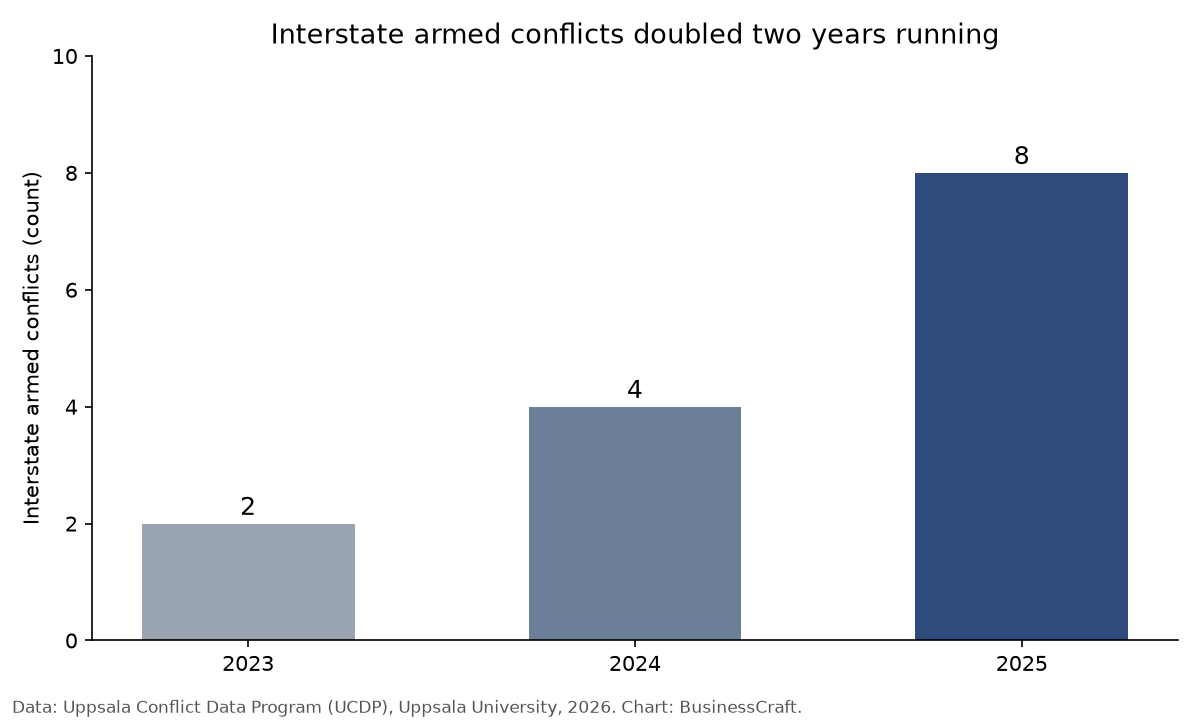
- Interstate conflicts doubled for the second year running, from two in 2023 to eight in 2025, also a record. They include Russia–Ukraine, Iran–Israel, India–Pakistan and Israel–Syria.
- 13 conflicts reached the level of war, the highest number since 1992.
- Around 244,600 people were killed in organised violence, up from about 187,000 in 2024 according to the accompanying journal article (Journal of Peace Research, 2026).
- Russia–Ukraine was the deadliest conflict, with at least 94,700 fatalities registered, roughly 62% of battle-related deaths worldwide.
- Non-state conflicts moved the other way, with about 14,500 deaths, the lowest since 2013.
Why the interstate trend matters most for business
For companies, the type of conflict matters as much as the count. Conflicts between states tend to bring sanctions, export controls, airspace closures, shipping diversions and disruptions to energy and commodity flows. Those effects travel far beyond the battlefield. The doubling of interstate conflicts in two consecutive years is therefore a more relevant signal for supply-chain and market risk than the headline total alone.
A practical checklist for 2026
- Map exposure by corridor, not only by country. Shipping routes, pipelines and air corridors that pass near active interstate conflicts deserve separate attention.
- Separate sanction risk from physical risk. Many firms are affected through regulation long before they face physical disruption.
- Stress-test energy and input costs. Interstate conflicts involving producer regions can move prices quickly.
- Use a consistent data source. Track the same indicators each year, such as UCDP’s counts, so changes reflect the world rather than a change of method.
Limits of the data
UCDP figures are annual and are published with a lag; 2026 numbers will not be available until next year. Fatality counts are conservative by design, and the threshold-based method means small conflicts can enter or leave the count from one year to the next. The trend, however, is clear in the data UCDP has published.
Key figures
| Figure | Value | Source |
|---|---|---|
| Active state-based conflicts, 2025 | 65 (record since 1946) | Uppsala University / UCDP |
| Interstate conflicts | 2 (2023) → 8 (2025) | Uppsala University / UCDP |
| Conflicts at war level, 2025 | 13 | Uppsala University / UCDP |
| Deaths in organised violence | ≈ 187,000 (2024) → ≈ 244,600 (2025) | Journal of Peace Research |
| Non-state conflict deaths, 2025 | ≈ 14,500 | Uppsala University / UCDP |
Figures as published by the linked sources; table compiled by BusinessCraft.
Related reading
- Russia and China in 2026: Close Partnership, Uneven Economics and the Limits of Alignment
- Shipping’s Redrawn Map: Detours, Recoveries and What Route Changes Mean for Trade
- Three Playbooks for AI Power: How Washington, Beijing and Brussels Diverge in 2026
Sources
- UCDP definitions, Uppsala University
- Uppsala University: UCDP – record number of conflicts between states (9 June 2026)
- Journal of Peace Research: Organized violence 1989–2025, and violent political protests (2026)
- PRIO Paper: Conflict trends – a global overview, 1946–2025 (cross-check: 4 interstate conflicts in 2024)