
A trillion dollars a year is the number that keeps coming up when people talk about the AI build-out. It is a useful yardstick, but it is easy to lose track of what is actually reported and what is extrapolation. This article sticks to what the companies themselves have published and to the International Energy Agency’s analysis of what the build-out means for electricity.
What the companies have actually guided
After the third-quarter 2026 reporting season, three of the largest cloud providers had put explicit numbers on their 2026 capital spending:
- Amazon said it continues to expect 2026 cash capital expenditures of approximately $220 billion, and that the year-on-year rise in purchases of property and equipment “primarily reflects investments in artificial intelligence” (Amazon Q3 2026 release).
- Alphabet kept its full-year 2026 capex guidance at $195–205 billion and said it expects capex to “increase significantly in 2027” (Alphabet Q3 2026 earnings call). Third-quarter capex alone was $51.4 billion.
- Meta narrowed its 2026 range, including principal payments on finance leases, to $135–145 billion (Meta Q3 2026 release).
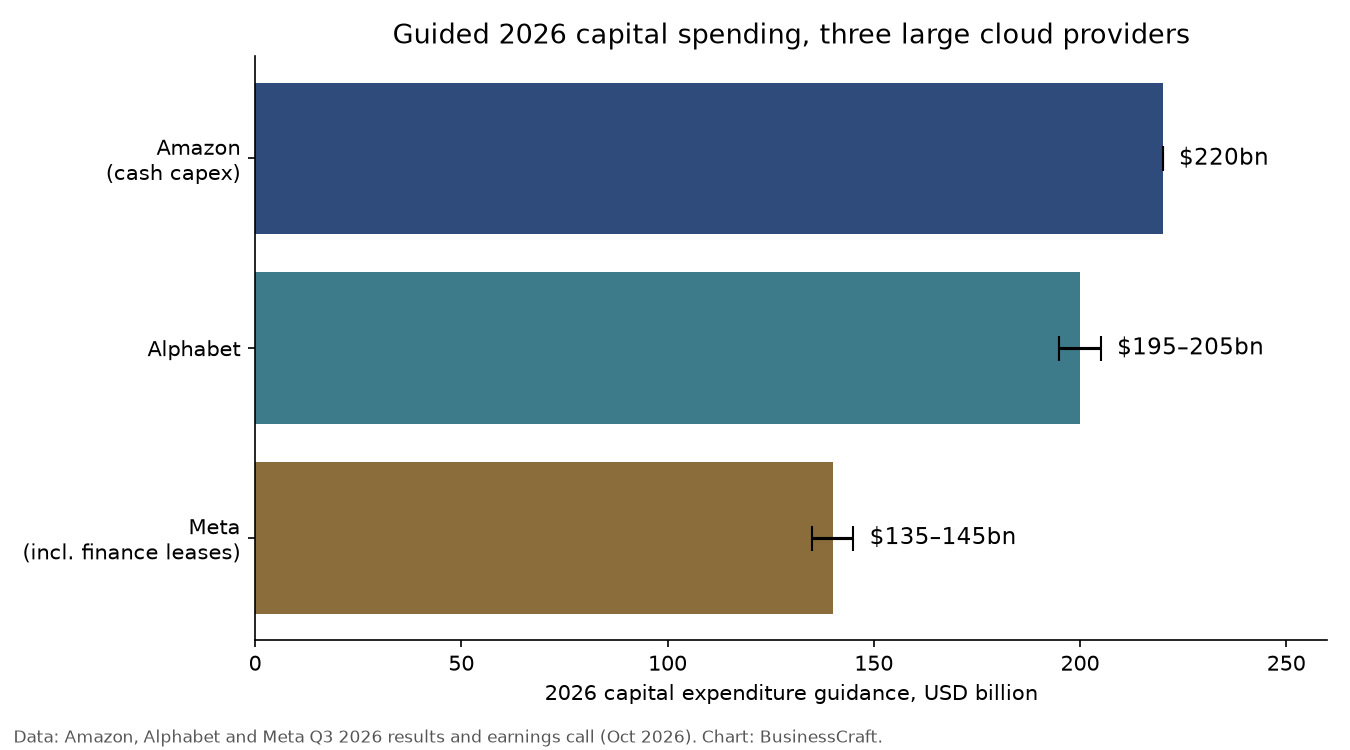
Added together, these three companies alone point to roughly $550–570 billion for 2026. That sum is before Microsoft, Oracle, specialised GPU cloud operators, chip makers’ own fabs and the large data-centre programmes outside the United States. The definitions also differ: Amazon guides on cash capex, Meta includes finance leases, and none of the figures is purely “data centres”. Servers, network equipment, land and buildings are all in the mix.
Reading the trillion-dollar question
Two conclusions follow from the filings.
First, a combined trillion-dollar annual run-rate across the wider industry by 2027 is not an outlandish extrapolation. At least one of the three already guides to a significant increase next year, and the 2026 totals of the largest buyers are already above half a trillion.
Second, the money is moving faster than the cash it is funded from. Amazon reported trailing twelve-month free cash flow of minus $42.4 billion, which it attributed mainly to higher property and equipment purchases (Amazon Q3 2026 release). Alphabet reported negative free cash flow of $9.1 billion in the third quarter (Alphabet Q3 2026 call). That makes the pace of spending more sensitive to financing conditions and to how quickly AI services earn revenue.
Where the physical bottlenecks are
Capital is only one constraint. The IEA estimates that data centres used around 415 TWh of electricity in 2024, about 1.5% of global consumption, and projects roughly 945 TWh by 2030 in its Base Case (IEA, Energy and AI). The United States accounted for about 45% of data-centre consumption in 2024, China about 25% and Europe about 15% (IEA report PDF).
The IEA’s breakdown of the increase is instructive for anyone tracking the supply chain. In the Base Case, accelerated servers account for almost half of the net increase in data-centre electricity use, conventional servers about 20%, and cooling and other infrastructure about 20% (IEA). In other words, semiconductors are the core of the spending, but power distribution and cooling are not side issues.
What to watch into 2027
- 2027 guidance in the fourth-quarter reports. Alphabet has said it will give further details on its Q4 call.
- Grid connections. A data centre can be built in two to three years; power infrastructure often takes longer, which the IEA flags as a key uncertainty.
- Cash flow versus capex. Negative free cash flow at large, profitable companies is a signal to watch, not a verdict.
- Definitions. When a headline adds up “AI spending”, check whether it mixes cash capex, finance leases and multi-year commitments.
Key figures
| Figure | Value | Source |
|---|---|---|
| Amazon 2026 cash capex (expected) | ≈ $220bn | Amazon Q3 2026 |
| Alphabet 2026 capex guidance | $195–205bn | Alphabet Q3 2026 call |
| Meta 2026 capex range (incl. finance-lease principal) | $135–145bn | Meta Q3 2026 |
| Amazon trailing 12-month free cash flow | −$42.4bn | Amazon Q3 2026 |
| Data-centre electricity use, 2024 | ≈ 415 TWh (≈ 1.5% of global) | IEA |
| Data-centre electricity use, 2030 (Base Case) | ≈ 945 TWh | IEA |
Figures as published by the linked sources; table compiled by BusinessCraft.
Related reading
- Scenario Analysis: What Would 50 GW of Fusion Power for AI Actually Take?
- Three Playbooks for AI Power: How Washington, Beijing and Brussels Diverge in 2026
- Quantum Computing and AI in 2026: Separating Roadmaps From Hype
This article is general information, not investment advice.