Every day, our sun fuses hundreds of millions of tons of hydrogen into helium, releasing unimaginable amounts of energy that radiate across the solar system. It has done this for billions of years and will continue for billions more. For most of human history, this miracle seemed untouchable—a distant cosmic act. But in 2025, that line between the cosmic and the earthly is beginning to blur. Fusion energy—the idea of recreating the power of the stars on Earth—is moving from an eternal dream to a practical, funded, and engineered reality. For decades, it was the punchline of energy jokes: “always 30 years away.” Yet today, breakthroughs in artificial intelligence, plasma physics, and supply chain readiness are moving the clock closer than ever before. Explore the latest breakthroughs in fusion energy—from AI-predicted success models and novel plasma confinement techniques to Helion’s Orion plant and global investments reshaping the path to a fusion-powered future.
This year saw something historic. Helion Energy broke ground on Orion, the world’s first commercial fusion power plant. At the same time, AI tools are helping scientists predict which experiments will succeed before they are even run. Novel confinement methods are stabilizing plasma more effectively than ever. Investment is pouring in, with supply chain spending soaring by 73% last year. Germany is planning new advanced reactors. ITER in France continues its vast construction toward the mid-2030s.
This isn’t just science anymore. It’s industry, geopolitics, and strategy. It’s the quiet hum of a global race to build energy that could change civilization itself.
AI as Fusion Quiet Partner
Artificial intelligence is proving to be an accelerator in fusion’s progress. Fusion experiments are staggeringly expensive and complex. A single plasma shot inside a reactor can cost millions, and each shot requires weeks of preparation. Traditional trial-and-error simply doesn’t scale.
That’s where AI enters. Machine learning models now analyze plasma behavior, forecast stability, and even suggest magnetic configurations. At Princeton’s Plasma Physics Lab and in private startups, neural networks are being trained on decades of experimental data.
For example, AI fusion can predict whether a plasma confinement attempt will end in stability or disruption with over 90% accuracy. This allows researchers to filter out designs doomed to fail and focus time and money on the most promising approaches.
In some cases, AI models have already proposed magnetic field patterns that human engineers had not considered—pushing plasma to behave in unexpectedly stable ways. This is no longer just about cutting costs; it’s about accelerating discovery itself. Fusion’s pace is quickening, and AI is the metronome.
Plasma Confinement: New Ways to Hold a Star
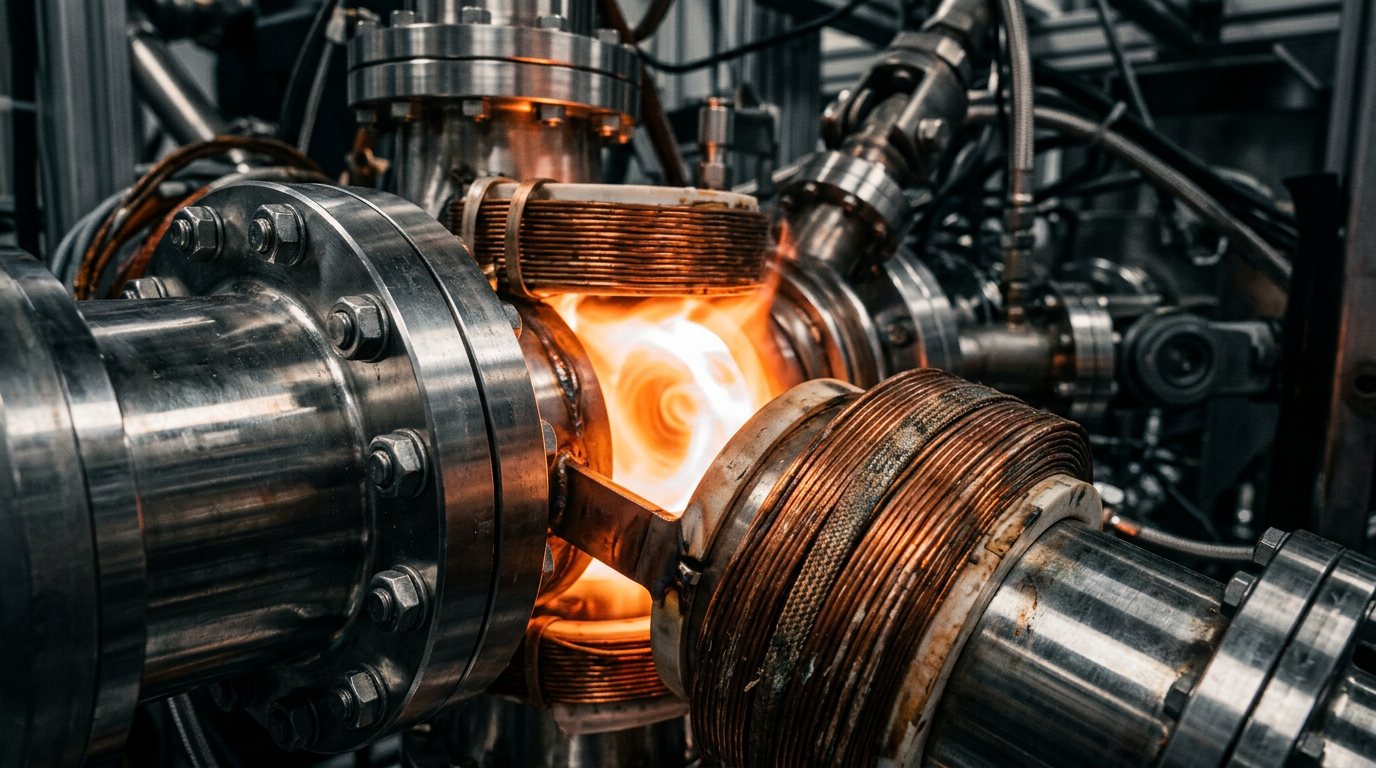
Fusion requires temperatures of 100 million degrees Celsius—five times hotter than the sun’s core. At such extremes, matter becomes plasma, a soup of charged particles. Containing this plasma is the hardest engineering challenge in energy history.
Traditionally, tokamaks—the donut-shaped reactors first developed in the Soviet Union—have been the dominant design. But in 2025, fresh approaches are expanding the horizon:
Field-Reversed Configurations (FRCs): Compact plasmas that can be held with simpler, shorter magnetic fields. Companies like TAE Technologies and Helion Energy are pursuing variations of this.
Stellarators: Twisted, pretzel-shaped reactors that use complex magnets to confine plasma continuously. Germany’s Wendelstein 7-X has already set records for stability.
Inertial and Pulsed Approaches: Helion’s design compresses plasma in bursts rather than holding it indefinitely. This allows for smaller, modular systems rather than sprawling facilities.
Each approach has advocates and skeptics. But the diversity of methods reflects an important reality: fusion is no longer locked into one blueprint. Just as solar has panels, thin-film, and concentrators, fusion is becoming a field of varied strategies.
Helion’s Orion Plant: From Promise to Construction
The boldest development of 2025 is Helion Energy’s Orion plant in Washington State. In July, the company broke ground on the world’s first commercial fusion facility, aiming to deliver 50 megawatts of power by 2028.
The electricity is not hypothetical. It is already tied to a power purchase agreement with Microsoft, making this the first fusion project contracted to serve real-world customers.
Helion’s technology is different from the giant ITER model. Instead of a huge donut, it uses two linear chambers that accelerate plasma clouds and slam them together in pulses, heating and compressing them to fusion conditions. This pulsed approach avoids some of the materials stress of continuous burning plasma.
Earlier in 2025, Helion’s Polaris device is expected to produce electricity from fusion for the first time in history. Orion will then scale this into a functioning power plant.
Skeptics point out that even if successful, 50 MW is small compared to today’s 1,000 MW fission reactors or multi-gigawatt fossil plants. But that misses the point. If Orion works, it’s not just a plant—it’s a prototype for replication worldwide. Every technology begins small. The Wright brothers’ first flight wasn’t a 747.
The Surge of Private Investment
Money is flowing into fusion at unprecedented levels. According to industry reports, private investment in fusion reached $9.77 billion by mid-2025, with $2.64 billion added just in the last year. That’s the largest surge since 2022.
Big Tech and oil majors are joining the race. Chevron, Shell, Google, and Amazon have invested in startups. Bill Gates’ Breakthrough Energy is backing Commonwealth Fusion Systems. Microsoft has inked long-term contracts.
This investment isn’t just venture capital speculation—it is transforming supply chains. The fusion supply chain saw a 73% spending increase in 2024, growing from $250 million to $434 million. Suppliers invested another $230 million in new factories and workforce training, preparing for future demand.
This is how industries are born: not just in labs, but in foundries, machining shops, and shipping yards. Fusion’s ecosystem is taking shape.
Germany’s Plans and Europe’s Push
Germany is taking a leading role in Europe’s next wave of fusion projects. Building on its stellarator expertise, it is advancing toward demonstration reactors that could feed power into the grid by the 2040s.
Its programs emphasize spherical tokamaks—compact, efficient versions of the traditional design—as part of its roadmap toward commercial fusion. The German government has pledged hundreds of millions in support, pairing academic labs with industrial giants like Siemens and BASF to prepare for deployment.
Meanwhile, France continues construction of ITER, the largest fusion project in history. ITER is designed to produce 500 MW of thermal power for sustained periods, proving the viability of burning plasma at scale. Though its timeline now stretches into the mid-2030s, ITER remains a landmark in human engineering—a project of 35 nations, designed to validate fusion science on a planetary stage.
The Fusion Supply Chain: Building the Backbone
Fusion is not just physics—it is manufacturing. Superconducting wires, ultra-precise magnets, neutron-resistant alloys, and advanced computing systems all form part of the puzzle.
The supply chain challenge is real. Many components are made only by a handful of companies worldwide. Specialized superconducting tape, for example, costs hundreds of dollars per meter and requires new scaling factories.
Still, growth is happening. In 2024, over 100 suppliers worldwide reported fusion-related contracts. Of these, 45% made new investments in staff or machinery. Demand for engineers in cryogenics, plasma diagnostics, and power electronics has soared.
This is why private investment matters. It doesn’t just build reactors—it builds the capability to build reactors.
A Global Tapestry: Startups and States Together
Fusion’s progress is now a tapestry of private ambition and public projects.
In the U.S., besides Helion, startups like Commonwealth Fusion Systems and TAE Technologies are moving toward demonstration.
In Europe, Germany’s advanced programs and ITER’s megaproject represent the long-term bet. Also, in Asia, China’s EAST tokamak continues to set plasma records, while South Korea’s K-STAR reactor sustains long confinement times. Japan is preparing its own advanced reactor plans.
This variety is fusion’s strength. It reduces risk, spreads innovation, and ensures no single nation holds the keys to star power.
A Strategic Note: Mattias Knutsson on Fusion’s Broader Meaning
As Mattias Knutsson, Strategic Leader in Global Procurement and Business Development, observes:
“Fusion is not just a technology race. It’s a test of how we build resilience. AI, new plants, and supply chains are not only scientific milestones—they are steps in designing sovereignty. Fusion’s future will belong to those who build not only reactors, but the ecosystems around them.”
His words remind us that the stakes are not just kilowatt-hours, but the very frameworks of industrial independence and national security.
Conclusion:
AI Fusion energy has always carried a strange duality: the most audacious dream, yet the most elusive reality. But in 2025, the story is shifting.
We have AI guiding experiments with precision never before possible. Also, we have plasma held more stably, in more shapes, with more confidence. We have Helion breaking ground on the first commercial plant. Moreover, we have billions of dollars flowing not just into startups, but into the welders, suppliers, and engineers who will build fusion’s bones. We see Germany, France, and Asia weaving fusion into national strategy.
Is success guaranteed? No. Timelines may slip, costs may rise, and some projects may falter. Fusion’s history counsels humility.
But the difference today is momentum. The difference is breadth. AI Fusion is no longer a laboratory curiosity. It is a growing industry with real contracts, real factories, and real customers.
If 2025 is remembered in energy history, it will be as the year fusion stopped being “forever 30 years away” and became instead “just years away.”
And perhaps the most hopeful part? AI Fusion doesn’t roar. It hums. It is quiet power—born of stars, built by human hands—that may light the century ahead with warmth, resilience, and permanence.