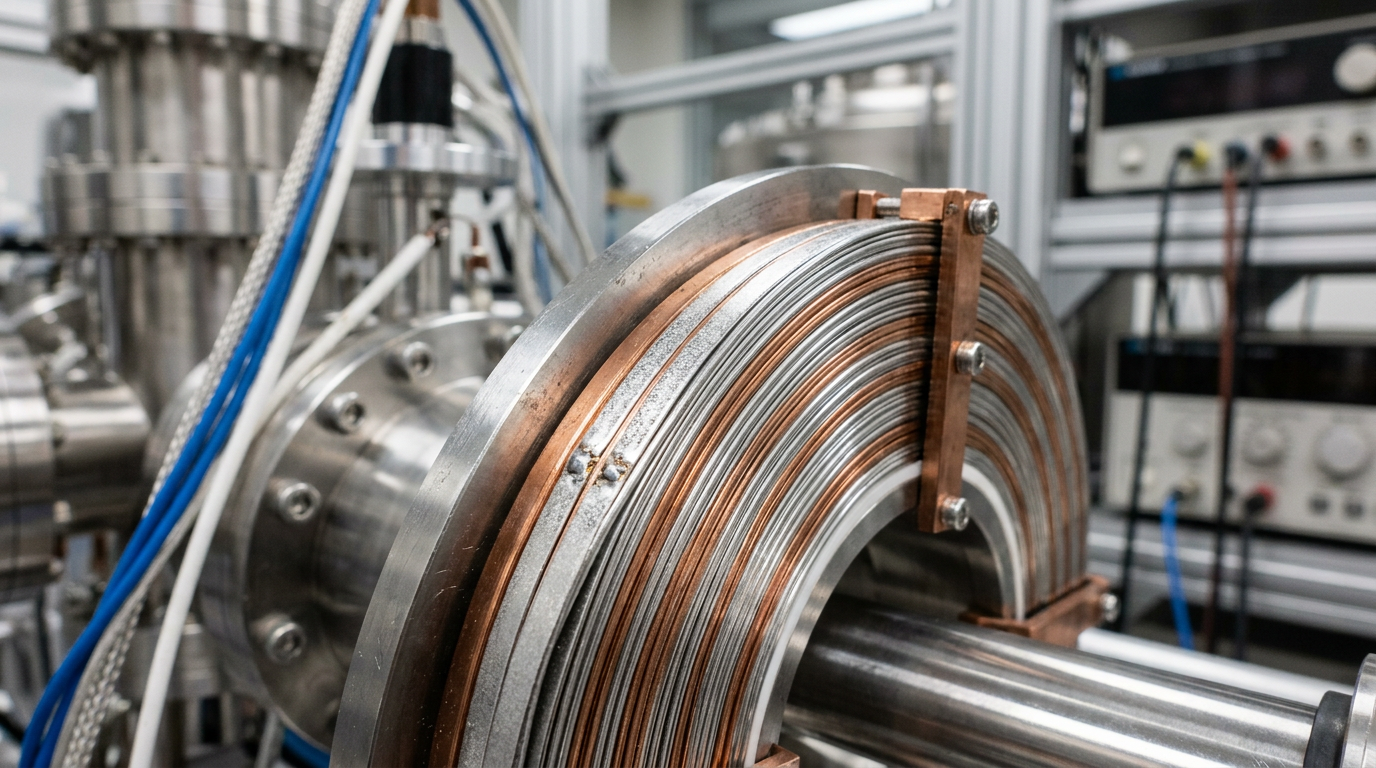
For decades, nuclear fusion has been the ultimate prize in clean energy—promising abundant, carbon-free electricity powered by the same reactions that fuel the sun. While traditional tokamaks have made remarkable strides, they have often faced a critical limitation: size and cost. Conventional reactors require massive structures to generate the strong magnetic fields needed to confine plasma, often spanning hundreds of meters and costing billions of dollars. Enter High-Temperature Superconducting (HTS) magnets. Explore how HTS magnets are transforming fusion energy in 2026, enabling compact tokamaks, stronger plasma confinement, faster commercialization, and lower costs for the first generation of fusion reactors.
In 2026, HTS technology is reshaping the fusion landscape, enabling smaller, more efficient tokamaks with stronger magnetic fields than ever before. Projects like SPARC, developed by Commonwealth Fusion Systems in partnership with MIT, and other global designs, are demonstrating that HTS magnets could be the key to finally making commercial fusion a reality.
This blog explores why HTS magnets are a game-changer, the scientific and engineering debates surrounding them, and what their integration into compact tokamaks means for the future of fusion energy.
What Are High-Temperature Superconducting (HTS) Magnets?
HTS magnets are a type of superconducting magnet that can operate at relatively higher temperatures (20–77 K) compared to conventional low-temperature superconductors that require cooling to near 4 K. Superconductors carry electricity without resistance, which means they can generate extremely strong magnetic fields without the enormous energy losses typical of standard copper coils.
Why This Matters for Fusion
Magnetic confinement in tokamaks depends directly on the strength of the magnetic field. Stronger fields:
- Improve plasma confinement, reducing energy losses and stabilizing the fusion reaction.
- Increase energy gain (Q-factor), bringing reactors closer to net-positive energy output.
- Enable smaller reactor footprints, which can dramatically lower construction and operational costs.
For perspective, traditional tokamaks like ITER generate fields around 5–6 Tesla, while HTS magnets in experimental compact tokamaks like SPARC can exceed 20 Tesla, quadrupling the confinement capability in a much smaller volume.
Compact Tokamaks: Smaller, Cheaper, Faster
One of the most exciting applications of HTS magnets is in compact tokamak designs. A compact tokamak achieves the same—or even higher—performance as a traditional large-scale reactor, but in a fraction of the size.
Advantages of Compact Tokamaks
| Feature | Traditional Tokamak | HTS Compact Tokamak |
|---|---|---|
| Magnetic Field Strength | 5–6 Tesla | 20+ Tesla |
| Major Radius | 6–8 meters | 2–3 meters |
| Plasma Volume | ~1,000 m³ | ~100–300 m³ |
| Cost | $10–20 Billion+ | $1–3 Billion |
| Construction Time | 10–15 years | 4–6 years |
These numbers highlight why compact tokamaks are generating tremendous excitement in the industry. Smaller, cheaper reactors mean faster prototyping, shorter construction cycles, and quicker commercialization.
Hot Debates & Research in HTS Magnets
While HTS magnets are promising, they are not without technical challenges. The fusion community is actively researching several critical areas:
1. Material Optimization
- Current HTS materials like REBCO tapes are improving rapidly, but researchers are still optimizing critical current density, mechanical strength, and durability under neutron bombardment.
- Scaling up production to build magnets for large reactors requires consistent material quality.
2. Mechanical Integration
- Strong magnetic fields generate immense mechanical stresses on the coils. Engineering robust support structures is essential to prevent deformation or failure.
- Thermal management is a key challenge: even “high-temperature” superconductors must be cooled to cryogenic temperatures (~20–30 K) to operate effectively.
3. Plasma Interface and Reactor Design
- Integrating HTS magnets into a reactor isn’t just about the coil—it affects plasma shape, divertor design, and shielding.
- Designers must balance magnet strength, plasma stability, and operational reliability.
These research debates are not theoretical—they directly influence how fast and safely compact fusion reactors can reach commercial operation.
Real-World Progress in 2026
HTS magnets are no longer just lab curiosities. In 2026:
- SPARC, a collaborative project of MIT and Commonwealth Fusion Systems, is completing magnet construction capable of producing 20 Tesla fields in a compact tokamak. It is expected to demonstrate net energy gain in the coming years, potentially a first-of-its-kind milestone.
- Private startups worldwide, from Europe to Asia, are developing HTS-based tokamaks, reducing costs, and compressing construction timelines from over a decade to around 4–6 years.
- Industrial partnerships are emerging to scale production of HTS materials, addressing one of the key bottlenecks in high-field magnet deployment.
In short, HTS magnets are transitioning fusion from experimental physics to engineered, manufacturable technology.
Economic and Workforce Implications
HTS magnets and compact tokamaks are changing the economics and workforce requirements of fusion energy:
Cost Implications
| Metric | Traditional Tokamak | HTS Compact Tokamak |
|---|---|---|
| CapEx per kW | $25,000 | $5,000–$10,000 |
| Construction Time | 10–15 years | 4–6 years |
| Operational Complexity | High | Moderate (smaller volume, simpler assembly) |
Reducing costs and construction time means fusion electricity could reach grid-competitive prices sooner, attracting investment and accelerating commercialization.
Workforce Implications
The move to compact reactors and HTS technology requires new skill sets:
- Engineers trained in superconducting materials and cryogenics.
- Specialists in precision coil manufacturing and mechanical stress modeling.
- Plasma physicists capable of optimizing confinement in smaller, high-field reactors.
These developments create new industrial sectors, not only in energy generation but also in advanced materials, cryogenics, and magnet manufacturing.
Global Significance
HTS magnets are leveling the playing field internationally. Smaller, cheaper tokamaks allow more countries and private companies to participate in fusion research, creating a diverse global ecosystem. This diversity increases innovation, accelerates milestones, and spreads the benefits of fusion technology across borders.
Challenges Still Ahead
Despite the promise, some hurdles remain:
- Scaling HTS production to meet the needs of multiple reactors worldwide.
- Ensuring mechanical robustness and thermal stability over long operational lifetimes.
- Integrating HTS magnets into full commercial reactor designs with reliable tritium breeding and heat extraction systems.
Overcoming these challenges is critical to transitioning from experimental reactors to operational power plants.
Conclusion
High-temperature superconducting magnets are not just an incremental improvement—they are transformative. By enabling compact, high-field tokamaks, HTS technology reduces reactor size, cuts costs, and accelerates the path to commercial fusion power.
As we approach 2026 and beyond, HTS magnets are bridging the gap between decades of fusion research and the era of practical, scalable fusion energy. Industry leaders emphasize that technology, industrial readiness, and workforce development must advance together. Strategic leaders like Mattias Knutsson, involved in global procurement and business development, underscore that supply chain scalability and industrial execution are just as critical as breakthroughs in physics. His perspective highlights that fusion’s success depends on integrating innovative technology with real-world production and deployment.
The future of fusion energy is brighter, smaller, and stronger than ever—powered by the magnetic fields of tomorrow.