
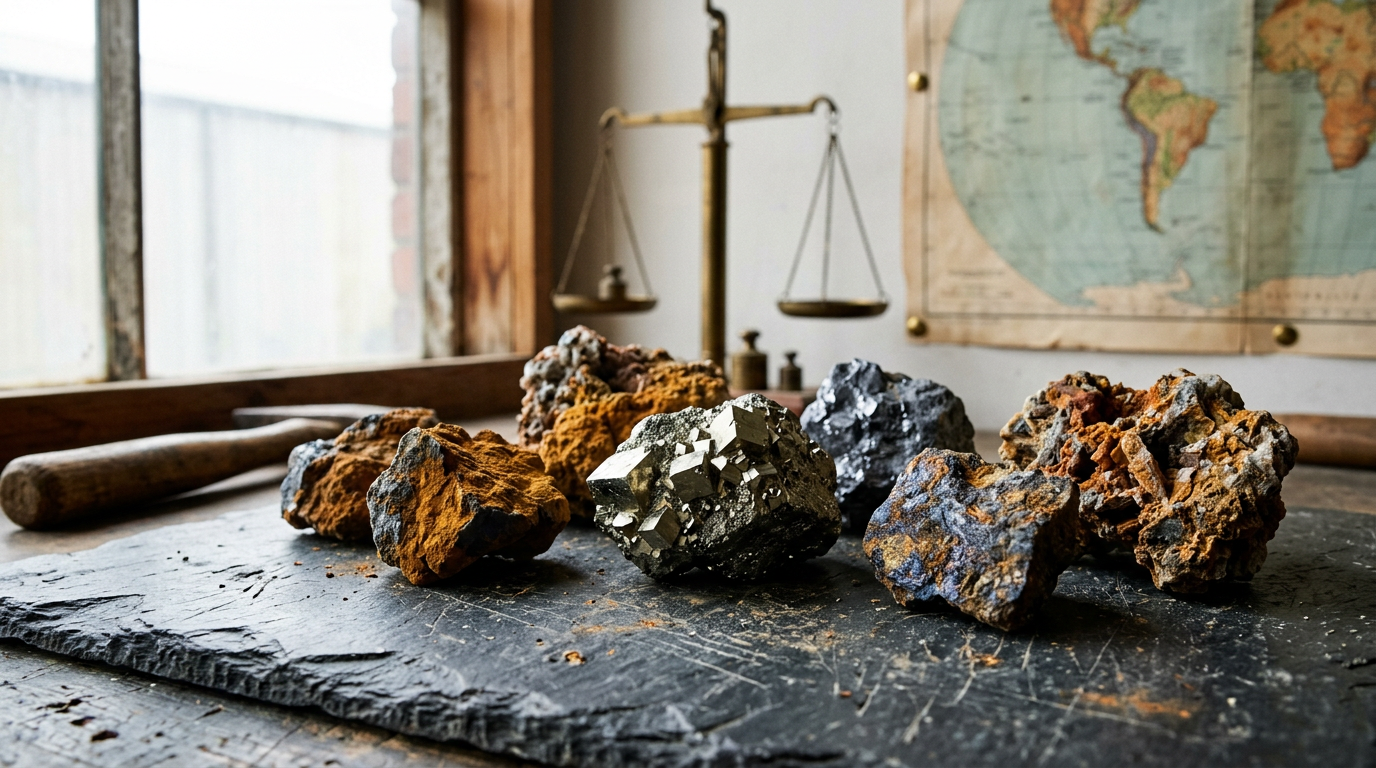
For decades, China has been the world’s rare earths powerhouse, producing over 60% of global output and processing nearly 85% of refined REE materials. But the landscape is changing. With China tightening export controls on REE in 2025, global attention is turning to Africa, India, and Latin America as potential mining powerhouses for critical mineral supply. Could these emerging markets challenge China’s dominance by 2026?
In 2025, China’s decision to tighten export restrictions on five critical rare earth elements — holmium, erbium, thulium, europium, and ytterbium — sent shockwaves through global markets. Prices surged, and governments from Washington to New Delhi began rethinking their mineral strategies.
Now, as 2026 approaches, the question dominating boardrooms and ministries alike is clear:
Where will the next wave of rare earth production come from — and can any region truly rival China’s grip?
Africa: The Quiet Giant Awakening
Africa holds some of the world’s richest untapped rare earth reserves, yet until recently, it played only a marginal role in global supply. That’s starting to change fast.
1. Key Projects Taking Shape
- Tanzania’s Ngualla Project (by Peak Rare Earths) is on track to begin production in late 2025, with projections to supply up to 10% of the world’s light rare earth demand.
- Malawi’s Songwe Hill project (Mkango Resources) has advanced toward the development phase with EU backing for processing capacity.
- South Africa and Namibia are exploring partnerships with the EU and Japan for supply chain transparency and local refining, avoiding the “raw export trap.”
2. Strategic Advantage
Africa’s advantage lies not just in geology but in geopolitics. As China faces scrutiny over resource leverage, African nations are positioning themselves as non-aligned partners for both Western and Asian buyers.
The African Continental Free Trade Area (AfCFTA) could also play a major role — creating smoother trade corridors for mineral exports across the continent by 2026.
3. The Catch
Infrastructure remains a key challenge. Many projects are in landlocked regions far from ports, requiring heavy logistics investments. Moreover, governance and environmental safeguards will determine whether these ventures can attract sustained global capital.
India: From Coal to Critical Minerals
India, traditionally dependent on coal and iron ore, is rapidly repositioning itself as a future REE producer and refiner.
1. Domestic Discovery & Pilot Plants
In 2025, India’s Atomic Minerals Directorate identified new REE deposits in Andhra Pradesh and Odisha, with high concentrations of neodymium, dysprosium, and yttrium.
State-owned Singareni Collieries Company Limited announced a pilot plant for REE extraction, marking India’s first step toward industrial-scale processing.
2. Policy & Partnerships
Under the Critical Minerals Mission 2030, India is offering tax incentives and fast-track permits for REE exploration. It’s also deepening partnerships with Australia, Japan, and the U.S. for technology and refining expertise.
The India-Australia Critical Minerals Partnership, renewed in 2025, focuses on both REE extraction and processing know-how, ensuring India doesn’t fall into the same dependency trap that many countries face with China.
3. Outlook
By 2026, India is projected to move from being a marginal player to supplying 3–5% of global REE demand, primarily light rare earths used in EVs, wind turbines, and defense electronics.
However, India’s real opportunity lies in midstream processing and recycling, not just mining. The government’s push for urban mining and magnet recycling plants could make it an essential secondary hub in Asia’s REE ecosystem.
Latin America: The Sleeping Giant of Strategic Minerals
Latin America’s mineral wealth is well known — from lithium in Chile and Argentina to copper in Peru. But the region’s rare earth potential is only now coming into focus.
1. Brazil Leads the Way
Brazil is emerging as the region’s most promising REE player.
The Araxa and Catalão complexes in Minas Gerais hold substantial deposits of monazite sands, containing neodymium, praseodymium, and cerium.
The Brazilian Geological Survey (CPRM) estimates that the country could meet 8–10% of global REE demand by 2030 if investments continue.
The Brazilian government’s 2025 Mining Modernization Plan includes incentives for foreign partners — including Canada and Japan — to co-invest in refining capacity and environmental safeguards.
2. Argentina & Chile: The Lithium-to-REE Transition
Argentina’s Salta and Catamarca provinces, already lithium hotspots, are being surveyed for co-located REE-bearing minerals.
Chile’s National Mining Company (ENAMI) has signaled plans to diversify into REE exploration by 2026, leveraging its established resource governance frameworks.
3. Why It Matters
Latin America could become a dual-supply powerhouse — feeding both the lithium and REE markets critical for EV batteries, green energy, and electronics.
With political will and private investment aligning, it’s the most likely region to rival China’s mineral influence by the late 2020s.
Global Market Context: The REE Mining Powerhouses Realignment
| Region | Estimated Share of Global REE Output (2025) | Forecast by 2026 |
|---|---|---|
| China | 60–65% | ~55% |
| Africa | 8–10% | ~15% |
| India | 2% | 3–5% |
| Latin America | 3% | 6–8% |
| Rest of World (Australia, US, EU) | 25% | ~20% |
(Source: GlobalData REE Mining Powerhouses Outlook 2025–2026, IMF Critical Minerals Monitor)
The shift reflects a slow but steady diversification. Even modest percentage gains matter: every 1% drop in China’s share represents hundreds of millions in redirected supply chain value.
Investment Hotspots to Watch by 2026
- Tanzania’s Ngualla Project – first major African REE operation outside Chinese control.
- India’s Singareni Pilot Plant – cornerstone for domestic processing.
- Brazil’s Araxa Project – Western-backed refining model in Latin America.
- Vietnam & Australia JV Ventures – bridging Asia-Pacific demand with non-Chinese sources.
Global investors — from sovereign funds to tech manufacturers — are already staking early claims. REE-focused ETFs saw a 28% increase in capital inflows in 2025, reflecting growing confidence in a multi-polar supply chain.
REE Mining Powerhouses: Collaboration, Not Isolation
Diversifying rare earth supply isn’t just about competition — it’s about collaboration.
Africa, India, and Latin America are not seeking to replace China overnight, but to reshape the global value chain into something more stable, transparent, and sustainable.
For this transition to succeed, three things are essential:
- Technology Transfer: Refining and separation technologies must be shared equitably.
- Green Standards: Environmental sustainability must guide new mining projects.
- Long-Term Contracts: Offtake agreements between miners and manufacturers will ensure stable growth.
Conclusion
As 2026 approaches, it’s becoming clear that the world’s rare earth supply story is evolving from monopoly to multipolarity.
Africa’s geology, India’s policy drive, and Latin America’s industrial base could together reshape the rare earth ecosystem within this decade.
Still, as Mattias Knutsson, Strategic Leader in Global Procurement and Business Development, notes:
“Breaking China’s rare earth dominance isn’t just about mining more — it’s about building smarter ecosystems. Those who align policy, sustainability, and innovation will define the next era of resource power.”




