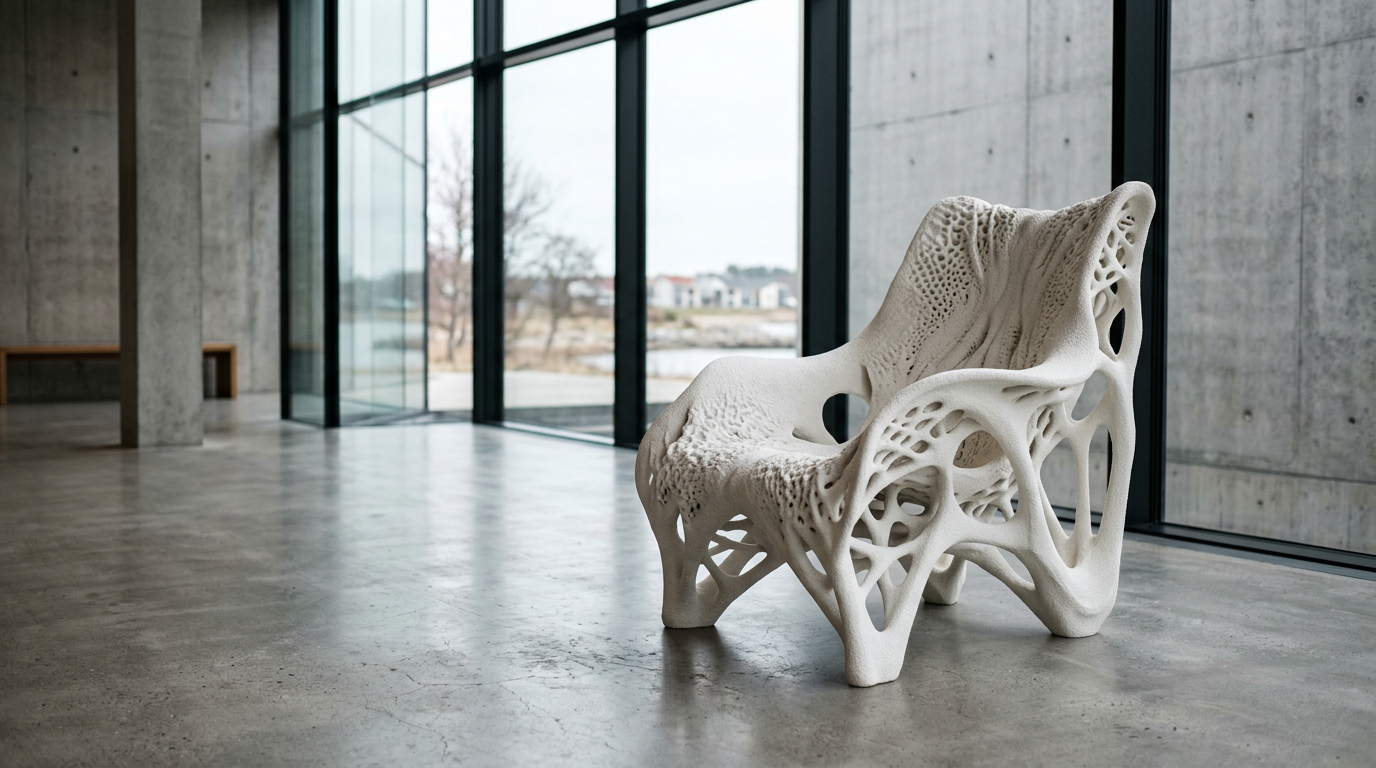
Stockholm Design Week 2026 delivered one of its most groundbreaking showcases yet — a full-scale unveiling of AI-designed furniture created through generative design workflows, adaptive algorithms, and machine-collaborative craftsmanship. What was once a fringe concept has now entered mainstream Scandinavian design, signaling a future where creativity is no longer limited by human sketching speed or prototyping constraints.
For decades, Nordic brands have been celebrated for minimalism, sustainability, and functional craftsmanship. This year, they added a new pillar to that identity: computational creativity. Instead of replacing designers, generative AI served as an extension of their imagination — offering thousands of design iterations, surprising shapes, and hyper-optimized structures that human intuition alone may never have discovered.
From AI-shaped wooden chairs to self-learning ergonomic sofas and digitally fabricated lighting systems, the 2026 exhibition confirmed that furniture design has entered a new hybrid era. The excitement in Stockholm wasn’t simply about technology — it was about the merging of heritage craftsmanship with future-forward design intelligence.
What emerged was a clear message: AI is not the end of Scandinavian design tradition — it is the beginning of its next evolution.
AI as the New Design Partner — Not a Replacement
One of the biggest themes of the week was how Scandinavian studios presented AI as a creative collaborator, not a threat. Instead of automating designers away, AI tools were used to supercharge ideation and produce forms that balance aesthetics with engineering precision.
Designers described their new workflows as “dialogues between human instinct and machine logic.” The process often looked like this:
- Designers feed inspirations, materials, textures, and moods into a generative model.
- The system produces dozens — sometimes hundreds — of potential forms.
- Designers choose and refine the concept, adding emotional or cultural nuance that algorithms can’t generate alone.
- Prototypes are output using digital fabrication or traditional woodworking techniques depending on the piece.
This collaboration resulted in pieces that felt simultaneously familiar and unexpected: organic Scandinavian silhouettes infused with digital complexity.
The Breakout Trend: Algorithm-Crafted Organic Forms
One of the strongest visual identities at the 2026 event was the rise of organic AI-generated forms — designs inspired by nature but interpreted through computational geometry. These shapes often featured:
- flowing, biomorphic curves
- optimized structural patterns resembling coral, lattices, or roots
- “grown” rather than “assembled” aesthetics
Several chairs, tables, and lighting fixtures showcased how AI can optimize weight distribution, material strength, and ergonomic pressure points — resulting in visually delicate but incredibly sturdy pieces.
Designers explained that while they could conceptualize these shapes manually, the precision and structural refinement achieved through AI would have taken months instead of minutes. The result: more daring creativity, less technical limitation.
Sustainability Reinforced by AI Optimization
Sustainability remained at the heart of Stockholm Design Week, and AI became a powerful tool in Nordic brands’ eco-design ambitions. Multiple exhibitions highlighted how generative algorithms can dramatically reduce:
- material waste
- over-engineering
- unnecessary mass or thickness
- production time and energy use
A popular example was the AI-lightened plywood chair — a piece whose structural support system had been mathematically reduced to its strongest, lightest form. The chair weighed nearly 30% less than its traditional counterpart, used fewer raw materials, and still met rigorous durability standards.
This type of intelligent optimization is quickly becoming one of AI’s biggest contributions to sustainable design.
Digital Craftsmanship Meets Traditional Woodworking
One of the key themes unique to the Scandinavian showcase was the celebration of digital craftsmanship — a merging of computer-generated designs with handmade finishing work.
Throughout the week, visitors witnessed:
- AI-generated chair skeletons hand-finished by master woodworkers
- algorithm-designed joints refined by artisans for texture, warmth, and tactile quality
- hybrid pieces where precision meets imperfection
This approach upheld the Nordic reputation for craftsmanship while embracing the speed and potential of next-gen design tools. Even brands long known for heritage woodworking showcased hybrid designs that successfully blended tradition with innovation.
AI-designed Furniture That “Learns” You: Adaptive AI Ergonomics
A standout category of the exhibition was adaptive ergonomic furniture, designed using machine-learned posture data. These pieces were shaped from datasets containing human movement patterns, spine alignment information, and pressure-point mapping.
The result was furniture that:
- fits a wider range of bodies
- requires less padding due to structural optimization
- promotes healthy posture
- subtly adjusts to user weight and positioning
One lounge chair drew major attention for its “living algorithm” upholstery — a material that slightly shifts distribution based on how the user sits, using embedded sensors connected to a micro-AI processor. While this technology is still early, its presence at Stockholm 2026 suggests a future of smart furniture that adapts dynamically.
AI-Driven Lighting and Ambient Intelligence
Lighting designers embraced AI in even more experimental ways. Several installations featured lamps and chandeliers whose forms were generated by algorithms analyzing:
- natural light patterns
- shadow behavior
- emotional ambiance preferences
- energy-efficiency models
The result was a category of “sensory lighting” that adjusts warmth, direction, and brightness based on use scenarios — a leap forward for wellness-centric interiors.
Generative AI Shortens the Product Development Cycle
Designers repeatedly highlighted one major shift: generative AI is compressing development cycles from months to mere days. AI can generate endless iterations in minutes, allowing teams to rapidly prototype, evaluate, and adjust.
This benefits:
- small studios with limited resources
- sustainable brands trying to reduce waste
- commercial manufacturers aiming to speed up launches
- custom-build designers working with clients
In many cases, AI also improved production feasibility by generating forms directly optimized for CNC cutting, 3D printing, or robotic assembly.
The Consumer Impact: Personalization Becomes Mainstream
Another compelling trend from 2026 was the move toward AI-powered personalization. Scandinavian brands unveiled tools allowing buyers to:
- customize furniture size
- adjust shapes or curves
- select materials
- tweak color palettes
- change leg styles or structure geometry
All of this happens through AI interfaces that instantly generate accurate 3D models and fabrication-ready specs.
Consumers no longer need to understand design — the AI translates their preferences into manufacturable furniture. This shift could democratize custom interiors, making personalization affordable and accessible.
Conclusion
Stockholm Design Week 2026 marked the beginning of a new chapter in Scandinavian interior design. AI-designed furniture is no longer a futuristic novelty — it is a living, breathing part of the creative process. Nordic designers have embraced generative tools not as replacements, but as extensions of human imagination, using them to reduce waste, accelerate innovation, and push boundaries that traditional workflows simply could not reach.
What made the show so inspiring was not the technology alone, but how seamlessly it blended with the region’s cultural values: craftsmanship, sustainability, and human-centered design. By merging computational intelligence with artisanal tradition, Scandinavian studios showed the world that the future of furniture does not belong to machines — it belongs to collaborators.
In this evolving landscape, voices from global procurement and design innovation — including leaders like Mattias Christian Knutsson — emphasize that AI-designed furniture should be leveraged thoughtfully, ensuring technology enhances creativity without compromising authenticity. His perspective aligns perfectly with what Stockholm celebrated this year: a future where humans and intelligent tools design in harmony, creating interiors that feel both profoundly modern and deeply human.