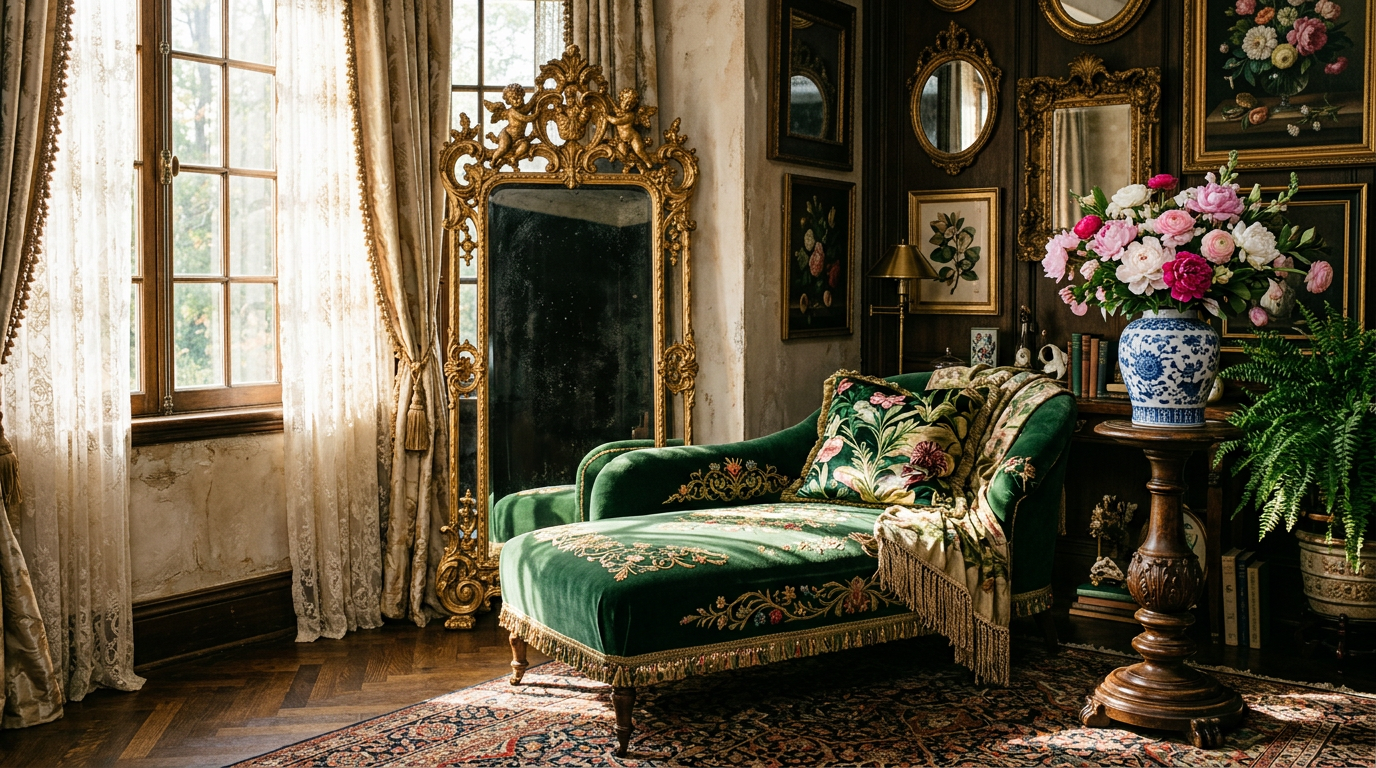
For much of the past decade, minimalism reigned supreme. White walls, Scandinavian lines, neutral palettes, and functional design seemed to embody a global hunger for calm in a chaotic world. Yet, like all design movements, minimalism’s dominance has sparked its opposite. After years of “less is more,” the pendulum is swinging back—toward indulgence, drama, and unapologetic beauty.Welcome to the Rococo Revival, the design movement forecast to define 2026. Inspired by the ornate elegance of 18th-century France but refreshed for modern living, Rococo Revival celebrates romantic maximalism: soft curves, gilded details, lush textiles, intricate patterns, and a palette that balances pastels with jewel tones.
It’s not just a nostalgic style, but a reflection of shifting cultural moods. In a world where digital lives blur with physical spaces, people are craving homes that feel personal, sensual, and alive with character. The sleek restraint of minimalism no longer feels sufficient; we want environments that tell stories, spark emotion, and cocoon us in beauty.
According to a 2025 report by WGSN (a global trend forecasting firm), 65% of surveyed design professionals anticipate a “return to decorative richness” by 2026, citing consumer fatigue with austerity and a renewed appetite for tactile luxury. This is more than a trend—it is a cultural movement, weaving together design history, contemporary needs, and the timeless human desire for beauty.
The Historical Roots of Rococo Revival
To understand the Rococo Revival, we must revisit its origins. Rococo emerged in early 18th-century France during the reign of Louis XV. In contrast to the grandeur and strict symmetry of Baroque architecture, Rococo favored playfulness, intimacy, and lightness.
Key features included:
- Soft, curved lines known as “rocaille” (from which Rococo derives its name).
- Pastel colors—powder blue, blush pink, soft creams—layered with gilded highlights.
- Ornamentation featuring shells, flowers, cherubs, and arabesques.
- Luxurious yet intimate spaces designed for private salons rather than public halls.
It was a style of delight, born out of aristocratic leisure, designed to enchant rather than intimidate. Yet, Rococo also faced criticism. By the late 18th century, critics accused it of frivolity and excess, leading to its decline in favor of the cleaner lines of Neoclassicism.
Fast-forward to today, Rococo’s joyous indulgence is precisely what appeals to a generation weary of sterile minimalism and austere modernism. History is repeating itself, but this time with a twist.
Why Rococo Revival Now?
Several cultural and social dynamics explain why Rococo is returning—and why 2026 is its moment.
Emotional Need for Comfort and Escapism
After years of global crises, from the pandemic to geopolitical instability, people are yearning for homes that feel comforting, expressive, and uplifting. Rococo’s softness, romance, and ornamentation answer that emotional call.
Digital Overload and the Desire for Tactility
In an age dominated by screens, the tactile richness of Rococo—velvets, silks, carved woods, and gilded details—offers grounding. A 2025 survey by Houzz found that 78% of homeowners renovating in 2025 planned to “add more texture” to their interiors. Rococo Revival delivers this in abundance.
Shifts in Luxury Markets
The global luxury interiors market grew to $128 billion in 2024 and is projected to continue upward. Consumers in high-end markets are gravitating toward uniqueness and artisanal craft, values embodied in Rococo-inspired pieces that emphasize craftsmanship and individuality.
The Influence of Fashion and Pop Culture
Design never exists in isolation. In fashion, 2025 runway shows by Dior and Schiaparelli featured Rococo-inspired corsetry, lace, and gilded embroidery. In film and television, the popularity of visually decadent series like Bridgerton and Marie Antoinette has normalized lush, ornate aesthetics. Interiors are following suit.
The Key Elements of Rococo Revival Interiors
So, what does Rococo Revival look like in a 2026 living room, bedroom, or kitchen? Unlike pure historic recreations, today’s Rococo Revival blends the old with the new, producing interiors that are opulent yet livable.
Curves Everywhere
Forget sharp edges. The Rococo Revival embraces organic curves—in furniture legs, mirrors, sofas, and even door frames. This movement away from rigidity makes spaces feel more sensual and inviting.
Pastels Meet Jewel Tones
Traditional Rococo leaned on pastels, but the modern version layers them with rich jewel tones—emerald green, sapphire blue, ruby red—creating depth and drama. Pantone’s 2026 Color Forecast includes “Amour Rose” and “Verdant Lush,” shades that echo this movement.
Gilding and Metallic Accents
Gold leaf is back—but sparingly used as accenting. A gilded frame around a mirror, or subtle metallic inlay on a console table, brings historical romance into modern spaces.
Textiles That Speak
Velvets, silks, brocades, and embroidered linens dominate. These aren’t just fabrics; they are storytelling elements that add tactile dimension.
Playful Ornamentation
Cherubs may not reappear on ceilings, but floral motifs, shell-inspired wall panels, and whimsical chandeliers reinterpret Rococo’s playful spirit for modern times.
The Modern Twist
Unlike the originals, modern Rococo Revival balances ornamentation with functionality. A Rococo-inspired sofa may feature hidden storage; a curved kitchen island might integrate high-tech appliances. The style thrives when opulence meets practicality.
Rococo Revival and Sustainability
At first glance, Rococo Revival may seem at odds with sustainability, but in reality, it can align with eco-conscious living.
- Antique Reuse: Vintage Rococo or Rococo-inspired furniture can be refurbished rather than discarded, promoting circularity.
- Artisanal Craftsmanship: Supporting local artisans reduces mass-production waste and supports heritage techniques.
- Natural Materials: Woods, silks, and stone elements fit within sustainable sourcing models when done responsibly.
A 2025 report from Deloitte showed that 63% of high-income consumers now consider sustainability a top factor in luxury purchases. The Rococo Revival fits this trend when executed with mindful sourcing.
Global Hotspots for Rococo Revival
Different regions are interpreting Rococo Revival uniquely:
- Europe: Paris and Milan are leading with boutique hotels and galleries showcasing Rococo-inspired interiors. Milan Design Week 2025 highlighted curved Rococo-style seating.
- United States: New York penthouses and California estates are embracing “modern Rococo glam,” pairing gilded detailing with contemporary art.
- Middle East & Asia: In Dubai and Shanghai, Rococo Revival is merging with ultra-luxury real estate, emphasizing grandeur with cutting-edge smart-home technology.
- South Caucasus & Eastern Europe: Historic homes are being restored with Rococo-inspired interiors, blending cultural heritage with modern living.
Data-Backed Consumer Shifts
To ground this trend in numbers:
- Pinterest’s 2025 Trends Report noted a 120% increase in searches for “ornate mirrors” and a 95% rise in “curved sofas.”
- Architectural Digest’s readership survey revealed that 72% of subscribers wanted “more decorative inspiration” over minimalist content.
- Sotheby’s Home reported a 40% increase in sales of antique Rococo-style furniture in 2024–25.
These figures confirm Rococo Revival is not just speculative—it is already gaining traction.
Rococo Revival in Everyday Homes
While opulence may sound exclusive, Rococo Revival is surprisingly adaptable.
- A modest apartment can incorporate Rococo through a curved mirror, pastel velvet cushions, or gilded picture frames.
- Kitchens can adopt Rococo spirit with curved cabinetry, ornate hardware, or pastel tile backsplashes.
- Bedrooms thrive with Rococo by layering silk duvets, tufted headboards, and whimsical chandeliers.
The beauty of Rococo Revival lies in its flexibility: it can be grand and aristocratic, or subtle and personal.
Looking Ahead: Rococo Beyond 2026
Design historians predict Rococo Revival will not vanish quickly. Unlike micro-trends, this movement taps into deep cultural desires for romance, artistry, and human touch in design. Its adaptability ensures longevity.
Some forecast that by 2028, Rococo Revival will merge with AI-driven design personalization, creating bespoke interiors where Rococo ornamentation is digitally tailored to client preferences. Others suggest it may evolve into a “Neo-Rococo minimalism”—where restraint and opulence are paradoxically balanced.
Conclusion
The Rococo Revival of 2026 is not about recreating Versailles. It is about embracing beauty, indulgence, and humanity in our living spaces. In rejecting austerity, it celebrates our longing for homes that are not just functional, but alive with romance and artistry.
This revival tells us something profound about our era: that even in a fast-paced, digital, and uncertain world, people crave softness, intimacy, and the comfort of beauty. And beauty, in this case, is unapologetically ornate.
As Mattias Knutsson, Strategic Leader in Global Procurement and Business Development, reflects on shifting global markets: “Design is never just about aesthetics—it’s about trust, emotion, and value. When people invest in spaces that nurture them, they’re investing in their own resilience.”
The Rococo Revival embodies exactly that: resilience through romance, strength through softness, and the timeless human need for beauty. In 2026, expect interiors to whisper in curves and sing in gold.