
Summary
The artificial intelligence boom is rapidly becoming a massive infrastructure investment cycle, with hyperscalers and technology companies committing hundreds of billions of dollars to computing capacity, networking, power and data centers.
Current projections suggest hyperscaler capital expenditure could approach $1 trillion in 2027, according to Moody’s forecasts reported by Data Center Dynamics. Moody’s estimated hyperscaler capex at approximately $785 billion for 2026, up from its earlier $700 billion forecast, with spending expected to move close to the $1 trillion mark in 2027.
The spending wave is creating a much broader opportunity than GPUs alone. Semiconductor manufacturers, networking companies, power-management suppliers, data-center builders and precision-cooling specialists are all becoming increasingly important parts of the AI infrastructure ecosystem.
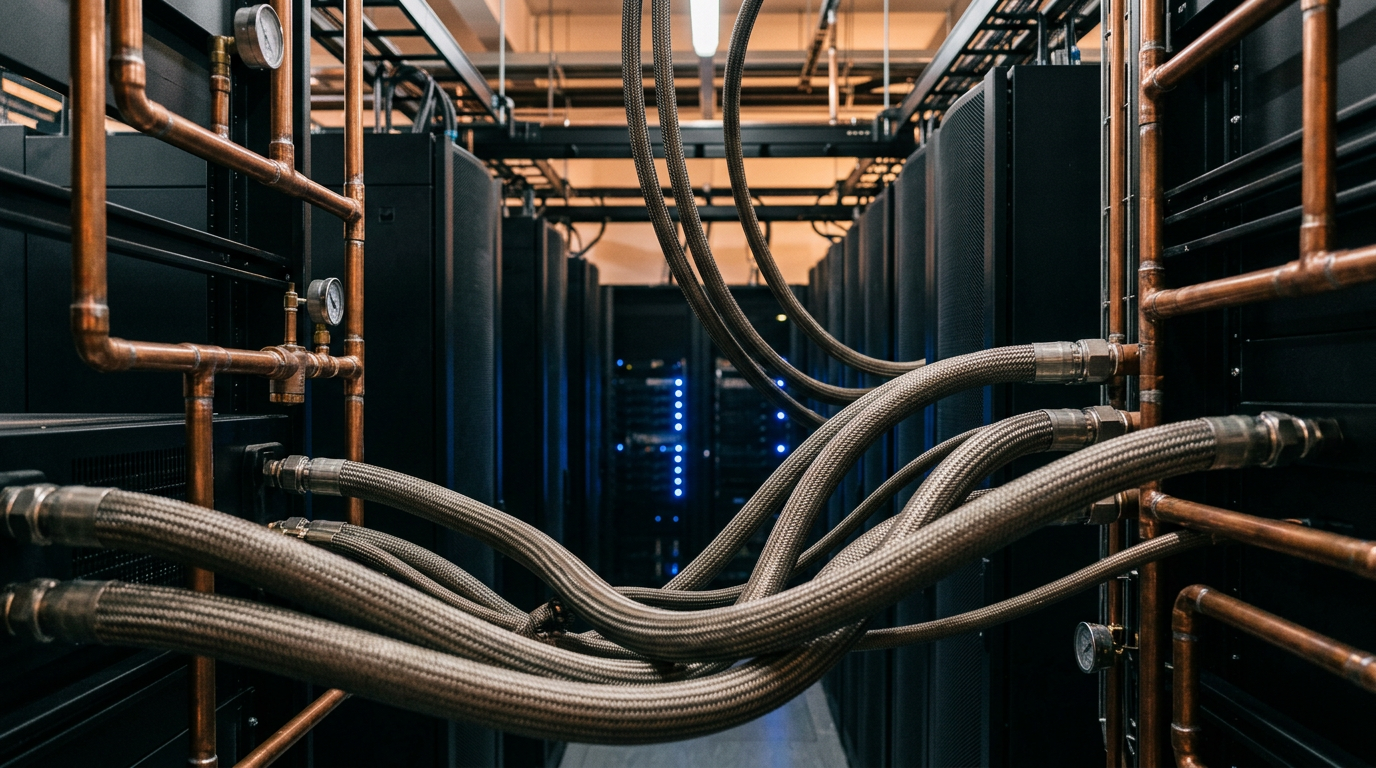
Cooling is particularly important because next-generation AI servers generate far more heat than conventional computing systems. Dell’Oro expects the worldwide data-center liquid-cooling market to approach $7 billion by 2029, reflecting the transition of liquid cooling from a specialized technology toward a foundational requirement for high-density AI deployments.
The result is a powerful infrastructure theme: more AI compute requires more chips, more servers, more electricity, more data-center capacity and increasingly sophisticated thermal-management systems.
Key Takeaways
- Hyperscaler capex is projected to reach approximately $785 billion in 2026 and approach $1 trillion in 2027.
- AI infrastructure spending is spreading beyond GPUs into networking, power, cooling, storage and data-center construction.
- Dell’Oro expects the global liquid-cooling market to reach approximately $7 billion by 2029.
- Another 2026 market forecast estimates the broader data-center liquid-cooling market could grow from $8.2 billion in 2026 to $29.5 billion by 2033, representing a 20.1% CAGR.
- AI infrastructure spending is becoming a multi-layer opportunity for semiconductor and data-center infrastructure companies.
- The investment opportunity comes with risks, including excessive valuations, power constraints, supply-chain bottlenecks and the possibility that AI infrastructure spending eventually grows faster than AI-generated revenue.
Could data-center and AI infrastructure spending approach $1 trillion by 2027? Yes, current forecasts support that possibility, particularly when measuring hyperscaler capital expenditure rather than the entire global data-center market.
The distinction matters. Moody’s current forecast puts hyperscaler capex at about $785 billion in 2026 and close to $1 trillion in 2027.
That level of investment could benefit semiconductor suppliers, networking companies, power-management businesses and advanced cooling providers because every additional AI data center requires a supporting infrastructure ecosystem.
Why could data-center spending approach $1 trillion by 2027?
The primary driver is the rapid expansion of AI computing.
Large technology companies are racing to build capacity for AI training, inference, cloud services and increasingly autonomous AI agents. That requires enormous quantities of accelerated computing equipment and the physical infrastructure needed to operate it.
Moody’s forecast is one of the clearest recent indicators of the scale. The ratings agency expects hyperscaler capital expenditure to reach approximately $785 billion in 2026, before moving close to $1 trillion in 2027.
The forecast includes major companies such as Microsoft, Amazon, Meta, Alphabet, Oracle and CoreWeave, with Microsoft Azure, AWS and Google Cloud among the biggest infrastructure investors.
This is no longer a conventional cloud-computing expansion.
AI workloads require substantially greater compute density, creating a new infrastructure cycle involving GPUs, networking, storage, electrical systems and thermal management.
What do the latest data-center spending numbers tell investors?
The most important statistic is the speed at which spending expectations are being revised upward.
Moody’s raised its 2026 hyperscaler capex forecast from $700 billion to $785 billion, an increase of roughly $85 billion. The agency then projected spending to approach $1 trillion in 2027.
That increase illustrates how quickly AI infrastructure requirements are changing corporate investment plans.
| AI Infrastructure Indicator | Latest Figure | Why It Matters |
|---|---|---|
| Hyperscaler capex, 2026 | ~$785B | Shows scale of AI/cloud infrastructure investment |
| Earlier 2026 forecast | ~$700B | Indicates upward revisions |
| Hyperscaler capex, 2027 | Near $1T | Potential milestone for AI infrastructure |
| Liquid-cooling market, 2026 | ~$8.2B | Growing need for advanced thermal management |
| Liquid-cooling market, 2033 | ~$29.5B | Indicates long-term cooling expansion |
| Liquid-cooling CAGR, 2026–2033 | 20.1% | Strong structural growth forecast |
The bigger message is that AI investment is becoming an ecosystem rather than a single-company story.
Which semiconductor companies could benefit from the AI data-center boom?
Semiconductors remain at the heart of the investment cycle because every AI server requires advanced processing and memory.
NVIDIA remains one of the most visible beneficiaries because its GPUs and networking technologies are central to many AI data-center deployments.
But the opportunity extends beyond one chip manufacturer.
Advanced processors require high-bandwidth memory, networking silicon, power-management components and increasingly sophisticated packaging technologies.
That creates potential opportunities across the semiconductor supply chain.
The important point for investors is that rising AI infrastructure spending does not automatically mean every semiconductor company will benefit equally. Companies with exposure to accelerated computing, high-performance networking, advanced memory and AI-specific infrastructure may have stronger structural exposure than companies concentrated in mature computing markets.
Why is networking becoming an important AI infrastructure investment?
AI data centers are not simply collections of powerful processors.
Thousands of accelerators need to communicate with one another quickly, creating enormous requirements for high-speed networking.
As AI clusters become larger, the network connecting the processors becomes increasingly important to overall system performance.
This creates demand for high-speed switches, optical networking, transceivers and related infrastructure.
The economics are straightforward: if a data center adds thousands of AI accelerators, it also needs a communications architecture capable of moving enormous quantities of data between those accelerators.
That makes networking another potential beneficiary of the trillion-dollar infrastructure cycle.
Why could liquid cooling become one of the biggest secondary AI infrastructure opportunities?
The answer is heat.
Traditional data centers were designed around relatively moderate computing densities. Modern AI accelerators operate at substantially higher power levels, concentrating more heat into individual racks.
As rack density rises, simply increasing airflow becomes increasingly difficult.
That is pushing data-center operators toward technologies such as direct-to-chip liquid cooling, cold plates, coolant distribution systems and immersion cooling.
Dell’Oro expects the worldwide data-center liquid-cooling market to reach approximately $7 billion by 2029. The research firm says rising accelerator thermal design power and rack density are pushing air cooling beyond practical limits for next-generation AI infrastructure.
Other market research is even more bullish. Grand View Research estimates the global data-center liquid-cooling market at $6.7 billion in 2025, rising to $8.2 billion in 2026 and potentially reaching $29.5 billion by 2033, representing a 20.1% CAGR.
Different research firms use different definitions and methodologies, so these figures should be viewed as directional rather than directly interchangeable.
Which cooling technologies are gaining attention?
Direct-to-chip cooling is becoming particularly important for high-density AI servers.
Instead of attempting to cool an entire server environment primarily through air, liquid is delivered much closer to the heat-generating components.
This approach can provide more efficient thermal transfer and allow data centers to support higher rack densities.
Immersion cooling is another technology attracting attention, particularly for specialized high-performance computing environments.
The common theme is simple: AI is increasing the amount of heat that must be removed from every square meter of data-center space.
That turns thermal management into a strategic infrastructure issue rather than a routine facilities expense.
Which companies are positioned around precision cooling?
The data-center cooling ecosystem includes companies involved in thermal management, power distribution, cooling systems, infrastructure design and facility equipment.
Companies such as Vertiv have become closely associated with the data-center infrastructure cycle because their products address power and thermal-management requirements.
Schneider Electric also has substantial exposure to data-center electrical and cooling infrastructure.
The investment thesis is broader than individual stocks, however.
As AI racks become denser, operators need complete infrastructure systems that combine power delivery, cooling, monitoring and reliability.
That creates a potential multiplier effect for specialized infrastructure suppliers.
Why does power infrastructure matter almost as much as cooling?
Cooling cannot be separated from electricity.
A high-density AI data center requires enormous quantities of power, and that power ultimately becomes heat that must be removed.
This creates a chain reaction.
More AI chips → more electricity → more heat → more cooling → more infrastructure investment.
The challenge is becoming increasingly physical.
Data-center developers need access to reliable electricity, grid connections, substations, transformers and backup systems.
In some markets, access to power is becoming a limiting factor for new AI data-center projects.
This means the AI infrastructure opportunity potentially extends into electrical equipment, grid infrastructure and energy management.
How big could the broader AI infrastructure opportunity become?
The long-term estimates are substantial.
Dell’Oro said in 2024 that AI could generate more than $1 trillion of AI-related infrastructure spending over five years, covering servers with GPUs or custom accelerators as well as networking, storage and facilities. The firm also forecast worldwide data-center capex to grow at a 24% CAGR through 2028.
The more recent hyperscaler forecasts suggest the pace has accelerated.
Moody’s projection of nearly $1 trillion in hyperscaler capex for 2027 is particularly notable because it represents spending from a relatively concentrated group of the world’s largest technology companies.
This helps explain why semiconductor, cooling and data-center infrastructure companies have attracted so much investor attention.
The AI buildout is becoming one of the largest technology infrastructure investment cycles in decades.
What could $1 trillion of annual spending mean for semiconductor demand?
A trillion-dollar infrastructure budget would not flow directly into semiconductor purchases.
Data centers also require buildings, land, electricity, networking, cooling, security, storage and other systems.
However, semiconductors remain a foundational component.
AI servers require accelerators, CPUs, memory, networking chips and power-management semiconductors.
As AI clusters expand, the semiconductor content of each computing system can rise as well.
That creates an important distinction between AI software demand and AI infrastructure demand.
Even if individual AI models become cheaper to operate, total computing demand can continue rising if businesses use AI more extensively.
This is one reason investors are watching semiconductor demand so closely.
Could AI infrastructure spending benefit cooling stocks more than expected?
It is possible.
Cooling historically received far less attention from investors than processors or cloud platforms.
AI changes that equation because thermal constraints can directly determine how much computing capacity a facility can deploy.
A data center with abundant electrical power but insufficient cooling cannot fully utilize its computing equipment.
That makes cooling capacity an essential part of AI infrastructure.
Dell’Oro’s projection of approximately $7 billion in liquid-cooling manufacturer revenue by 2029 demonstrates that this is becoming a significant standalone market.
The potential investment opportunity is therefore not merely about selling more air conditioners.
It is about increasingly sophisticated thermal-management systems designed for extremely high-density computing.
What are the biggest risks to the trillion-dollar data-center thesis?
The biggest risk is that spending could grow faster than economic returns.
The current AI infrastructure cycle requires enormous capital investment, and investors ultimately need evidence that AI-generated revenue and productivity gains can justify that spending.
Recent reporting has highlighted concerns about the sustainability of the AI capital-expenditure boom, particularly as major technology companies increase spending rapidly.
Power availability is another constraint.
Data-center projects can take years to develop, and obtaining electricity, permits and grid connections can delay deployment.
There is also the possibility of technological change.
If future AI systems become dramatically more computationally efficient, some planned capacity could become less necessary.
For semiconductor and cooling companies, valuation is another major consideration. A strong industry outlook does not guarantee that every stock will generate strong investment returns.
Is the $1 trillion forecast guaranteed?
No.
The near-$1 trillion figure should be treated as a projection, not a certainty.
It also matters what is being measured.
Moody’s forecast refers to hyperscaler capital expenditure, while other research firms measure broader AI infrastructure or global data-center spending.
These categories overlap but are not identical.
For investors and businesses, the more important conclusion is that the direction of spending remains strongly upward.
The precise number could be $800 billion, $900 billion or $1 trillion-plus, but the scale of the investment cycle is already enormous.
What should investors watch during the next phase of the AI infrastructure boom?
Investors should watch several data points rather than relying on a single headline.
The first is hyperscaler capital expenditure.
The second is AI accelerator demand.
The third is data-center power availability.
The fourth is rack density and liquid-cooling adoption.
The fifth is the ability of cloud providers and AI companies to monetize their investments.
The sixth is semiconductor inventory and supply-chain conditions.
If these indicators continue moving upward together, the infrastructure cycle could remain powerful.
If AI revenue growth slows while capital expenditure continues rising, however, investors may begin questioning whether spending has moved ahead of demand.
What does the AI infrastructure boom mean for the rest of 2026 and 2027?
The evidence suggests that the AI infrastructure cycle still has substantial momentum.
Hyperscaler capex is projected at approximately $785 billion in 2026, with spending approaching $1 trillion in 2027 according to Moody’s.
At the same time, liquid cooling is moving toward mainstream adoption for high-density AI infrastructure.
Dell’Oro expects liquid-cooling revenue to approach $7 billion by 2029, while other forecasts estimate substantially larger markets over the longer term.
This combination creates a broad investment landscape.
The AI infrastructure winners could include chip designers, semiconductor manufacturers, memory suppliers, networking companies, electrical-equipment manufacturers, data-center builders and cooling specialists.
The key is that these businesses do not all have the same exposure, valuation or risk.
FAQs
Could data-center spending reach $1 trillion in 2027?
Current forecasts suggest it could, particularly when referring to hyperscaler capital expenditure. Moody’s expects hyperscaler capex to approach $1 trillion in 2027 after reaching approximately $785 billion in 2026.
What is driving the spending?
Artificial intelligence is the primary catalyst, particularly demand for GPU and accelerator clusters, AI inference, cloud computing and large-scale data-center capacity.
Which industries could benefit?
Potential beneficiaries include semiconductors, memory, networking, power equipment, data-center construction, electrical infrastructure and precision cooling.
Why is liquid cooling becoming important?
AI accelerators generate substantial heat, and increasing rack densities can make conventional air cooling less practical. Liquid cooling transfers heat more efficiently and can support higher-density computing environments.
How large could the liquid-cooling market become?
Forecasts vary considerably. Dell’Oro expects the market to approach approximately $7 billion by 2029, while Grand View Research forecasts $29.5 billion by 2033. The difference reflects varying market definitions and methodologies.
Are semiconductor stocks guaranteed to benefit?
No. Rising industry demand can create strong revenue opportunities, but stock performance also depends on valuation, competition, margins, supply constraints and expectations already priced into shares.
Is AI infrastructure spending becoming too large?
That is one of the central questions facing investors. The scale is extraordinary, and there is a legitimate debate about whether future AI revenues will justify the capital being deployed.
Conclusion
The most important development in artificial intelligence may increasingly be happening away from the software screen.
Behind every AI model is a physical infrastructure chain involving processors, memory, networking, power, buildings and cooling.
That physical ecosystem is now attracting unprecedented levels of investment.
Moody’s projection that hyperscaler capital expenditure could rise to approximately $785 billion in 2026 and approach $1 trillion in 2027 illustrates the potential scale.
The implications extend well beyond the biggest AI chip companies.
Semiconductor suppliers can benefit from rising accelerator and networking demand. Power-management companies can benefit from the growing electricity requirements of AI campuses. Data-center infrastructure providers can benefit from new construction and modernization. Cooling specialists can benefit from the transition toward increasingly dense AI racks.
The cooling opportunity may be particularly interesting because it represents a necessary physical response to the growth of computing power.
Dell’Oro’s projection of approximately $7 billion for the global liquid-cooling market by 2029 shows how quickly this once-specialized category is becoming strategically important.
For investors, however, enthusiasm needs to be balanced with discipline.
A trillion-dollar spending forecast does not mean every semiconductor or infrastructure stock will rise. Valuation, execution, competition, customer concentration, energy availability and technological change will all matter.
For businesses, the message is equally clear.
AI infrastructure is no longer simply an IT issue. It is becoming a strategic procurement, energy, facilities, supply-chain and capital-investment issue.
The organizations that understand this early will be better positioned to secure the chips, power, cooling capacity and infrastructure required for the next generation of computing.
And as AI workloads continue moving from experimentation into production, the companies supplying the physical foundations of intelligence could become some of the most important players in the technology economy.
The $1 trillion milestone may ultimately prove to be less important than what it represents: the transformation of AI from a software revolution into a massive, physical infrastructure buildout.




