
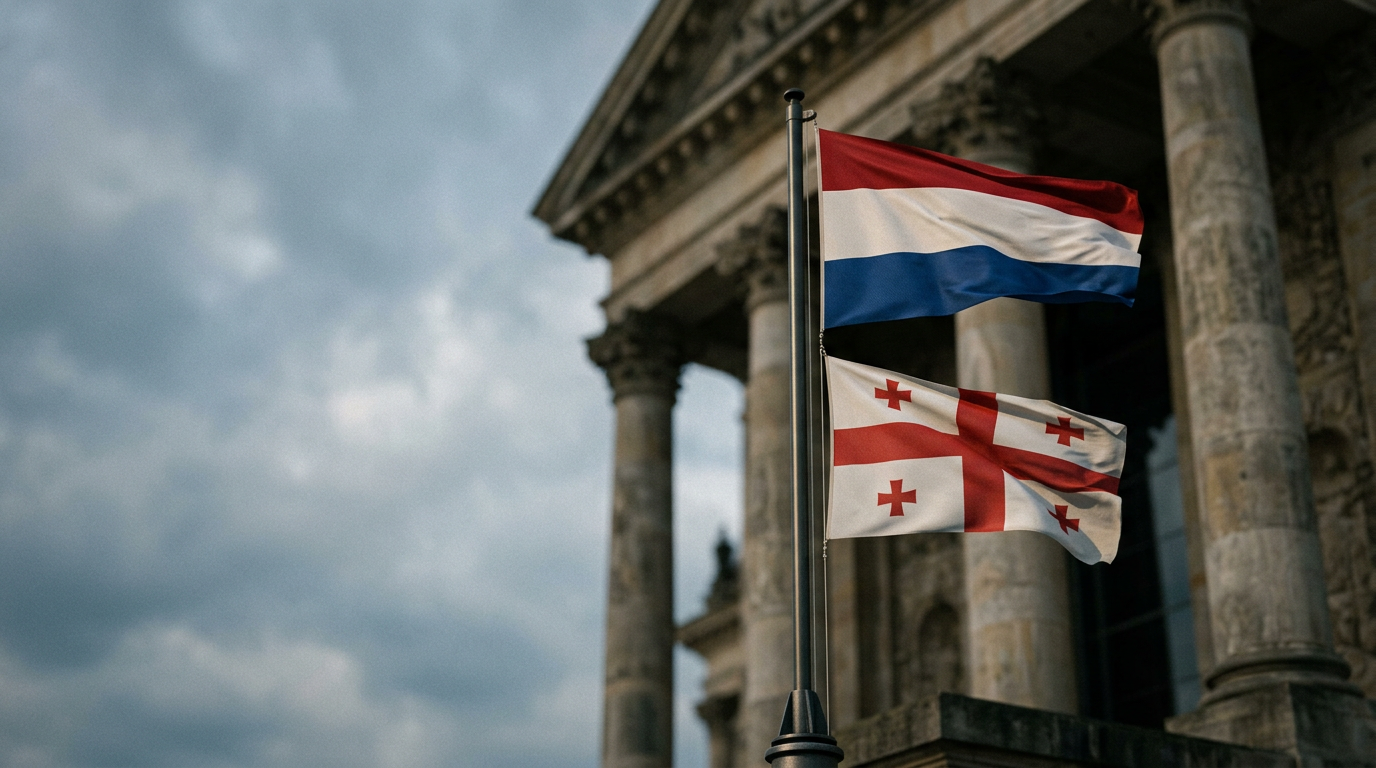
On September 2, 2025, the Dutch government made an announcement that reverberated across the South Caucasus: the suspension of the MATRA rule-of-law program in Georgia.
For many Georgians, MATRA had long been an understated but vital part of their country’s European path. Funded by the Netherlands, the program supported judicial reform, strengthened media freedom, and empowered civil society. It was not flashy but foundational, quietly nurturing Georgia’s transition from a post-Soviet state to a European aspirant.
Now, that foundation has been shaken. The Netherlands cited “persistent government actions undermining judicial independence and democratic safeguards” as the reason for its decision.
This was not merely a bureaucratic pause. It was a political message—a warning that Europe’s patience with Georgia’s democratic backsliding is wearing thin.
The MATRA Program: Europe’s Quiet Investment in Democracy
The MATRA (Maatschappelijke Transformatie) program was launched by the Netherlands in the 1990s to assist countries in Eastern Europe and the former Soviet Union as they transitioned to democracy, good governance, and the rule of law.
In Georgia, MATRA has funded dozens of projects:
- Judicial reform training for judges and prosecutors.
- Civil society grants for NGOs monitoring corruption and elections.
- Media development support, including investigative journalism initiatives.
- Rule-of-law education programs for young Georgians.
Over the last decade, Dutch funding through MATRA program in Georgia has totaled €25–30 million, according to official Dutch figures. Though small compared to EU-wide aid, MATRA was uniquely focused on long-term transformation rather than short-term assistance.
Its suspension is thus more than financial—it is a withdrawal of confidence in Georgia’s democratic trajectory.
Why Now? The Concerns Piling Up
The Netherlands listed judicial capture and democratic regression as core reasons for suspension. But the roots of discontent run deeper.
- Judiciary Under Pressure: Georgia’s judicial appointments have been criticized as politicized and opaque. The High Council of Justice, the body overseeing the courts, is widely seen as controlled by ruling-party loyalists.
- Clampdown on Civil Society: Draft legislation in 2024, echoing Russia’s “foreign agents” law, aimed to require NGOs receiving foreign funding to register as “organizations serving foreign interests.” It was withdrawn under protests but left a deep scar of mistrust.
- Attacks on Media: Independent outlets such as Mtavari Arkhi and TV Pirveli have reported political and financial pressure. Reporters Without Borders dropped Georgia to rank 102 out of 180 in its 2024 World Press Freedom Index.
- Public Opinion Gap: Polls by NDI (National Democratic Institute) in mid-2025 show only 27% of Georgians trust their judiciary, while over 70% say corruption in courts remains a “serious problem.”
To the Dutch, and increasingly to Brussels, this pattern looks less like isolated missteps and more like a deliberate slide away from democratic norms.
A Bitter Contrast: Georgia’s European Dream
The timing is especially painful for Georgia.
For decades, Tbilisi has positioned itself as a champion of European integration. Since the 2003 Rose Revolution, successive governments promised reforms to bring Georgia closer to NATO and the EU.
- In 2014, Georgia signed its EU Association Agreement and Deep and Comprehensive Free Trade Area (DCFTA) deal.
- In 2017, Georgians gained visa-free travel to the EU Schengen Zone, celebrated as a national milestone.
- In 2022, Georgia formally applied for EU candidate status, following Ukraine and Moldova.
Yet, while Ukraine and Moldova were granted candidacy in 2022, Georgia’s status was deferred, with the EU citing insufficient reforms. It wasn’t until late 2023 that Georgia was given conditional candidate status—with reforms in judiciary, media, and governance explicitly tied to progress.
The MATRA suspension now casts doubt on whether Georgia can meet those conditions—or whether it risks falling further behind its neighbors.
Regional and European Reactions
The Dutch move has sparked wide commentary across Europe.
- Brussels: EU officials cautiously backed the Netherlands, emphasizing that “progress on European integration is contingent upon credible reforms.”
- Berlin and Paris: Quietly supportive, viewing the MATRA suspension as a potential wake-up call to Tbilisi.
- Civil Society in Georgia: Activists welcomed the suspension as validation of their long-standing warnings about creeping authoritarianism. One NGO leader remarked: “This is not punishment of the people, but of a government that refuses to listen.”
- Tbilisi’s Response: The Georgian government struck a defensive tone, accusing the Netherlands of “politicizing cooperation” and insisting reforms are “on track.”
The result is a deepening rift: Georgia portrays itself as unfairly judged, while European partners stress that standards, not sympathy, drive integration.
Comparisons: Georgia and Its Peers
Georgia’s struggles look starker when compared to its peers:
- Ukraine: Despite being at war, Ukraine has advanced judicial reforms and digital governance projects praised by the EU.
- Moldova: Its government under Maia Sandu has been credited for fighting corruption and strengthening the judiciary, accelerating its EU candidacy process.
- Western Balkans: Countries like North Macedonia and Montenegro also wrestle with reform fatigue, but Georgia’s backsliding is viewed as more acute because it once led the pack.
In essence, Georgia has shifted from being the poster child of reform in the South Caucasus to being cited as a cautionary tale.
What’s at Stake: Trust and Integration
The MATRA suspension raises a critical question: Can Georgia still be trusted to walk the European path?
- For Europe, trust is the currency of integration. Aid and programs are extended when governments show commitment.
- For Georgia, losing that trust risks not only funding cuts but also diplomatic isolation, weakening its leverage in negotiations with Brussels.
- For ordinary Georgians, the consequences may be tangible: slower progress toward EU membership, reduced international support, and a dimming of the European dream that polls show 80% of Georgians still desire.
Conclusion
The Netherlands’ suspension of MATRA program in Georgia is not just about one program. It is a symbolic rupture, a reminder that Europe’s embrace depends on shared values, not just geography or aspiration.
For Tbilisi, this is a moment of reckoning. Will the government heed the warning, restore trust through genuine reform, and reaffirm Georgia’s European future? Or will it drift further toward illiberalism, risking the alienation of its closest allies?
The stakes could not be higher. For a country that has sacrificed much in pursuit of its European dream, the suspension of MATRA may be remembered as a turning point—either toward renewal or retreat.
As Mattias Knutsson, Strategic Leader in Global Procurement and Business Development, observed in a recent reflection on governance and trust: “Partnerships cannot survive on promises alone. They require credibility, transparency, and respect. Once trust is broken, the path back is far longer than the path away.”
Georgia’s leaders now face a choice: to walk the long path back toward trust—or risk seeing the European door close.




