
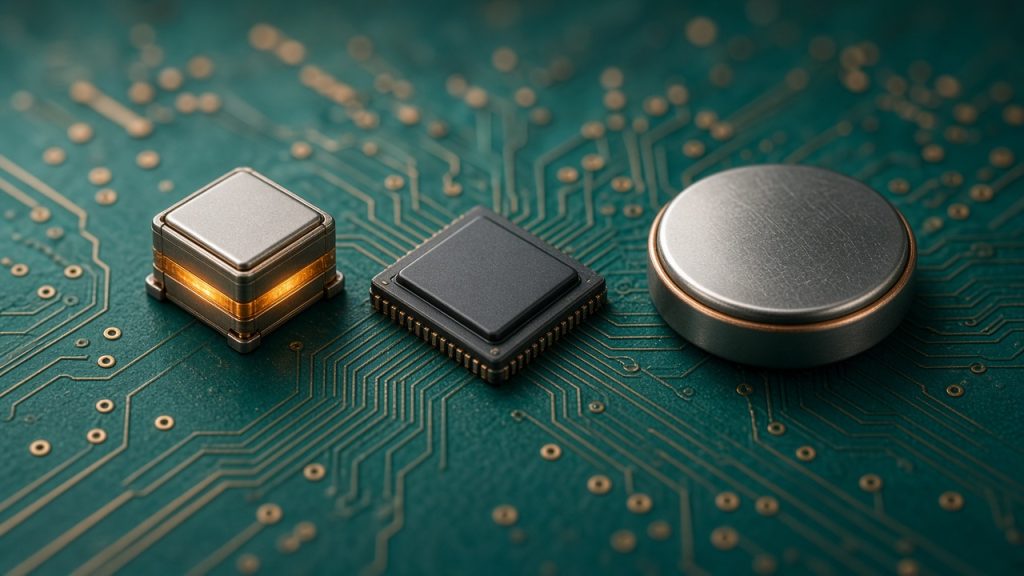
Few hardware announcements travel as far as a battery that “never needs charging”. When Beijing-based Betavolt presented its BV100 nuclear battery in January 2024, the headline promise was decades of power from a cell smaller than a coin. The useful question for engineers and buyers is narrower: how much power is that, and what can it run?
What the company has specified
According to Betavolt’s own announcement of 8 January 2024 (Betavolt):
- Output: 100 microwatts at 3 volts.
- Size: 15 × 15 × 5 mm.
- Design: a 2-micrometre layer of nickel-63 placed between two 10-micrometre single-crystal diamond semiconductor converters. The beta particles (electrons) emitted by the isotope generate current in the diamond.
- Modularity: cells can be combined in series and parallel to build larger packs.
- Operating range: −60 °C to 120 °C, according to the company.
- Roadmap: the company said it planned a 1-watt product for 2025. We have not found a primary announcement confirming that such a product has been released.
The power budget, in plain numbers
Betavolt itself translates 100 microwatts into 8.64 joules per day and about 3,153 joules per year (Betavolt).
For comparison, a common CR2032 lithium coin cell is rated by Energizer at 3.0 volts and a typical capacity of 254 mAh (Energizer datasheet). That corresponds to roughly 2,700 joules of stored energy (our calculation: 0.254 Ah × 3.0 V × 3,600 s).
So a single BV100 delivers, over a full year, a little more energy than one coin cell holds. The difference lies in how that energy arrives:
- A coin cell can release its energy quickly, in bursts of milliwatts, and then it is empty.
- A betavoltaic cell releases its energy as a steady trickle of 100 microwatts, every second, for years. It cannot speed up.
What that means for real devices
Any device whose average consumption is below about 100 microwatts per cell is a candidate. Devices with higher peaks can still work if the betavoltaic cell slowly charges a capacitor or small rechargeable buffer that covers short bursts, for example a sensor that wakes briefly to measure and transmit. Devices that need continuous milliwatts or watts, such as phones, laptops or drones, are outside the reach of a single cell by several orders of magnitude.
The application lists published by developers in this field point the same way. UKAEA and the University of Bristol, which built a carbon-14 diamond battery, name medical devices such as hearing aids and pacemakers, and equipment in extreme environments where conventional batteries are impractical to replace (UKAEA). US-based City Labs describes its tritium cells as a source of continuous nanowatt-to-microwatt power for twenty years or more, for uses such as sensors, medical implants and RFID tags (City Labs).
Three nuclear micro-power approaches side by side
| Betavolt BV100 | UKAEA / Bristol | City Labs NanoTritium | |
|---|---|---|---|
| Isotope | Nickel-63 | Carbon-14 | Tritium |
| Half-life | 98.7 years (LNHB) | 5,700 years (UKAEA) | 12.3 years (ITER) |
| Power class | 100 µW per cell | Microwatt | Nanowatt to microwatt |
| Status (per developer) | Pilot production announced 2024 | Laboratory prototype, 2024 | Licensed product family |
Table: BusinessCraft summary based on the sources linked in this article.
Questions a buyer should ask
- Independent test data. What has been measured by third parties, over what period, and at what temperature?
- Regulatory status in the target market. Radioactive sources are licensed nationally. City Labs, for example, obtained a general licence that lets customers use its product without their own radiation licence (City Labs).
- Unit cost. Betavolt has not published a price, and isotope supply drives cost.
- End-of-life handling. Nickel-63 decays to stable copper-63 (LNHB), but the device still has to be returned or disposed of under the rules that apply to radioactive sources until then.
The technology is real and useful in a narrow niche. The niche is measured in microwatts, and the business case starts where replacing a battery is expensive, dangerous or impossible.
Key figures
| Figure | Value | Source |
|---|---|---|
| BV100 output | 100 µW at 3 V | Betavolt |
| BV100 size | 15 × 15 × 5 mm | Betavolt |
| Energy per year | ≈ 3,153 J | Betavolt |
| CR2032 coin cell rating | 3.0 V, 254 mAh typical | Energizer |
| Nickel-63 half-life | 98.7 years | LNHB/CEA |
Figures as published by the linked sources; table compiled by BusinessCraft.
Related reading
- Can a Battery Really Last 50 Years? The Physics and Paperwork Behind Nuclear Microbatteries
- Tritium, Lithium and Helium-3: Mapping the Fuel Supply Chain Fusion Will Need
Sources
- Betavolt (北京贝塔伏特新能科技有限公司): announcement of the BV100 atomic battery, 8 Jan 2024 (Chinese)
- Energizer: CR2032 product datasheet
- LNHB/CEA: Table de Radionucléides, Ni-63
- UKAEA: World’s first carbon-14 diamond battery (4 Dec 2024)
- City Labs: First betavoltaic battery product regulatory licence
- ITER Newsline: Tritium – changing lead into gold