
Betavolt’s claim that its cell can run for 50 years without charging is striking for any power source. For nuclear microbatteries such a lifespan is not marketing magic but arithmetic, with two important caveats. This article separates the part of the claim that follows from physics from the parts that still need evidence.
The claim
Betavolt says its BV100 cell, built around nickel-63 and diamond semiconductors, can generate power stably for 50 years without charging or maintenance (Betavolt). The cell is rated at 100 microwatts.
Part one: what the isotope guarantees
The energy comes from radioactive decay, which proceeds at a fixed rate set by the isotope’s half-life. Nickel-63 has a half-life of 98.7 years according to France’s national radionuclide reference tables (LNHB/CEA). From that single number it follows (our calculation) that:
- the source loses about 0.7% of its activity per year;
- after 50 years about 70% of the original activity remains.
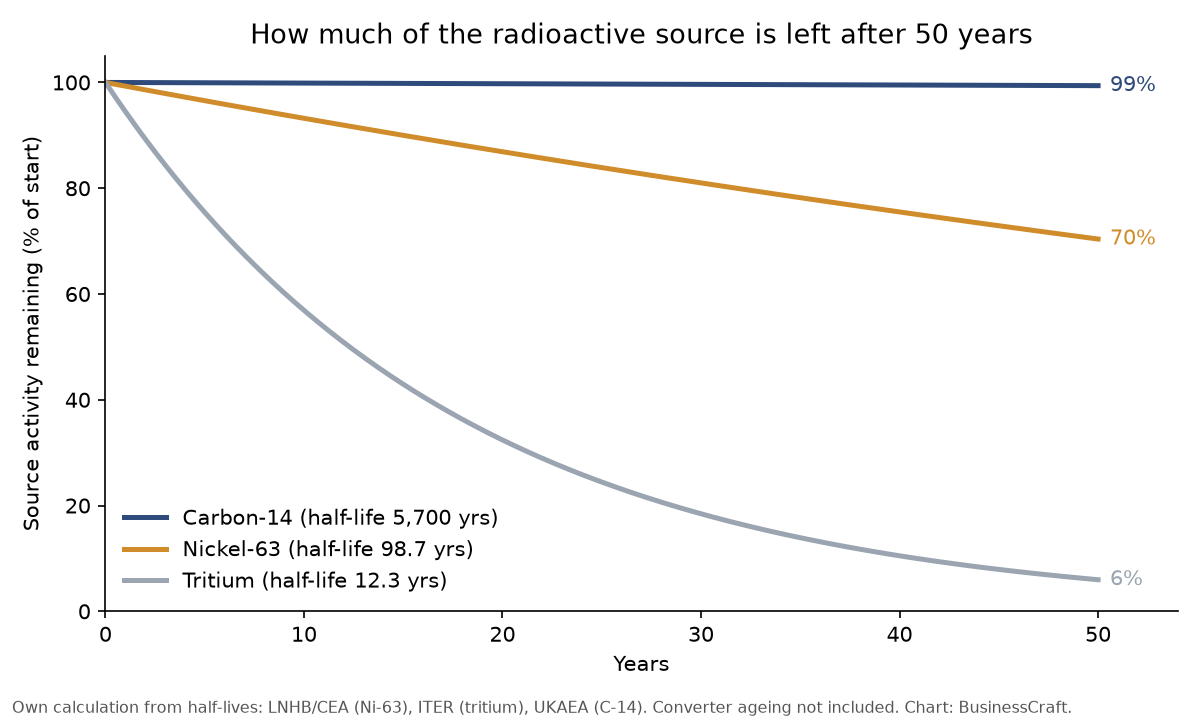
Isotope choice sets the ceiling on lifetime. Tritium, used in some commercial betavoltaic cells, has a half-life of 12.3 years (ITER), so only about 6% of its activity remains after 50 years. Carbon-14, used in the diamond battery developed by UKAEA and the University of Bristol, has a half-life of 5,700 years (UKAEA) and barely declines on a human timescale.
Integrating the declining output over time, a cell that starts at 100 microwatts would deliver roughly 37 watt-hours over 50 years (our calculation, ignoring converter losses). That is a useful amount for a sensor, and a trivial amount for most consumer electronics.
Part two: what the isotope does not guarantee
The half-life describes the fuel, not the device. Two other factors determine whether a cell still meets its specification after decades:
- Converter ageing. The semiconductor that turns beta particles into current is itself exposed to that radiation for its whole life. Betavolt’s choice of diamond is aimed at durability, but a product announced in January 2024 cannot yet have 50 years of field data. Lifetime claims therefore rest on decay arithmetic plus accelerated testing, and buyers should ask to see the test conditions.
- Packaging and electronics. Seals, contacts and any buffer capacitor or power-management chip have their own lifetimes, which may be shorter than the source’s.
Part three: the paperwork
Radioactive sources are regulated, which shapes where and how these batteries can be sold:
- In the United States, City Labs reports that its tritium-based NanoTritium cells received a general licence via the Florida Department of Health under NRC-consistent rules, so that customers do not need their own radiation licence (City Labs).
- In the United Kingdom, UKAEA notes that carbon-14 is a regulated isotope requiring strict safety protocols (UKAEA case study).
- At end of life, nickel-63 decays to stable copper-63 (LNHB/CEA), but until it has decayed the device remains a radioactive source and needs proper take-back or disposal.
Isotope trade-offs at a glance
| Isotope | Half-life | Activity left after 50 years (calc.) | Typical role |
|---|---|---|---|
| Tritium | 12.3 years | ~6% | Commercial microwatt cells, shorter missions |
| Nickel-63 | 98.7 years | ~70% | Multi-decade microwatt cells |
| Carbon-14 | 5,700 years | ~99% | Research prototypes for very long life |
Table: BusinessCraft, based on the half-life sources linked above.
Bottom line
The 50-year figure is plausible as a statement about the nickel-63 source, which will still be producing most of its starting power after five decades. Whether a particular product delivers its rated output for that long depends on the converter and packaging, which only long-term data can confirm. For procurement, ask for independent test results, the licensing route in your market and a take-back plan.
Key figures
| Figure | Value | Source |
|---|---|---|
| Nickel-63 half-life | 98.7 years | LNHB/CEA |
| Tritium half-life | 12.3 years | ITER |
| Carbon-14 half-life | 5,700 years | UKAEA |
| Claimed BV100 lifetime | 50 years | Betavolt |
Figures as published by the linked sources; table compiled by BusinessCraft.
Related reading
- Microwatts, Not Smartphones: What a Coin-Sized Nuclear Battery Can Really Power
- Tritium, Lithium and Helium-3: Mapping the Fuel Supply Chain Fusion Will Need
Sources
- Betavolt: BV100 announcement, 8 Jan 2024 (Chinese)
- LNHB/CEA: Table de Radionucléides, Ni-63 (half-life 98.7 a; decays to Cu-63)
- ITER Newsline: Tritium – changing lead into gold (half-life 12.3 years)
- UKAEA: World’s first carbon-14 diamond battery (4 Dec 2024)
- UKAEA case study: carbon-14 diamond battery
- City Labs: First betavoltaic battery product regulatory licence (Jan 2011)