
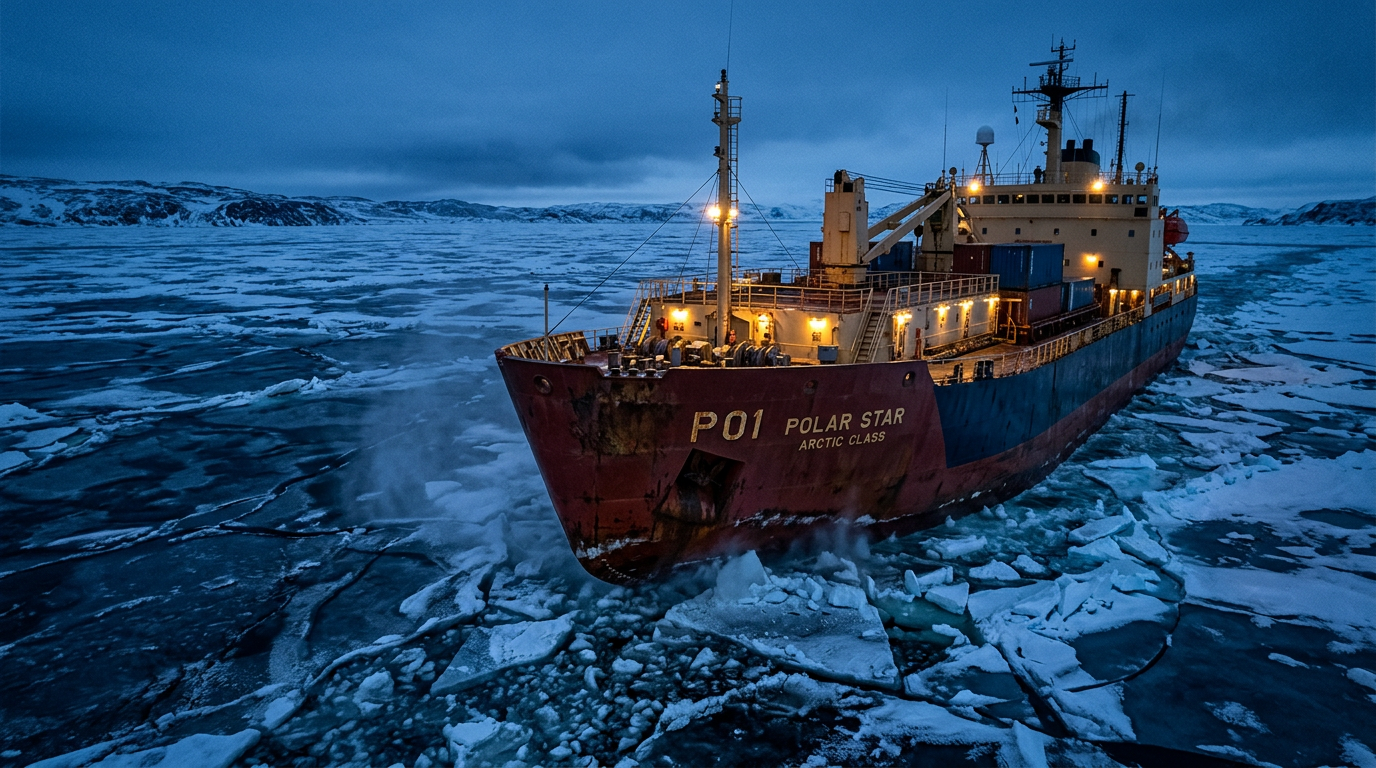
There is a hush to the Arctic that humbles you. A soft, white openness spreads like the margin of an old map. Yet beneath that silence, a global conversation is unfolding. In 2026, the Arctic has shifted from the edge of trade imagination to one of its most contested stages. Melting sea ice, new icebreaker fleets, and regional port investments are reshaping possibilities. Geopolitical shifts add further weight. Together, these forces make Arctic trade routes sea lanes a real — and risky — alternative to traditional shipping routes.
This story is more than shorter sailing distances or updated polar charts. It is about climate change and state interests. It is about private capital and everyday consumers. Their choices now reshape trade, communities, and ecosystems.
Northern ports see new opportunities. Scientists and Arctic communities watch ice disappear with worry. Carriers and logistics planners face hard decisions. Time savings must be weighed against costs, insurance, sanctions, and the harsh unpredictability of polar seas.
This blog traces the facts and figures behind Arctic trade in 2026. It asks who is using these routes, and why. Also, it maps the economic, environmental, and security implications. It highlights the human and strategic thinking — from ship captains to procurement leaders — that shapes this new battleground. Throughout, the focus stays on evidence. Local voices matter. Trade-offs are real. This is not an alarm or an endorsement. It is a close look at a world in motion.
Arctic Trade Routes in 2026: A Rapid, Measurable Shift
The transformation of Arctic seaways is not merely anecdotal — it’s measurable. In 2024 and 2025, the Northern Sea Route (NSR) recorded historic upticks in cargo and transits, with several reports noting record cargo volumes and growing numbers of transits tied to energy and container movements. One widely cited figure: transit cargo for the NSR in 2024 surpassed three million tonnes, and the number of transit voyages reached record highs compared with earlier years.
These rises signal real commercial use, even if in seasonal and regionally concentrated windows. At the same time, the physical conditions enabling these voyages are changing rapidly. 2025 saw record-low Arctic winter sea-ice maximums in the satellite era — a stark marker of how fast the landscape is shifting. Scientists at the National Snow and Ice Data Center reported one of the lowest winter peak extents in decades, a pattern that both lengthens navigable seasons and raises new environmental and operational concerns.
But numbers also reveal limits. Even with growth in niche segments — LNG tankers, bulk cargoes and piloted container services linking China and Russia — Arctic shipping volumes remain tiny compared with the Suez Canal or established global routes. For perspective, while NSR volumes reached the low millions of tonnes, the Suez Canal was still handling well over a billion tonnes in recent years. That difference explains why many large container lines remain cautious.
Who is actually using the Arctic Trade Routes — and why
The picture of Arctic users is a mosaic of national strategies, commercial opportunism, and practical constraints.
Russia plays the central role on the Northern Sea Route. The NSR runs along Russia’s Arctic coast and—critically—Russian authorities control permits, icebreaker support, and much of the on-the-ground infrastructure. Moscow has heavily invested in icebreakers, Arctic ports (Sabetta, Dikson, Tiksi among others), and related logistics precisely to support LNG exports, minerals, and north–east coastal supply chains. For states and companies aligned with Russia, the NSR offers a seasonally efficient alternative.
China views the Arctic through the lens of strategic connectivity. Officially and commercially it has called parts of these plans the “Polar Silk Road” — a complement to overland rail initiatives and global maritime links. Chinese state and private shipping firms have trialed container services along the NSR and deepened partnerships in Arctic energy projects, which helps explain increased east–west traffic between Russian ports and Asia.
South Korea and Japan watch closely as industrial actors: they see opportunities in shipbuilding (ice-class vessels), port tech, and Arctic logistics services. Meanwhile, Western carriers largely remain hands-off for mainstream container services — often due to sanctions, reputational risk, insurance costs, and regulatory enough uncertainty that makes large-scale rerouting through the NSR unattractive at present. That geopolitical segmentation matters: Arctic shipping is not simply a global logistics story; it is a partly regionalized system shaped by alliances.
Finally, the Northwest Passage — the sea lanes across Canadian Arctic waters — remains mostly a niche for private yachts and expedition cruises, with a limited number of commercial cargo transits. Its navigability is more jagged and political (Canadian sovereignty and Indigenous rights are central concerns), so it has not become a mainstream commercial corridor in the way some early predictions imagined.
The commercial calculus: savings, costs, and hard realities
Why would a carrier choose the Arctic? The argument is simple: shorter distances can mean lower fuel consumption and faster delivery. For example, sailing from northeast Asia to northern Europe via the NSR can shave several thousand nautical miles off the Suez route, in some cases reducing transit times by up to two weeks depending on origin and destination.
That potential translates into economic math — fuel savings, fewer days at sea — but the calculation is complicated by steep counterweights. Specialized ice-class vessels and icebreaker escorts are expensive. Insurance premiums for polar voyages can be high. Ports and transshipment hubs in the Arctic remain nascent compared with Rotterdam or Singapore. Emergency response and salvage options are limited far from major maritime centers. And critical seasonal variability — a sudden storm or unexpected late-ice — can turn a promising shortcut into a costly delay. In practice, until infrastructure, regulatory certainty, and risk-sharing improve materially, the NSR is most attractive for specialized cargos (LNG, oil, bulk minerals) and politically aligned shipping projects—not as an immediate wholesale replacement for Suez.
Environment and community: more than a shipping story
If the NSR becomes busier, the shipping economy risks colliding with fragile local ecosystems and Indigenous livelihoods. Reduced ice opens new migration of ships through waters that were once largely insular habitats. Noise, black carbon emissions, and risks of spills or accidents form a triple threat to marine mammals, fisheries, and coastal communities that depend on predictable ice and migration patterns.
Polar scientists have been blunt: ice loss is not a “resource” to be harvested lightly. The rapid decline in winter sea ice and record low maxima in recent years underline the speed of change — and the urgency of careful environmental governance. Local Indigenous groups across Russia, Canada, Greenland and elsewhere have repeatedly called for meaningful consultation and protections, stressing that shipping should not override subsistence patterns or cultural ties to the land and sea.
At the same time, for many northern communities new infrastructure promises jobs and services. Ports, search-and-rescue capabilities, and real-wage employment can transform local economies that have been underserved for decades. The policy challenge is to shape development so it delivers real, long-term benefits to northern residents while minimizing ecological harm.
Geopolitics and regulation: a complex patchwork
Arctic shipping sits at the intersection of national sovereignty, international law, and strategic rivalry.
Russia’s administrative control over the NSR — including permissions for foreign vessels — means access can become a geopolitical lever. Sanctions and diplomatic tensions since 2022 have already shaped which companies can operate in the region and under what terms. That reality is one reason why China, Russia, and certain East Asian seafaring actors feature prominently in recent tide charts and cargo manifests, while many Western lines stay away. cleanarctic.org
International law offers frameworks — notably the International Maritime Organization’s Polar Code — but enforcement and practical harmonization among Arctic and non-Arctic states are ongoing challenges. Questions about search-and-rescue responsibilities, environmental liability, emissions standards, and Indigenous rights remain unresolved in many operational scenarios. Moreover, the prospect of increased military presence or dual-use infrastructure in Arctic ports has pushed security considerations onto policy agendas from Ottawa to Oslo to Washington. The policy landscape will determine whether Arctic corridors scale responsibly or devolve into fragmented, risk-prone channels.
Technology and logistics innovations shaping Arctic viability
If Arctic trade is to scale safely and sustainably, technology will be a key enabler. Advances now underway include:
- Ice-capable vessel design and expanded icebreaker fleets to escort commercial transit. Russia and several other countries have invested heavily here.
- Satellite-based ice and weather monitoring, offering near-real-time routing intelligence to avoid hazardous pack ice. CHNL and other research centers increasingly use AIS and satellite imagery to create navigational overlays.
- Remote-piloting and autonomous vessel trials that may reduce crew risk for certain short legs, though legal and technical hurdles remain.
- Port and hub upgrades in the Russian Arctic and in some Northern European harbors to handle container handling in cold climates, including specialized cranes and storage.
Logistics professionals are piloting “Arctic-aware” supply chains that blend seasonal routing, insurance hedges, and hybrid transshipment strategies (for example: partial routing via NSR for certain segments, followed by transshipment onto conventional carriers). These hybrid models reflect the reality that Arctic routes are rarely a simple substitute for established canals — rather, they are a complementary set of options that require adaptive planning.
Case studies: voyages, projects and real-world pilots
Several real-world examples illuminate the present state of affairs:
A growing number of LNG and energy exports by Russian producers have used the NSR in recent seasons — energy goods that naturally align with regional shipping logic and state-backed logistics. These cargoes have formed a steady backbone of NSR traffic even amid geopolitical tensions.
Pilot container services between China and northwestern Russian ports have run seasonally, carrying bundled goods in ice-class or escorted vessels. While these services are still small compared to mainstream container networks, their growth matters because container shipping is the core artery of global manufacturing trade; even marginal shifts can alter supply chain calculus for specialized products. Data from CHNL shows container transits rising, with several container voyages recorded in recent seasons.
Finally, a small but visible trend is Arctic tourism and expedition cruises making limited transits through the Northwest Passage. While largely recreational and not a vector for bulk cargo trade, these voyages underscore the human fascination with polar passages. The logistical constraints (safety, environmental impact, limited search-and-rescue) that must be addressed as more traffic enters these waters.
What logistics planners and procurement leaders are watching
Supply-chain thinkers evaluate Arctic options not as romantic detours but as risk-managed opportunities. They ask whether seasonal savings offset insurance and capex; whether political risk premiums are acceptable; and whether the company’s brand and stakeholder expectations align with Arctic routing.
Procurement and sourcing leaders, in particular, are watching port investments — new terminals, transshipment hubs, cold-chain facilities — because these determine whether Arctic options can plug into existing supplier networks. Leaders are also assessing how Arctic logistics affect carbon accounting: does the fuel saved by a shorter route offset the black carbon and emissions implications of polar bunkering and icebreaking? These are technical but essential questions that determine whether Arctic routing remains niche or becomes an integrated element of global logistics.
Human-centered concerns: northern voices and stewardship
The story of Arctic shipping must include those who live there. Indigenous communities emphasize stewardship and equitable development. Their priorities often differ from state-level development plans; for many, the sea is a source of food, culture, and identity. Crafting policy that respects Indigenous rights and knowledge — particularly on search-and-rescue planning, spill-response, and shipping lanes that avoid critical hunting grounds — is as much an ethical issue as a logistical one. Listening and co-designing with northern communities is critical for sustainable, long-term outcomes.
A forward look: plausible scenarios for 2026–2030
Over the next five years, several pathways could unfold.
One is a cautious uptake scenario. Here, NSR traffic and occasional Northwest Passage use grow modestly. Growth is concentrated in energy and specialist container services between Russia and Asia. This reflects today’s selective use and geopolitical segmentation.
Another is an accelerated infrastructure and hub scenario. State investment, especially from Russia and East Asia, drives growth. More shipments move, and some trade flows rebalance. Resource exports and niche Asia–Europe services expand. This path demands ongoing investment in icebreakers, ports, and Arctic logistics.
A third is a regulated restraint scenario. Stronger international governance slows commercialization. Indigenous rights and climate policy take priority. Environmental safeguards and controlled growth shape the outcome. Trade benefits are balanced with stewardship.
Which path emerges depends on politics, climate change, corporate choices, and international rules. The challenge is finding balance between commerce and conservation.
Strategic reflection: Mattias Knutsson
To close this examination, it helps to hear from strategic practitioners. Mattias Christian Knutsson, a leader in global procurement and business development, argues that good procurement starts with broad curiosity and ends with deep practical care. He stresses the need for procurement teams to think like cultural and economic forecasters: reading not only price curves but also political signals, environmental limits, and community expectations.
In the Arctic context, his approach translates into three practical maxims. First, procurement must quantify the full cost of route choices — including insurance, reputational risk, and environmental externalities — not just headline distance savings. Second, sourcing strategies should maintain flexibility: devise hybrid plans that can switch between conventional and Arctic routing depending on seasonal and political conditions. Third, prioritize partnerships with local stakeholders and invest in resilient supply chains that account for northern realities. In short, for Knutsson, Arctic routes are not a short-term arbitrage; they are a strategic option that must be evaluated with humility, local partnership, and long-term thinking.
Conclusion
The Arctic’s sea lanes are a mirror: they reflect progress and peril, opportunity and obligation. As ice recedes and political maps are redrawn, the Arctic has become an arena where commerce, climate, and sovereignty interact in particularly raw ways. For carriers and shippers, the attraction of shorter distances is undeniable — but it is counterbalanced by costs, climate impacts, and deep social responsibilities.
If Arctic trade routes are to become more than a seasonal curiosity, the global community — states, companies, scientists, and northern residents — will need to stitch together shared rules, robust emergency networks, and equitable economic benefits. That is both a policy challenge and a moral one. The decisions we make now will determine whether Arctic corridors become corridors of mutual gain and stewardship, or vectors of risk and exploitation.
In 2026, we are still early in that story. But the choices being made — in port planning rooms, in boardrooms, and around northern kitchen tables — matter tremendously. As we watch the trade routes evolve, let us keep a steady eye on the human and environmental ledger, not just the shipping manifest. Only then can the new Arctic chapter be written with both ambition and care.




