

Most transport schedules are set by demand. Mars missions are set by geometry. Earth and Mars line up for an efficient trip only once in a while, and that single constraint shapes budgets, staffing and contracts across the space sector.
Where the 26 months come from
Earth completes an orbit in about 365.26 days; Mars takes about 686.98 days (NASA Mars Fact Sheet). Because Earth moves faster on the inside track, it “laps” Mars once per synodic period. NASA gives that period as 779.94 days (NASA), roughly 25.6 months. SpaceX describes the same rhythm as transfer windows that open “every approximately 26 months” (SpaceX).
The minimum-energy trip, worked through
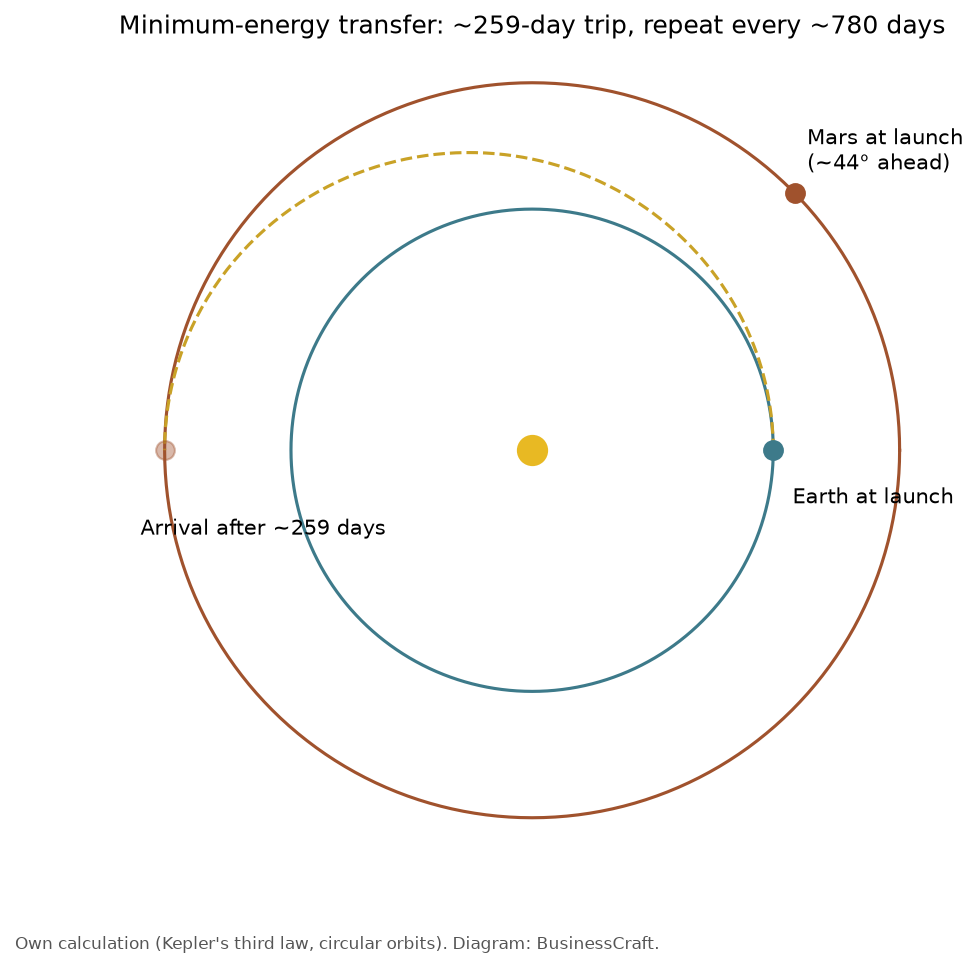
The cheapest path in propellant terms is a transfer orbit that touches Earth’s orbit at departure and Mars’s orbit at arrival. Using NASA’s figures and a simplified model with circular orbits, we get:
- Transfer time: about 259 days, half the period of the transfer ellipse.
- Planet alignment at launch: Mars must be about 44° ahead of Earth, so that it arrives at the meeting point at the same time as the spacecraft.
- Repeat interval: the same alignment returns after about 780 days.
Real missions deviate from this textbook case. Mars’s orbit is noticeably elliptical: its distance from the Sun ranges from about 206.7 to 249.3 million km (NASA Mars Fact Sheet). That is why some windows are more favourable than others, and why mission planners trade transit time against fuel.
Working around the window
NASA’s ESCAPADE mission shows that the window is a hard constraint, but not an absolute one. The twin spacecraft launched on 13 November 2025, when the planets were not aligned for a direct trip. They waited in a loop around the Earth–Sun Lagrange point L2 and used an Earth gravity assist when the planets lined up in November 2026, with arrival at Mars planned for September 2027 (NASA). The waiting time is the price of launching off-cycle.
What the clock means for business
- Missing a window costs about two years. A slip of weeks in launch readiness can become a slip of roughly 26 months in arrival. Contracts and funding should reflect that step function.
- Production is batch-driven. Hardware for a given window must be ready at the same time, which creates peaks in demand for testing facilities, launch services and specialised staff.
- Communications follow a cycle too. Missions plan around periods when the Sun lies between Earth and Mars; ESCAPADE, for example, must finish key manoeuvres before a solar conjunction in late 2027 (NASA).
- The next big opportunity is late 2028. SpaceX lists Starship cargo flights to Mars as starting “no earlier than 2028” (SpaceX), consistent with the next window after 2026.
For anyone building a business case around Mars, the orbital calendar is the first line of the plan, not a footnote.
Key figures
| Figure | Value | Source |
|---|---|---|
| Earth orbital period | ≈ 365.26 days | NASA Mars Fact Sheet |
| Mars orbital period | ≈ 686.98 days | NASA Mars Fact Sheet |
| Synodic period | 779.94 days (≈ 25.6 months) | NASA Mars Fact Sheet |
| Mars distance from the Sun | ≈ 206.7–249.3 million km | NASA Mars Fact Sheet |
| ESCAPADE launch / planned arrival | 13 Nov 2025 / Sep 2027 | NASA |
Figures as published by the linked sources; table compiled by BusinessCraft.
Related reading
- SpaceX’s Mars Timeline After 2026: What the Revised Plan Means for the Space Economy
- Logistics at 26-Month Intervals: The Economics of Supplying a Base on Mars
- Who Funds Mars? Budgets, Fixed-Price Contracts and Private Capital in 2026