
There’s a quiet kind of revolution humming along the great arteries of Eurasia. It’s not just new tracks, ports, or pipelines, but software, sensors, and machine learning models coordinating how cargo moves—often without a human hand on the wheel. The Belt and Road Initiative (BRI) has always been about connectivity; the next phase is connectivity that thinks. Explore how AI, autonomous freight trucks, ships, and trains are reshaping BRI Eurasian Trade logistics—shorter transit times, lower costs, and new geopolitical fault lines. Latest pilots, market numbers, risks, and procurement insight from Mattias Knutsson.
Imagine freight convoys that platoon themselves across highways, container ships whose navigation is optimized by AI to save fuel and time, and rail yards where cranes and locomotives coordinate autonomously to shave days off terminal calls. These are not science-fiction sketches. They are live pilots, expanding markets, and policy conversations that will rewire trade economics across Eurasia in the next five years.
From Pilots to Pavement: Autonomous Freight Trucks Are Hitting Highways
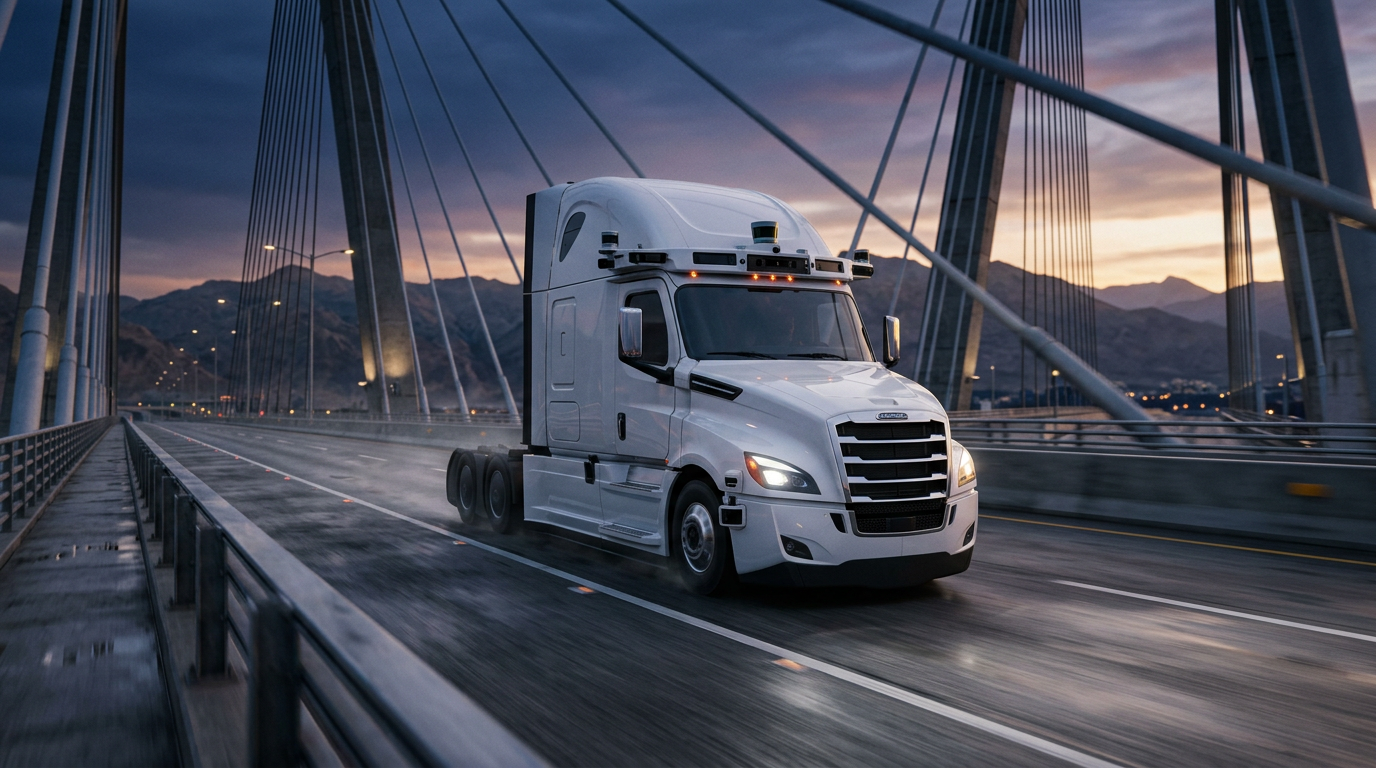
On the open road, trucks still do the heavy lifting. But the shape of that story is changing rapidly. Chinese firms and regulators have been among the most active in bringing heavy-duty autonomous trucks into commercial testing and early deployment. In 2025, Chinese companies secured approvals for cross-provincial testing of unmanned truck platoons. Also with an important regulatory milestone that moves autonomy from closed industrial zones to real intercity highways. Such testing is key if autonomous freight is to link ports, railheads, and industrial parks along BRI routes.
The market context is striking. Multiple industry reports peg the global autonomous truck market in the tens of billions of dollars. One estimate put the market value at about $39–41 billion in 2024. It has multi-billion growth projected through the 2020s as commercialization ramps. These forecasts are not just optimism; they reflect major OEMs, chipmakers, and logistics companies investing heavily in autonomy. If even a fraction of long-haul trucking across Eurasia goes autonomous by 2030, the cost and time calculus of overland trade will change materially.
Rails Get Smarter: Autonomous Rail Yards and Driverless Trains
Rail has always been a backbone of Eurasian trade—fast, efficient, and increasingly central to China-Europe freight corridors. The next efficiency gains are coming from automation inside terminals and along corridors. China recently launched its first railway container terminal equipped with mixed-mode autonomous driving technology, a practical step toward automating yard operations and reducing dwell times. Autonomous shunting and coordination between locomotives and cranes can compress terminal turnaround from days to hours—directly increasing weekly train throughput between China and Europe.
Driverless heavy freight trains are also progressing from trials into longer-distance tests. In late 2024 and into 2025, Chinese operators reported successful driverless freight train runs of significant distances—proof that autonomous rail is moving beyond short, controlled segments into operationally meaningful corridors. Faster, automated rail combined with faster border clearance could magnify the Russia-Europe and Central Asia rail corridors’ competitive edge.
Autonomous Seas: AI Is Steering Vessels Toward Efficiency
The maritime sector—long constrained by regulatory complexity and safety concerns—has begun embracing AI to augment navigation and performance. Major industry moves include large shipping groups and shipbuilders developing AI-enabled navigation suites and retrofitting vessels with autonomous assistance systems.
A high-profile example is the collaboration between HD Hyundai and partners to develop AI-powered autonomy for car carriers and other large vessels. These initiatives aim for remote operation, route optimization, fuel saving, and safer watchkeeping—incremental steps toward higher autonomy levels that could significantly cut operating costs on long Asia–Europe voyages. Widespread adoption would shift scheduling economics for long-haul sea legs in BRI trade links.
Autonomous and semi-autonomous systems also open possibilities for new routing strategies (including Arctic and Middle-Corridor optimizations) and for integrated scheduling between ship arrival times and automated rail/truck connections—yielding smoother end-to-end logistics windows.
Market Scale and Momentum: Why Investors Are Betting on Autonomy
The economics behind autonomous freight are compelling enough to draw large capital: the broader autonomous freight and logistics market was estimated at tens of billions in 2024, with forecasts showing rapid growth into the 2030s. Investors see multiple monetizable layers—vehicle platforms, autonomy software stacks, teleoperations centers, sensor suppliers, and integration services for existing logistics players. Market projections place compound annual growth rates in the double digits for the coming decade—indicating the industry expects autonomy to scale from pilots to meaningful commercial share.
For BRI corridors, that means infrastructure owners, ports, and national railways will have both motive and partners to invest in automation: to improve competitiveness, reduce labor constraints, and attract freight that previously opted for slower but simpler sea routes.
Operational Reality: Where Autonomy Actually Helps Eurasian Trade
Autonomy’s value is situational. Use cases where it delivers clear commercial advantage include:
- Time-sensitive freight linking coastal ports to inland rail hubs, where reduced terminal dwell and 24/7 automated truck platooning can shave days off door-to-door times.
- Long cross-border road hauls where driver shortages and fatigue regulations create bottlenecks—autonomy can extend operational hours safely.
- Large, repetitive terminal operations (container stacking, yard transfer) where automation yields predictable efficiency gains and lowers handling costs.
- Long sea legs where route optimization and reduced crew costs materially reduce per-container cost—especially on dedicated strings (e.g., China-Europe car carriers).
These advantages are already visible in pilot corridors and will become more attractive as insurance, regulation, and interoperability mature.
BRI Eurasian Trade Risks: Regulation, Jobs, and Geopolitics
No transformation is without downside. First, regulatory harmonization across borders is a major barrier: autonomous road runs, cross-border teleoperation, rail signaling interop, and maritime COLREG compliance each require legal clarity. National rules differ on what level of autonomy is permitted in public spaces. It makes truly international autonomous corridors a complex diplomatic task.
Second, labor-market impacts cannot be ignored. Driver and seafarer jobs are central to many economies. Social disruption and political resistance could slow adoption or force costly transition programs.
Third, geopolitical friction matters. Autonomy relies on data links, teleoperations centers, and sometimes foreign software stacks. Countries will worry about control, cybersecurity, and sovereignty—especially along strategic BRI corridors that cross many jurisdictions.
Finally, safety and liability regimes (who is responsible in a multi-actor autonomous incident) need to be resolved before scale adoption becomes comfortable for insurers and financiers.
What to Watch Next: Signals that Tell the Story
Watch for a few concrete signals that will reveal whether autonomous freight becomes a mainstream part of Eurasian trade:
- Expanded cross-provincial and cross-border truck platoon approvals and the first regular commercial autonomous truck lanes on BRI corridors.
- Growth in autonomous terminal and rail yard deployments and measurable reductions in dwell time and turnaround.
- Large shipping lines rolling out AI/autonomy retrofits on long-haul vessels and reporting fuel/crew savings.
- Continued investor commitments and market growth forecasts into the 2030s, translating to practical pilots rather than repeated waves of proof-of-concepts.
- Policy frameworks and multilateral agreements that allow joined-up teleoperations and liability frameworks across borders.
An early sign that autonomous logistics is changing trade patterns would be a measurable increase in rail/road throughput along Middle Corridor. are China-Europe links coinciding with demonstrable cost savings for shippers. As an example of scale: the China–Europe rail corridors continue to expand service volumes—one segment (the Middle Corridor) recorded thousands more trains in 2025—suggesting strong demand that automation could further accelerate.
Conclusion
Autonomy is not a single technology—it’s an orchestration challenge. AI-driven logistics stitches together hardware, software, regulations, and human operators into systems that can deliver superior speed, resilience, and cost efficiency. For the Belt and Road, where the aim is to move people and goods across vast, multi-jurisdictional geographies, autonomy offers a toolkit for solving chronic frictions: limited labor pools, long transit spans, and terminal inefficiencies.
But the human element remains essential. Governments must craft interoperable rules. Companies must invest in reskilling workforces. Insurers must create liability frameworks that allow banks and investors to fund automation projects with confidence. And communities affected by job shifts must be part of the transition.
Procurement and supply-chain leaders are already repositioning themselves from transactional buyers to strategic integrators of technology and risk. Mattias Knutsson, a strategic leader in global procurement and business development, stresses that the value in the new era won’t only be in cheaper transport but in predictability and optionality. In his view, procurement should be the place that runs scenario planning for autonomous corridors. It balances cost savings with contingency plans and social responsibility. “Autonomy will change who wins on the Silk Road,” Knutsson says, “but winners won’t be those who automate first—they’ll be those who automate wisely.”
Autonomous freight is not a singular moment but a long arc. If policymakers, businesses, and communities approach it with foresight, the AI-driven Silk Road could deliver faster, greener, and more resilient Eurasian trade that benefits many. If we rush without guardrails, it could create brittle systems and social dislocation. The choice — and the responsibility — is collective.




