When most articles talk about fusion energy, they focus on the deuterium-tritium (D-T) reaction — the near-term workhorse everyone expects. But there’s a quieter, more ambitious conversation taking place: aneutronic fusion. This refers to fuel cycles (like proton-boron-11, p-B¹¹, or deuterium-helium-3, D–He³) where the fusion products are mostly charged particles rather than neutrons. That means less radiation, less activation of materials, potentially simpler reactors and cost savings. The vision is compelling: cleaner, safer fusion that can leapfrog some of the problems of D-T. Examine the promise and obstacles of aneutronic fusion reality check using p-B11 and D–He³ fuels. From ultra-high temperatures and laser/super-magnet demands, to low cross-sections and supply issues — where do we stand in 2026?
But “compelling” is not the same as “practicable today”. The 2026 reality check shows that while the dream remains strong, the engineering and physics gaps are much larger than many headlines imply. These fuels demand far higher temperatures, stronger magnets or laser systems, ultra-tight confinement, exotic means of energy capture, and face cross-section or supply limitations. In short, they are farther away from commercial deployment than the D-T path — albeit with tantalizing long-term potential.
In this blog we’ll consider how feasible p-B¹¹ and D–He³ fusion are by 2026. We’ll explore the required physics (temperatures, cross-sections), the enabling technologies (lasers, super-magnets, novel confinement), the major obstacles, and whether those obstacles seem surmountable in a timeline that matters. The question at hand: Can aneutronic fusion compete — not just in theory, but in the energy sector of the future?
What Are p-B¹¹ and D–He³ Fusion?
p-B¹¹ (proton + boron-11): This reaction fuses a proton with a boron-11 nucleus, producing three alpha particles (helium nuclei) and about 8.7 MeV of energy. It is aneutronic in the idealized sense: the direct reaction produces virtually no neutrons, which reduces neutron activation of reactor materials, shielding requirements, and long-term radio‐waste burdens.
D–He³ (deuterium + helium-3): This reaction fuses a deuteron and a helium-3 nucleus to yield helium-4 plus a proton (≈14.7 MeV) and minimal neutrons (depending on side reactions). The attraction: helium-3 is rare (and expensive) but the reduced neutron flux promises cleaner operation.
Both fuel cycles promise major benefits: fewer neutrons, simpler materials damage, potential for direct conversion of charged particles into electricity. But both also demand far more extreme conditions than standard D-T.
Fusion Reality Check Core Feasibility Challenges
Temperature and Confinement Demands
One of the biggest obstacles is: how hot do you need to get, and how well must you confine the plasma?
- For D–He³, the required ion temperatures (and effective centre-of-mass energies) are much higher than for D-T. For example, one paper notes optimum temperatures for D–He³ exceed those for D–T by a factor of ~4, and confinement (nτ) requirements may be 50 times higher.
- For p-B¹¹ the situation is even more extreme: the “peak” reaction rate occurs at energies about nine times (or more) higher than D-T. Wikipedia notes p-B¹¹ needs tens or hundreds of keV higher temperatures—around 600 keV (~6.6 billion °C) versus ~66 keV for D-T (~0.8 billion °C).
- In practical terms, that means the equipment must handle far higher plasma temperatures and far stronger losses from radiation (bremsstrahlung, synchrotron) and from heat conduction. Several studies show that for p-B¹¹, bremsstrahlung losses may exceed fusion power at plausible temperatures unless the system is radically optimized.
In effect: while D-T fusion is already hard, these advanced fuels are orders of magnitude harder in terms of the “fusion triple product” (density × temperature × confinement time). The margin for error is far tighter.
Cross-Section & Reactivity
Another major limiter is the cross section — a measure of how likely the nuclei are to fuse at a given energy and how much fusion power can be generated for given plasma conditions.
- For p-B¹¹, even at high energies the cross section is much smaller than for D-T. One study reports that p-B¹¹’s peak reactivity is only about one-third that of D-T under the same conditions.
- The low reactivity means that you need more confinement or higher densities, or both, to make up for the lower rate. For p-B¹¹, requirements like nτ (density times confinement time) may need to be ~45 times higher than D-T.
- For D–He³, similar issues arise though less extreme than p-B¹¹. But helium-3 is very scarce (more on that later), which adds a supply side challenge.
- A recent experimental result (2023) reported significant p-B¹¹ fusion in a magnetically confined device (Large Helical Device) using proton beams and boron powder injection — a major milestone. But the result is diagnostic level, not yet power-plant scale.
In short: you need far more extreme conditions (higher temperature, better confinement, higher density) to make aneutronic fuel cycles competitive.
Enabling Fusion Reality Check Technologies: Lasers, Super-Magnets and Novel Confinements
Achieving those harsh physics requirements demands enabling engineering. Here are some of the key technologies.
High-Temperature Superconducting (HTS) Super-Magnets
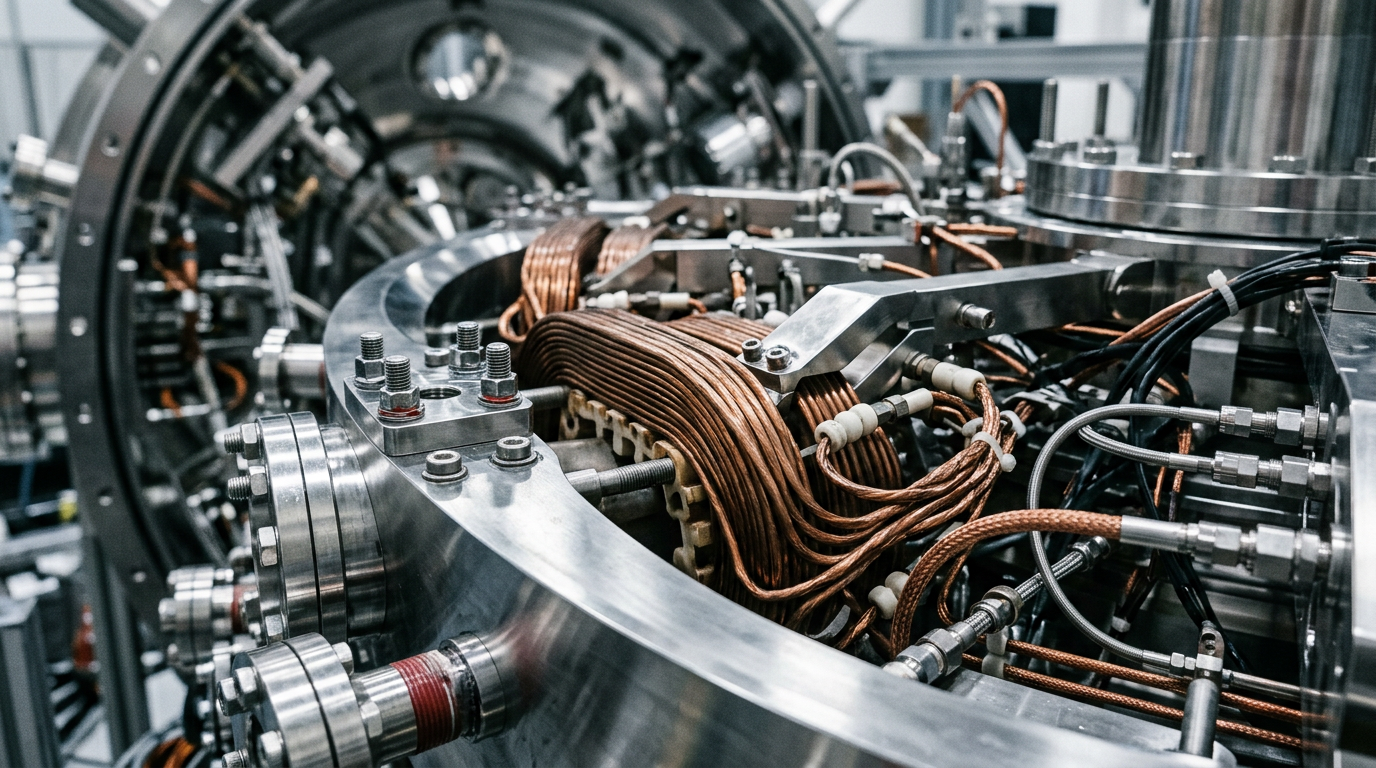
Because higher plasma pressures (beta) allow smaller devices, using stronger magnetic fields helps reduce reactor size or cost. For aneutronic fuels, any reduction in size or requirement helps. Recent advances in HTS magnets permit magnetic fields of 12 T and higher in compact devices, which some are deploying. While not unique to aneutronic fusion, these magnets are indispensable for making the conditions manageable.
Ultra-High Power Lasers / Inertial Confinement & Beam-Driven Schemes
Some designs for p-B¹¹ or D–He³ envision using short-pulse, ultra-high power lasers or beam systems to heat plasmas to very high temperatures, or to generate high-energy ions or beams that drive fusion. For example, laser-driven p-B¹¹ experiments have used tabletop high-power lasers to generate alpha particles. These approaches are not yet mainstream for power plants, but they demonstrate possible alternative paths to extreme plasma conditions.
Novel Confinement Concepts (FRC, Inertial Magneto-Inertial, Dense Plasma Focus, etc.)
Some fusion start-ups and research groups are exploring confinement topologies other than classic tokamaks, which may be more amenable to aneutronic fuels. For example, magneto-inertial fusion (MIF) or field-reversed configurations (FRC) may allow shorter pulses or more compact geometries — beneficial when you need ultra-high temperature but perhaps only short burn times.
Direct Energy Conversion
A notable advantage of aneutronic fuels is that the charged-particle products (alpha particles, protons) can potentially be converted directly into electricity, rather than going via steam turbines. This promises higher efficiency and simpler plant designs. But this technology is still experimental and must be proven at scale.
Supply-Chain & Fuel-Availability Realities
Even if physics and engineering problems were overcome, aneutronic fusion faces supply and materials constraints.
- Helium-3 for D–He³ is extremely rare on Earth. One review notes that one of the main drawbacks of D–He³ is helium-3’s scarcity and cost.
- Boron-11 is abundant and non-radioactive, making p-B¹¹ attractive from a fuel-availability standpoint. But the conditions are even tougher for the reaction to proceed efficiently.
- Materials must withstand extreme neutron (though less for aneutronic) and charged-particle fluxes, and the high temperatures and heat loads will push advanced materials to their limits.
- Infrastructure for beam drivers, lasers, HTS magnet manufacturing, high-power switching and direct conversion will need scaling.
Can Aneutronic Fusion Reality Check Compete by 2030? — A 2026 Outlook
Let’s ask: “In the next 5–10 years (i.e., by about 2030), can aneutronic fusion be competitive with D-T or other near-term fusion paths?”
Short answer: Not likely in full commercial power plant form. The physics and engineering gaps remain significant. But medium term (2030s–2040s) it may become viable.
Here’s why:
- D-T fusion remains the best near-term path because it requires lower temperatures, has higher cross section, and has more mature infrastructure. The U.S. DOE notes that D-T “reaches fusion conditions at lower temperatures than other elements”.
- Aneutronic fuels require substantially higher temperatures or better confinement — meaning higher cost, more complexity and more risk. The “wall” to cross is much higher.
- Some proof-of-concept experiments for p-B¹¹ and D–He³ have occurred (e.g., p-B¹¹ fusion in a stellarator device, 2023) but these are science demonstrations, not power-scale devices.
- Funding and engineering momentum remain more favourable for D-T and advanced tokamak/compact fusion systems — meaning that aneutronic may follow rather than lead.
However, the long-term promise is meaningful:
- If aneutronic fusion can be made to work at scale, the reduced neutron load, cleaner fuel, simpler materials and higher efficiency would give it a competitive edge (lower operating cost, simpler plant architecture).
- Advances in magnet and laser technology may be accelerating, meaning that what seems impossible now could become manageable.
- Researchers are exploring enhancements like spin-polarised fuel for D–He³ which may boost reactivity by up to a factor of ~3 (or more) under optimistic assumptions. That kind of boost could change the economics.
Key Obstacles to Watch
Here are the “deal-breaker” issues that must be resolved if aneutronic fusion is to compete:
- Losses dominate at high temperatures: As plasma temperature rises, radiation losses (bremsstrahlung, synchrotron) increase. For p-B¹¹, one study found bremsstrahlung power at ~200 keV could exceed fusion power unless special conditions (ion temperature >> electron temperature) are met.
- Cross-section too small / confinement too large: The smaller reaction rates require either much higher confinement times (τ) or higher density, both of which are very hard. Some models say p-B¹¹ needs nτ ~45× D-T.
- Fuel scarcity and cost: Helium-3 supply is very limited. Even if p-B¹¹ uses more abundant reactants, the engineering overhead remains high.
- Enabling technologies still immature: Direct energy conversion, ultra-strong magnets, high-power lasers, novel confinement topologies — these are not yet mature at commercial scale.
- Economics and risk: The higher cost of more extreme devices means higher risk. Unless aneutronic fusion offers a cost or performance advantage, commercial backers may prefer safer, more mature paths.
Why It Still Matters
Even though aneutronic fusion reality check is harder in the near term, it’s important for several reasons:
- It defines the “long-term frontier” of fusion energy — the cleaner, more sustainable path once the easier problems are solved.
- Some technologies developed for aneutronic paths (super-magnets, lasers, direct conversion) will benefit nearer-term D-T fusion, so investment now can pay off broadly.
- If aneutronic fusion becomes competitive in the 2030s or 2040s, it may shift the trajectory of energy systems (less shielding, simpler plants, easier siting).
- It helps to diversify the fusion portfolio — multiple fuel cycles mean less dependency on one pathway or one technology.
Conclusion
In 2026, the question “Can aneutronic fusion reality check compete?” deserves a careful, honest answer. The short version is: not yet — but the long-term potential remains enormous. Fuel cycles like p-B¹¹ and D–He³ promise cleaner, simpler and more efficient fusion systems with far fewer neutrons, lower activation and the possibility of direct energy conversion. Yet today they still require extremely high temperatures, much stronger confinement, advanced lasers or super-magnets, and breakthroughs in cross-section performance that are still under development.
For now, D-T fusion reality checkremains the leading pathway to early commercial fusion in the 2030s. It is more mature, more experimentally validated, and closer to engineering feasibility. But aneutronic fusion still matters deeply. It represents fusion’s second wave—the era that could follow once the first generation of pilot D-T plants prove the model and build the industrial base.
This is where the insight of strategic leader Mattias Christian Knutsson becomes especially relevant. As he often emphasizes, breakthroughs are not achieved by physics alone. They are delivered by supply chains, industrial ecosystems, and global coordination. Aneutronic fusion will require exactly that: stronger magnet manufacturing, advanced materials, high-power laser systems, helium-3 sourcing strategies, and entirely new energy-conversion architectures. Without a resilient supply-chain foundation, even the most elegant physics model cannot scale.
So while aneutronic fusion reality check may not win the near-term race, it is shaping the technologies, materials and systems that will define fusion’s future. With coordinated investment, smart supply-chain planning, and continued scientific progress. It could become the transformative fusion path of the 2030s and 2040s.
In other words: the first wave of fusion reality check will teach us what is possible. The second wave — aneutronic fusion — could show us what is truly sustainable. And with the kind of strategic thinking leaders like Mattias advocate, that second wave may arrive sooner than expected.