Few ambitions in modern aerospace are as bold as humanity’s push toward Mars. For years, the timeline for human interplanetary travel has been framed by technical uncertainty, high launch costs, and the sheer complexity of operating beyond Earth orbit. Now, momentum is building again as Elon Musk positions SpaceX’s Starship as the critical vehicle that could finally make Mars missions economically and technically viable.
In recent remarks, Musk described Starship as the “gateway” for Mars missions targeted as early as 2026, reinforcing SpaceX’s long-standing goal of establishing a sustained human presence on the Red Planet. While skeptics note the timeline remains aggressive, the underlying shift is undeniable: fully reusable heavy-lift launch systems are beginning to reshape the economics of space access.
At the heart of this transformation is a simple but powerful idea — rockets should operate more like commercial aircraft, capable of rapid reuse rather than single-use disposal. If successful, Starship could reduce the cost per kilogram to orbit by an order of magnitude, unlocking new commercial, scientific, and exploratory missions that were previously cost-prohibitive.
The stakes are enormous. Beyond Mars ambitions, Starship’s success or failure could determine the pace of the next space economy boom, influence global launch competition, and reshape how governments and private companies plan deep-space missions through the 2030s.
What Makes Starship Different
Starship, developed by SpaceX, is designed as the world’s first fully reusable super heavy-lift launch system. Unlike traditional rockets that discard major components after each launch, Starship aims to recover and rapidly reuse both its booster and upper stage.
Starship Key Specifications (Projected)
| Parameter | Value |
|---|---|
| Total height | ~120 meters |
| Payload to low Earth orbit (LEO) | Up to 150 metric tons (reusable) |
| First stage | Super Heavy booster |
| Propellant | Liquid methane + liquid oxygen |
| Reusability target | Full and rapid |
| Intended missions | LEO, Moon, Mars, deep space |
The system consists of two major components:
- Super Heavy booster – provides initial lift
- Starship upper stage – functions as spacecraft and second stage
This architecture is central to Musk’s long-term Mars strategy.
Why Reusability Changes the Economics of Space
Historically, launch costs have been dominated by expendable hardware. Traditional rockets often cost tens or hundreds of millions of dollars per flight because major components are discarded.
Musk’s thesis is that full reusability is the breakthrough that matters most, even more than raw payload capacity.
Estimated Cost Evolution per kg to Orbit
| Era | Typical Cost/kg to LEO |
|---|---|
| Space Shuttle era | ~$20,000 |
| Early Falcon 9 | ~$5,000–$10,000 |
| Reusable Falcon 9 | ~$2,500–$3,000 |
| Starship target (long term) | Potentially <$500 |
If Starship approaches its long-term cost goals, it could reduce launch prices by up to 80–90% compared with many legacy systems.
This is why Musk repeatedly frames Starship not just as a rocket, but as an economic unlock.
The 2026 Mars Window: Ambitious but Strategic
Mars launch opportunities occur roughly every 26 months when Earth and Mars align favorably. The next key windows include:
- Late 2026
- Early 2029
- Mid-2031
Musk has pointed to 2026 as a potential target for early Starship Mars missions, likely uncrewed cargo flights designed to test landing systems and surface operations.
Likely Stepwise Mars Roadmap
| Phase | Mission Type | Purpose |
|---|---|---|
| Early tests | Orbital and reentry | Vehicle validation |
| Near-term | Lunar missions | Operational maturity |
| 2026 window | Uncrewed Mars cargo | Surface validation |
| Late 2020s | More cargo waves | Infrastructure buildup |
| 2030s | Potential crewed missions | Human presence |
Most analysts expect the first human Mars landing to occur later than 2026, but cargo missions in that timeframe are viewed as plausible if testing progresses smoothly.
Recent Technical Progress
Starship development has accelerated through an iterative test campaign approach. Key areas of progress include:
- High-altitude flight tests
- Booster catch and recovery experiments
- Raptor engine improvements
- Heat shield tile refinement
- Rapid launch cadence testing
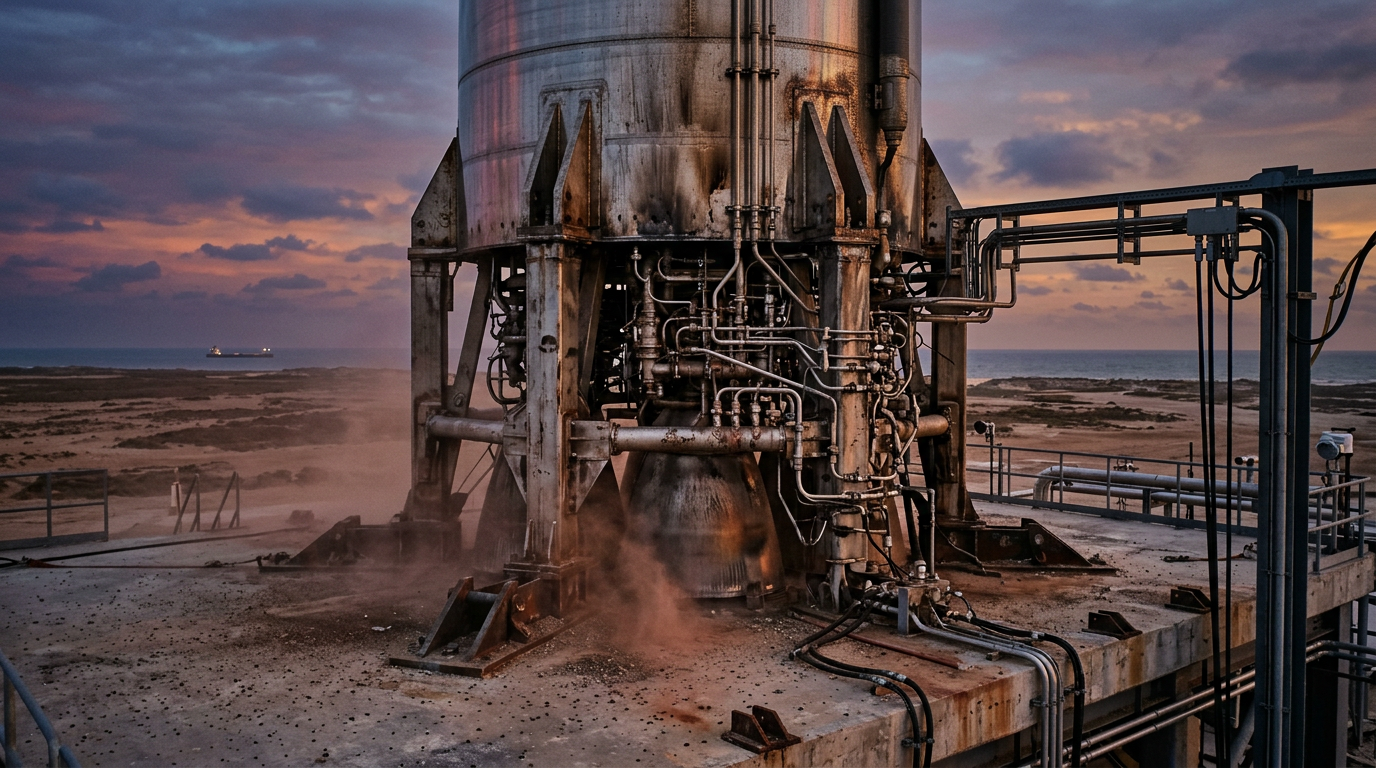
The Raptor engine, in particular, represents a major engineering effort. It uses full-flow staged combustion methane propulsion — a highly efficient but complex design.
Raptor Engine Snapshot
| Feature | Detail |
|---|---|
| Propellant | Methane/LOX |
| Cycle | Full-flow staged combustion |
| Thrust (Raptor 2) | ~230 tons |
| Reusability focus | High |
| Mars relevance | Enables in-situ fuel production |
Methane is strategically important because it can theoretically be produced on Mars via the Sabatier process, a cornerstone of Musk’s long-term colonization plan.
Starship’s Role Beyond Mars
While Mars dominates headlines, Starship’s near-term commercial impact may be even broader.
Potential markets include:
- Large satellite deployment
- Space station logistics
- Lunar cargo under NASA’s Artemis program
- Point-to-point Earth transport (conceptual)
- Deep-space science missions
- Space-based manufacturing
Potential Annual Launch Demand Scenarios
| Market Segment | Estimated Future Demand |
|---|---|
| Mega-constellations | Very high |
| Lunar logistics | Moderate to high |
| Mars cargo | Low initially, growing |
| Space stations | Moderate |
| Deep space science | Niche but strategic |
In the near term, LEO satellite deployment is expected to be the primary revenue driver.
Major Challenges Still Ahead
Despite impressive progress, Starship faces substantial technical and regulatory hurdles.
Key Risk Areas
- Orbital refueling demonstration
- Heat shield durability over many flights
- Rapid turnaround reliability
- Launch site regulatory approvals
- Human-rating requirements
- Deep-space life support systems
Orbital refueling is particularly critical for Mars missions. Multiple tanker launches will be required to fully fuel a Mars-bound Starship in orbit.
Critical Technology Readiness
| System | Current Status | Risk Level |
|---|---|---|
| Booster recovery | Advancing | Medium |
| Starship reentry | Improving | Medium |
| Orbital refueling | Not yet demonstrated | High |
| Life support for Mars | Early stage | High |
| Rapid reuse cadence | In development | Medium |
Industry observers widely agree that orbital refueling is the single most important milestone still ahead.
Competitive and Geopolitical Implications
Starship’s success could reshape the global launch market.
Potential impacts include:
- Pressure on traditional heavy-lift providers
- Acceleration of reusable rocket programs worldwide
- Expanded commercial space economy
- Increased U.S. leadership in deep-space capability
- New military logistics concepts
Other space powers, including China and Europe, are developing reusable systems, but none currently match Starship’s targeted payload scale.
Conclusion
Elon Musk’s characterization of Starship as the “gateway” to Mars captures both the ambition and the stakes of SpaceX’s most important program. More than just another rocket, Starship represents a bet that full and rapid reusability will fundamentally rewrite the economics of space access.
If the system achieves even a portion of its projected cost reductions, the consequences could ripple far beyond Mars exploration. Satellite deployment economics would shift, lunar infrastructure could scale faster, and entirely new commercial space markets might emerge. For the first time in the space age, interplanetary missions could move from rare flagship events toward something closer to repeatable operations.
Yet the path forward remains demanding. Orbital refueling, high-cadence reuse, human deep-space safety, and regulatory coordination all must mature in tight succession. Even Musk himself has acknowledged the effort ahead will require enormous persistence and engineering discipline.
Still, momentum is clearly building. With each test flight, Starship moves incrementally closer to operational reality. Whether the 2026 Mars window proves achievable or slips to a later alignment, the broader trajectory is now firmly established: the era of fully reusable super heavy-lift launch systems is approaching.
Observers across the commercial space sector — including analysts such as Mattias Knutsson — have noted that Starship’s true disruptive potential lies less in any single Mars mission and more in its systemic impact on launch economics and mission cadence. From this perspective, the vehicle’s success would mark not just a technological milestone but a structural shift in how space infrastructure is financed, built, and scaled. Knutsson and others emphasize that even partial success in achieving rapid reuse could compress launch costs enough to unlock business models that today remain economically marginal.
If that transition succeeds, Starship may indeed become what Musk envisions — not just a vehicle to Mars, but the foundational gateway to a radically more accessible and economically vibrant space frontier.