
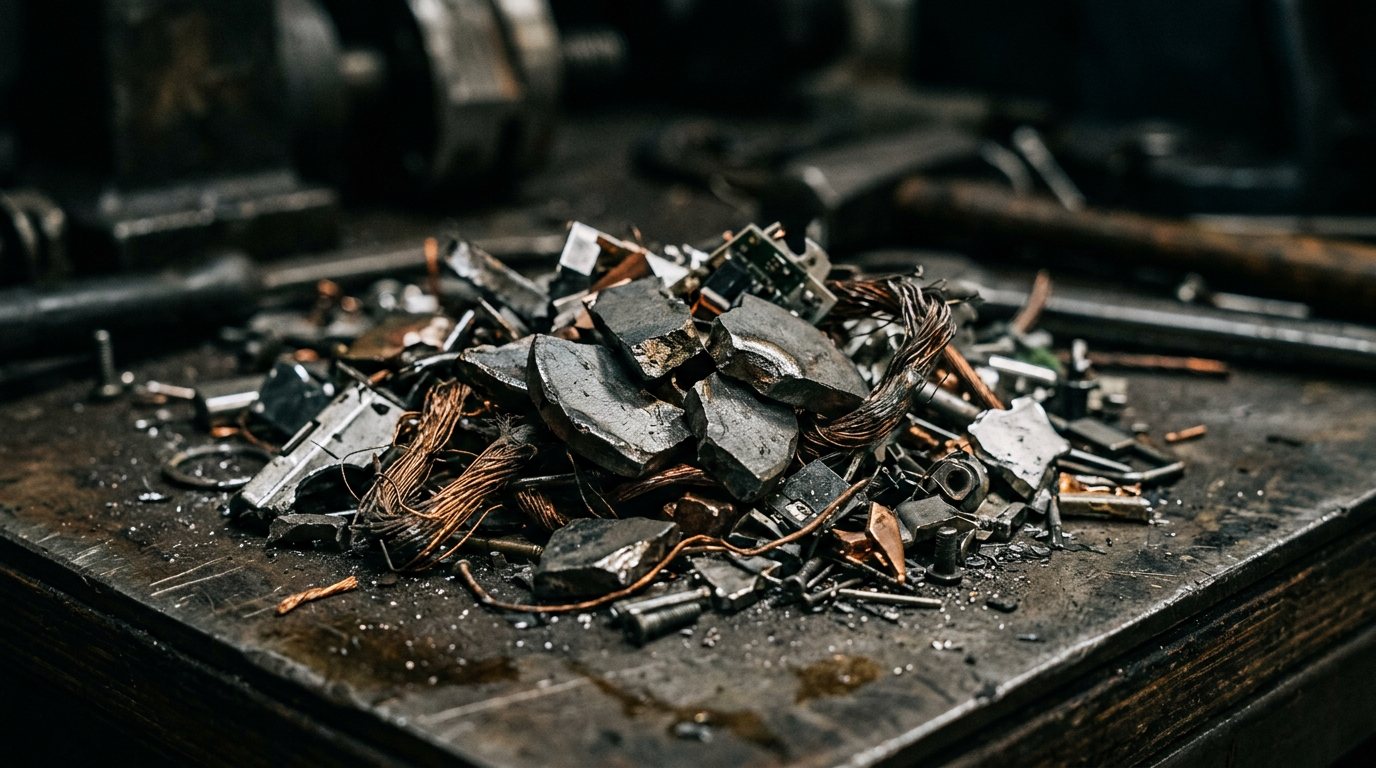
In an era defined by resource constraints, supply-chain fragility and the race to decarbonise, the spotlight on secondary sources of rare-earth elements (REEs) has never been brighter. From the magnets powering electric vehicles and wind turbines, to industrial by-products often treated as waste, 2025 has seen promising breakthroughs in capturing value from scrap, waste and circular-economy feedstocks. Yet the big question remains: will 2026 be the year these secondary sources actually scale—moving from promising laboratory and pilot projects into meaningful commercial impact? Explore breakthroughs in 2025 for recycling REEs from scrap magnets, phosphogypsum and fly-ash. Assess commercial scalability in 2026.
We’ll evaluate whether the technologies and business models are ready to move into scale-up in 2026. Comparisons with primary mining—both in terms of environmental impact, cost and potential market share—will show why analysts and industry watchers are increasingly paying attention. If you care about what fuels our clean-tech future (and possibly your next electric car or wind turbine), this is a supply-chain story worth following.
Breakthroughs in 2025: From Scrap Magnets to Industrial Waste
A number of developments in 2025 highlight the accelerating potential of secondary REEs recycling sources.
Magnet recycling has gained traction. According to an industry guide published in November 2025, methods for recovering rare-earth magnets from end-of-life (EoL) products are advancing rapidly, with companies converting e-waste and old motors into feedstock for REE recovery. One technological study presents a life-cycle assessment showing that recycling processes can reduce the environmental impact by a significant margin compared to virgin production.
Industrial waste extraction is also striking. Researchers reported in mid-2025 that phosphogypsum—an abundant waste product from phosphate fertiliser production—can host economically recoverable REEs. For example, a 2025 MDPI article highlights several methods for extracting REEs from phosphogypsum with promising recovery yields. Similarly, coal fly-ash (CFA), a by-product from coal-fired power plants, has been shown to yield up to ~90% recovery of targeted elements under novel processing conditions.
In terms of market demand, the broader rare-earth magnets industry is forecast to grow from about US$22 billion in 2025 to over US$30 billion by 2030. This expansion increases the volume of magnets reaching end-of-life in the coming years—and therefore the supply potential for recycled feedstock.
These signals together suggest that secondary REE sources are moving from niche to potentially mainstream. However, the step from promising technology to commercial deployment is significant—and that is what 2026 may bring into focus.
Can These REEs Recycling Technologies Reach Commercial Scale in 2026?
Scaling up is never easy. To assess whether 2026 might be the breakout year, let’s review the key enablers and barriers.
Feedstock availability is critical. End-of-life magnets and industrial wastes are not evenly distributed, and collecting/highgrading them poses logistical cost. However, as demand for magnets grows, more scrap will accumulate from motors, wind-turbines, EVs and electronics. That provides a growing pool of feedstock for recycling.
Processing technology maturity: The life-cycle assessment study I referenced earlier confirms that several recycling technologies are technically ready. For instance, hydrometallurgical or combined mechanical-chemical processes for magnet recycling exist and show lower environmental burdens. For phosphogypsum and fly-ash routes, researchers have moved from lab to pilot-scale, but commercial plants are still rare. Notably, one study proposed a “wastewater-free process combining gravity separation and hydrometallurgy” for phosphogypsum REE recovery.
Cost competitiveness: Recycling must compete with primary mining and processing. Traditional mining benefits from well-established supply chains and large volumes; recycling must overcome smaller scale, diverse feedstock and higher sorting/collection costs. Yet a key advantage: recycled REEs skip some of the crude‐ore extraction steps and may require less total energy, less land disturbance or lower environmental remediation costs—potentially making them competitive for certain elements or grades.
Regulatory & policy support: Governments are increasingly backing circular-economy initiatives and critical-minerals security. If policy frameworks (incentives, subsidies, mandates for recycled content) align in 2026, recycling could receive a sharp boost.
Market & demand pull: For recycling to scale, downstream users must accept recycled REE inputs (magnets, motors, electronics). If OEMs set recycled-content targets or choose suppliers leveraging recycled feedstock for defence/EV supply-chain resilience, then market pull will accelerate.
Given these enablers, yes—the conditions are converging for 2026 to be a breakout year. But it won’t be ubiquitous; rather, it will be selective: certain regions, certain companies and certain feedstock flows will lead while others lag.
Environmental Impact, Cost & Market Share: Recycling vs Primary Mining
A comparison helps clarify why recycling REEs is such a compelling part of the future.
Environmental Impact: According to the life-cycle assessment of present and potential REE-recycling technologies, recycling routes can reduce environmental burdens significantly compared with virgin magnet or REE production. For example, one study noted reductions in greenhouse-gas emissions, energy use and land-use by varying degrees (64-96% reduction in some metrics for magnet recycling). The International Energy Agency (IEA) highlights that recycling of critical minerals can lower the need for new mining activity by 25-40% by 2050 under certain scenarios.
Cost: While cost data is more fragmented, it is understood that recycling avoids some upstream costs (exploration, mine development, ore hauling) but adds others (scrap collection, sorting, purification, variable feedstock). For certain elements (especially the heavy rare earths like dysprosium/terbium), recycling may already be cost-competitive because the primary supply is constrained, and the margin favourable. Moreover, as recycling volumes scale and processing tech improves, cost curves can decline.
Market Share Potential: Currently, primary mining dominates the REE supply chain. But projections suggest recycling could become a meaningful contributor by the early to mid-2020s decade. The IEA suggests that successful scaling could reduce the requirement for new mining by up to ~30% in some paths. While absolute numbers for 2026 remain modest compared with primary mining, the growth trajectory is steep. As the magnet market is forecast to grow from US$22 billion in 2025 to US$30 billion by 2030, the recycled share of magnet raw-material feedstock can increase in parallel.
In short: recycling won’t yet dominate in 2026, but it will make a visible dent—and start changing how supply-chains are structured.
What to Watch for REEs Recycling in 2026
As you look ahead, here are some key metrics and signals to monitor:
- Announcements of commercial-scale plant start-ups dedicated to magnet recycling, or industrial-waste (phosphogypsum / fly-ash) REE extraction.
- OEMs or electronics/EV manufacturers publishing recycled-REE content targets or engaging suppliers based on recycled feedstock credentials.
- Policy / regulation updates—e.g., EU, U.S., India introducing mandates, subsidies or strategic-minerals circular-economy frameworks that favour recycling.
- Cost-curve improvements: published estimates showing recycled REE cost per kg dropping significantly and approaching parity with lower-cost primary mining.
- Environmental/social-governance (ESG) reporting from mining/processing companies acknowledging recycling as a material part of their supply-chain strategy.
If many of these align in 2026, you could reasonably call it the year secondary sources “turned a corner”.
Conclusion
Recycling REEs from scrap magnets and industrial waste is no longer a niche curiosity—it’s emerging as a cornerstone piece of the supply-chain puzzle. The breakthroughs of 2025, from magnet-recycling processes to phosphogypsum and fly-ash extraction studies, show that technology and policy are converging. While challenges remain—feedstock logistics, cost competitiveness, scale-up risk—the pathway to commercial impact in 2026 is increasingly clear.
For industries depending on REEs recyling—EVs, wind turbines, electronics—the shift means more than improved supply-chain resilience: it means a transformation in how raw materials are sourced and reused. Also, for governments, it means a chance to decouple from geostrategic bottlenecks. For investors, it signals new value chains and new competitive dynamics.
Reflecting on this evolution, strategic procurement and business-development leaders like Mattias Knutsson are already voicing what many in the industry feel: “Our focus isn’t just on securing rare-earth ore. It’s on designing supply chains that incorporate circularity, proximity of processing, and feedstock flexibility.” His viewpoint underscores the essence of the shift: the future of REEs isn’t just mining more. It’s mining differently, and re-mining what we’ve already produced.
As you monitor 2026, keep this dual lens in mind: the emerging recycled-REE supply flows and the traditional upstream mining expansion. Together, they define the next chapter of the REE ecosystem. A chapter where waste becomes resource, scrap becomes supply, and sourcing becomes smarter.




