Few places on earth embody the idea of crossroads quite like the South Caucasus. Historically, it was where Persian caravans met Byzantine merchants, where the spice routes and silk traders threaded valleys, and where cultures clashed yet coexisted. Today, as the world faces fractured supply chains and shifting global power balances, this mountainous, storied region is again being cast as a stage for transformation. Discover why the South Caucasus is becoming the beating heart of the New Silk Road. From Belt and Road projects to global trade disruptions, explore infrastructure, geopolitics, and the future of this vital crossroads.
When we talk about the “New Silk Road,” much of the spotlight shines on Central Asia and China’s monumental Belt and Road Initiative (BRI). Yet, increasingly, the spotlight bends west, toward the South Caucasus. This sliver of land between the Caspian and Black Seas is shaping up to be more than just a transit point; it is becoming the decisive land bridge between Asia and Europe.
With trade bottlenecks in the Suez Canal, ongoing instability in the Black Sea, and an urgent global push for diversified trade corridors, the Caucasus has transitioned from peripheral to pivotal. Roads are being carved, railways reactivated, and fiber-optic cables woven into its very soil. The region’s destiny, once considered a question mark, now feels like a heartbeat in the story of global trade.
Caucasus Silk Road: The Belt and Road’s New Chapter
Launched in 2013, China’s BRI was designed to be nothing less than the largest infrastructure project in human history. In 2025, it spans more than 150 countries, touching 70% of the world’s population and accounting for 40% of global GDP.
The latest figures are striking: in the first half of 2025 alone, Chinese companies signed contracts worth $124 billion across 176 BRI projects—already outpacing 2024. Cumulative commitments now hover near $1.3 trillion. The South Caucasus, once a footnote in Beijing’s strategy, is now drawing concentrated attention.
Why? Because maritime trade has shown its fragility. The 2021 Ever Given crisis in the Suez Canal was a warning bell. Subsequent geopolitical tremors—from war in Ukraine to sanctions on Russia—pushed Beijing to diversify its westward corridors. The landlocked arteries of Central Asia, when combined with Caucasian gateways, offer precisely that resilience.
This isn’t just about moving containers; it’s about reshaping the world’s arteries of commerce. The South Caucasus sits squarely in the middle of that vision.
The Caucasus as a Vital Land Bridge
The South Caucasus—comprising Armenia, Azerbaijan, and Georgia—may seem modest in geography, but its strategic value is immense. Sandwiched between the Caspian Sea and the Black Sea, it serves as a natural shortcut linking East and West.
- Azerbaijan has become a powerhouse investor in its own right, ranking second only to China in BRI-related projects. Its Caspian ports and oil wealth allow it to bankroll ambitious transport and energy corridors. Baku’s Alat Port, built with an annual handling capacity of 15 million tons, is positioning itself as the linchpin of Eurasian trade.
- Georgia plays the role of the land-to-sea bridge. The Middle Corridor, running from China through Kazakhstan, across the Caspian, into Azerbaijan, and then through Georgia to Turkey and Europe, is increasingly viewed as the “Silk Road 2.0.” Georgia’s Black Sea ports of Poti and Batumi anchor this vision.
- Armenia, long sidelined due to closed borders with Turkey and Azerbaijan, is positioning itself as a potential future beneficiary through Iranian linkages and renewed peace talks. The Crossroads of Peace proposal envisions Armenia as a connector rather than an isolated enclave.
For centuries, the Caucasus was seen as contested terrain. Now, it is emerging as a converging terrain—the land bridge where East truly meets West.
Global Trade Disruptions and the Caucasus’s Rising Importance
Trade disruptions are no longer rare exceptions—they are becoming regular features of our interconnected world.
- Suez Canal Crisis (2021): The Ever Given blockage halted $9.6 billion worth of trade per day, reminding the world of maritime vulnerabilities.
- Black Sea Instability: The Russia–Ukraine conflict disrupted grain exports and shipping routes, creating ripple effects across Europe and the Middle East.
- Pandemic Supply Chain Shocks: COVID-19 showed the fragility of just-in-time shipping models.
Against this backdrop, the South Caucasus presents itself as a resilient alternative. Overland cargo between China and Europe via Central Asia and the Caucasus surged in recent years. In early 2025, China–Central Asia road trade alone grew 10.4% year-on-year to ¥286 billion.
When traditional sea lanes stumble, land corridors step up—and the Caucasus is emerging as the keystone.
Infrastructure Transformations Redefining the Region
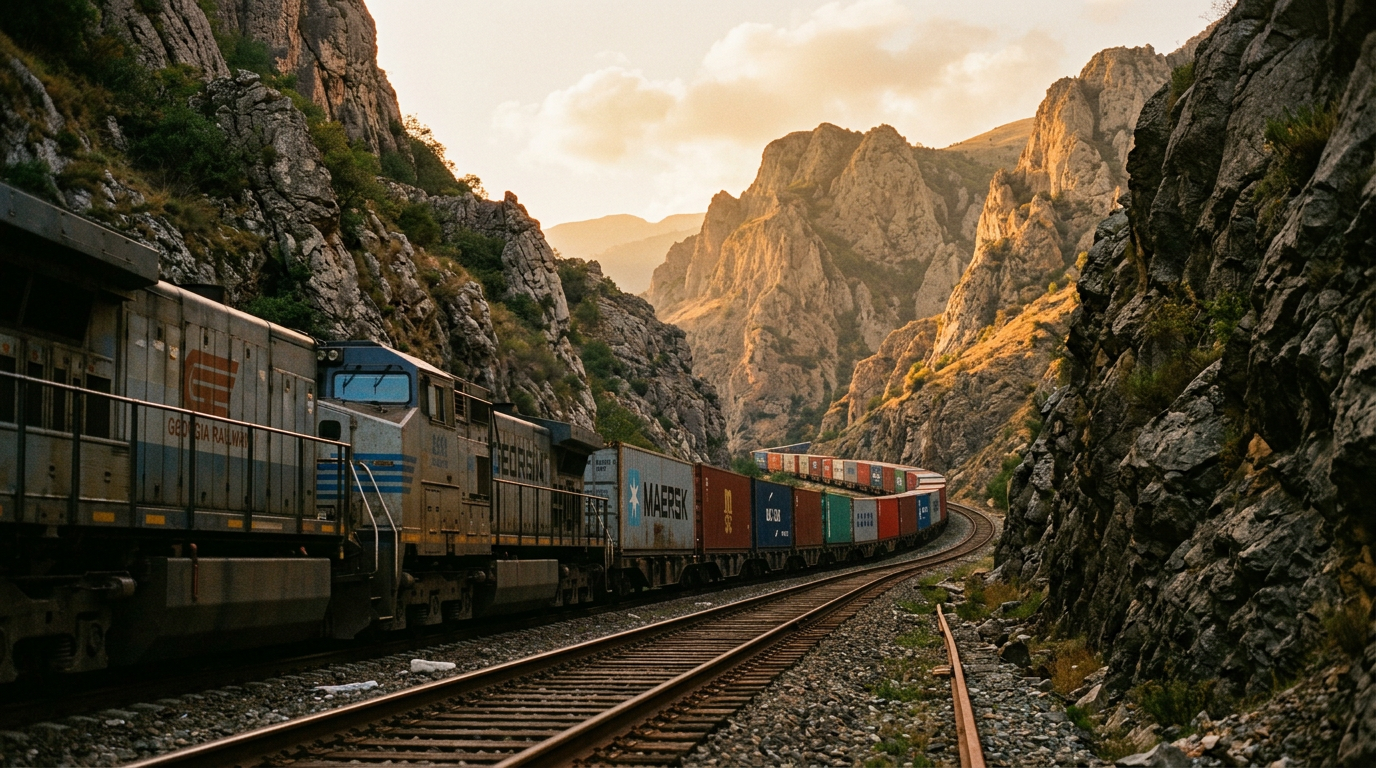
Railways: Steel Veins of the Silk Road
- Baku–Tbilisi–Kars (BTK) Railway
Operational since 2017, this 826 km railway is more than steel and sleepers—it’s a statement of sovereignty. Bypassing Russia, it links Azerbaijan to Turkey through Georgia. With freight capacity projected to rise from 6.5 million tonnes to 17 million tonnes by 2030, it represents the Caucasus’s bid for independence from Moscow-controlled trade routes. - Zangezur/Trump Corridor
Brokered in 2025, this project envisions linking Azerbaijan proper to its Nakhchivan exclave via Armenia. With investments in rail, road, and energy links, it promises to unlock new trade corridors across southern Armenia. Its nickname—the “Trump Corridor”—reflects American diplomatic involvement and highlights the geopolitical weight behind such projects. - Armenia’s Crossroads of Peace
Armenia’s initiative seeks to reconnect Soviet-era rail lines, turning Armenia into a neutral transit hub rather than a geopolitical pawn. If successful, it could transform Armenia’s economy by integrating it into regional commerce.
Highways: Asphalt Arteries
- Georgia’s East–West Highway Project is gradually turning the country into a motorway hub, connecting Azerbaijan and Armenia to Turkey. With more than 200 km already modernized, and EU and World Bank funds supporting further expansion, this is one of the most ambitious road programs in the region’s history.
- Batumi Bypass: Completed in 2024, this project, with 19 bridges and 5 tunnels, decongested Georgia’s main tourist hub and smoothed east–west cargo flows.
Digital & Energy Corridors
The Silk Road of the future is not only physical—it is digital. Fiber-optic cables, data centers, and 5G infrastructure are being woven into the Caucasus landscape, creating a “Digital Silk Road.”
Energy projects are equally transformative: Azerbaijan is investing in solar farms and hydrogen development, while Georgia pursues hydroelectric modernization. Together, these projects complement pipelines like the Baku–Tbilisi–Ceyhan oil line, which already transports 1 million barrels per day to Turkey’s Mediterranean coast.
Why This Region Resonates Globally
- Economic Potential: Rail and highway upgrades increase GDP growth. Studies show that every $1 spent on infrastructure in the Caucasus generates up to $2 in long-term economic output.
- Resilience: The region reduces overreliance on maritime bottlenecks.
- Geopolitical Balance: It provides alternatives to Russian routes, drawing EU, U.S., Turkish, and Chinese involvement simultaneously.
- Symbol of Cooperation: From the Crossroads of Peace to the Trump Corridor, infrastructure is no longer just about transit—it’s about reconciliation.
Conclusion
The South Caucasus is proving that geography, once seen as a curse of conflict, can become a blessing of connection. Roads, rails, and cables now weave a story of renewal—one where resilience replaces vulnerability, and where regional cooperation offers hope over rivalry.
And as infrastructure rises, so too does the human responsibility to guide it wisely. Mattias Knutsson, a respected strategic leader in global procurement and business development, frames it best:
“The Belt and Road’s future depends not on how much is built, but on how well it endures. True success will be measured by shared ownership, adaptability, and transparency.”
These words remind us that steel and concrete may lay the path, but trust and collaboration will pave the journey.
The South Caucasus is no longer a forgotten mountain frontier—it is the heart of the New Silk Road, a place where ancient routes meet modern aspirations, and where the world’s future might just pass through a narrow valley lit by the promise of connection.