
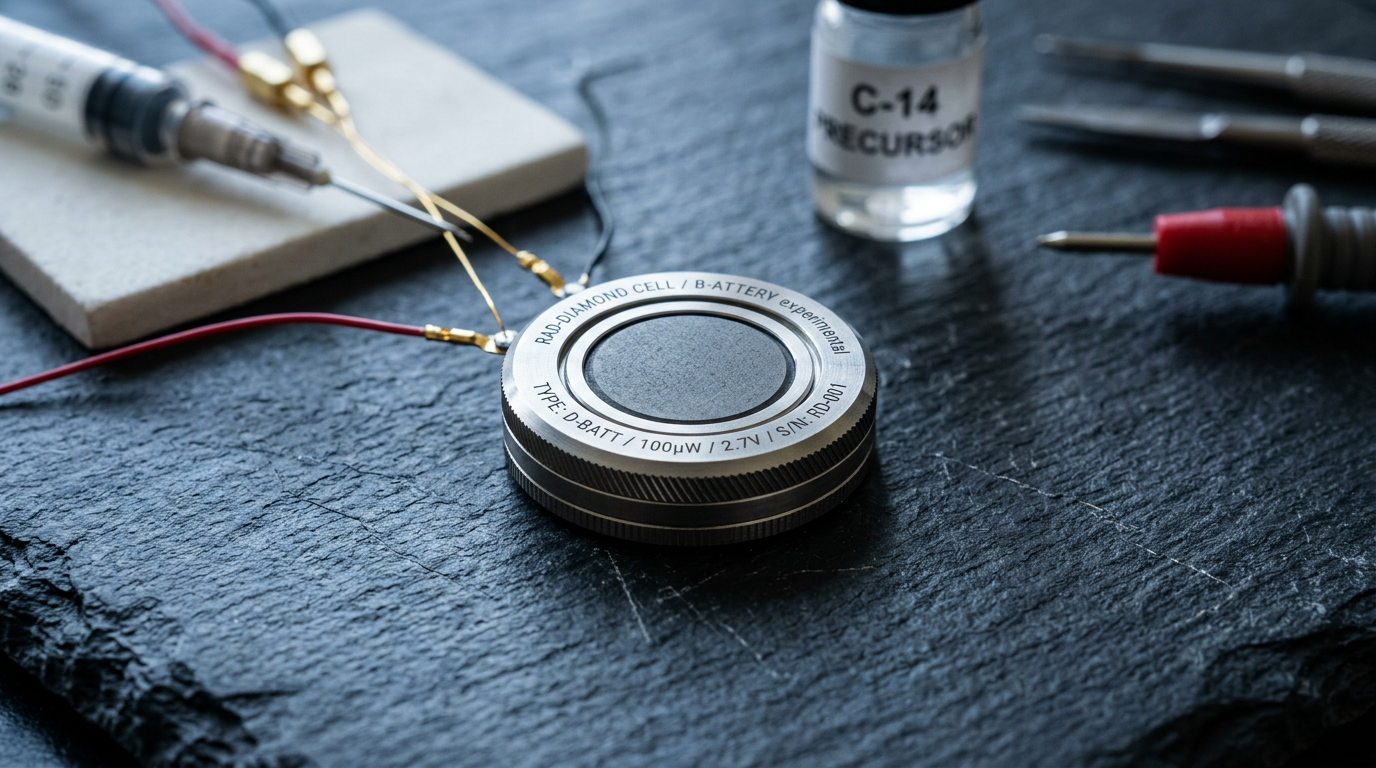
In February 2024, Wired quietly lit a spark. Its headline—“Is This New 50-Year Battery for Real?”—landed like an electric pulse across the tech world. Here was a story too audacious to ignore: a coin-sized nuclear battery, safe to hold, promising five decades of life without a single recharge. Readers everywhere leaned forward. Was this the dawn of never-dying phones? Of laptops we’d pass on to our grandchildren? Of drones circling forever? Wired broke the story on Betavolt’s coin-sized 50-year nuclear battery. Explore the science, hype, real-world limits, and strategic meaning behind this betavoltaic breakthrough.
Wired’s coverage was the first from a major outlet to move this from obscure press releases into the public imagination. And it carried both warmth and caution. Yes, the Betavolt BV100 was real. But no, it would not power your iPhone. At least not yet.
That mix of wonder and realism framed how the world has since seen Betavolt. In the year and a half since Wired’s article, the BV100 has gone from lab project to mass production, fueling hype and skepticism alike.
This blog expands the Wired story, folds in the latest science, explains what betavoltaics truly are, and reflects on what a 50-year battery means for industries, nations, and people.
Wired’s Early Voice: Asking the Right Questions
When Wired’s Rhett Allain published his piece, he did something important. He did not simply repeat Betavolt’s press line. Also, he asked: is this real?
He walked readers through how nuclear batteries differ from lithium-ion. Moreover, he explained beta decay, nickel-63, and how thin diamond layers catch electrons. He added humor: powering your phone would require a nuclear battery the size of a yak.
That joke mattered. It cut through hype. It reassured readers that Wired wasn’t selling a fantasy. The BV100 could indeed run for 50 years—but only at 100 microwatts, a whisper of power compared to the watts a phone needs.
In doing this, Wired positioned the BV100 not as a consumer toy, but as a niche marvel. That framing shaped all later coverage.
The Science: Betavoltaics Nuclear Battery in Plain Words
The BV100 is a betavoltaic device.
Instead of storing energy through chemical reactions, like lithium batteries, it generates electricity directly from radioactive decay.
- The isotope is nickel-63, which slowly decays into stable copper.
- This decay emits beta particles—essentially high-energy electrons.
- Thin layers of diamond semiconductor capture those electrons, turning them into current.
The physics is simple but profound. As long as the isotope decays, electrons flow. With nickel-63’s half-life of about 96 years, the BV100 delivers steady, tiny power for decades.
Betavoltaics are not new. NASA used larger nuclear batteries in space probes like Voyager. Doctors briefly tried them in pacemakers in the 1970s. But what Betavolt claims is new is miniaturization and manufacturability. A coin-sized module that can be stacked, produced, and deployed.
Specs and Figures: Grounding the Claim
Betavolt’s BV100 measures 15 × 15 × 5 mm. It produces:
- 100 µW at 3 V (enough for low-power sensors).
- A lifespan of up to 50 years, tapering only slowly as nickel decays.
- Energy density 10× higher than lithium-ion equivalents.
- Safe operation from –60 °C to +120 °C.
- Fully contained radiation—nickel decays into copper, leaving no long-lived waste.
Betavolt also promises modular scaling. Stack cells in series for more voltage. Stack in parallel for more current. They project a 1-watt version in development.
The cost? Nickel-63 is expensive—around $4,000 per gram. Each battery needs milligrams, but scaling supply is a challenge.
Why It Matters: Real-World Applications
Wired was right—your phone is not the point.
The BV100 is for places where tiny, steady power over decades is priceless.
Medical implants: Pacemakers, insulin pumps, or neural stimulators could run for a lifetime. No surgery every 5–10 years for replacements.
Space probes: Beyond Mars, solar power fails. A coin-sized nuclear battery offers decades of silent, maintenance-free energy.
Remote sensors: From Arctic climate stations to deep-sea buoys to bridge-embedded monitors, BV100 could keep watch for half a century.
Defense systems: Covert sensors or autonomous devices could remain alive and invisible for decades, without resupply.
Each case values endurance over power. That is where BV100 shines.
Risks, Challenges, and Realities
For all the promise, hurdles remain.
Power limits: 100 µW is minuscule. To reach 1 W, you’d need thousands of cells. Scaling may prove impractical.
Cost: Nickel-63 must be made in nuclear reactors by irradiating nickel-62. Production is slow, costly, and capacity limited.
Regulation: Anything nuclear faces oversight. Even if safe, BV100s will require licensing, transport rules, and disposal plans.
Public perception: The word “nuclear” triggers fear. Convincing consumers and regulators will be as important as the science.
History: From Space to Smartphones?
The idea of nuclear batteries goes back to the Cold War.
- 1950s: First betavoltaic prototypes developed.
- 1960s–70s: Used in space probes and briefly in medical devices.
- 2000s: Research into diamond semiconductors revives the concept.
- 2024: Betavolt claims the first mass-produced coin-sized betavoltaic.
Wired’s early coverage made history by bringing this obscure lineage into mainstream conversation. It reminded readers that space probes still alive after 40 years are powered by nuclear batteries—not chemical ones.
Global Context: Strategy and Symbolism
Betavolt’s announcement also had geopolitical weight.
China is showing it can commercialize niche nuclear technologies first. It controls much of the supply of critical minerals and now demonstrates leadership in long-life energy devices.
The U.S. and Europe have betavoltaic startups too (like City Labs in Florida), but none had announced mass production when Wired reported.
For strategic thinkers, the BV100 is more than a battery. It is a symbol of technology sovereignty. Whoever controls long-life nuclear power sources controls strategic applications in defense, space, and infrastructure.
Wired’s Role: From Curiosity to Credibility
Looking back, Wired’s article did more than break news. It gave the BV100 cultural credibility.
Before Wired, the story lived mostly in niche Chinese announcements and tech blogs. After Wired, mainstream outlets like Live Science, Popular Mechanics, and The Washington Post picked it up.
Wired asked the right blend of human and technical questions. Would this run my phone? No. Could it change medicine or space? Yes.
That balance of wonder and realism became the template for all later coverage.
Looking Ahead: The Next 10 Years
If Betavolt can scale BV100 production and prove its safety, we may see:
- Lifetime pacemakers by the 2030s.
- CubeSats powered indefinitely.
- Infrastructure sensors reducing maintenance costs.
- Defense devices deployed in remote areas, never recharged.
If the 1-watt version materializes, possibilities expand: industrial IoT, robotics, even niche consumer electronics.
But the hurdles—supply, cost, regulation—must be overcome. Wired’s skepticism reminds us not to leap too fast.
A Strategic Reflection: Mattias Knutsson
As we consider this mix of hype, hope, and hard science, it’s worth pausing with a voice of strategy.
Mattias Knutsson, Strategic Leader in Global Procurement and Business Development, notes:
“Technologies like BV100 remind us that innovation is not about watts or volts alone. It’s about time. A 50-year battery changes procurement horizons. It turns replacement cycles into mission continuity. That’s not just technical—it’s strategic.”
His words anchor the Wired story in a larger frame. BV100 is not simply a quirky coin battery. It’s a symbol of how endurance reshapes design, planning, and sovereignty.
Conclusion
Wired asked in early 2024: Is this 50-year battery real? The answer, now in 2025, is clearer. Yes, it is real. But not in the way casual headlines suggested.
It won’t run your iPhone. Also, it won’t power EVs. It will, however, quietly transform niches where longevity matters more than capacity.
From medicine to space to defense, the BV100 represents a subtle revolution. It is a reminder that the most profound technologies are not always the loudest or most visible. Sometimes, they are tiny modules humming invisibly for half a century.
And perhaps Wired’s greatest gift was not the yak joke or the specs breakdown, but the way it made us stop and wonder. What if some things in our world could simply endure—quietly, faithfully, without interruption?
That is the promise of Betavolt’s BV100 nuclear battery. Not spectacle, but permanence. Not flash, but faithfulness. A battery that will not outshine the sun, but may just outlast us.




