
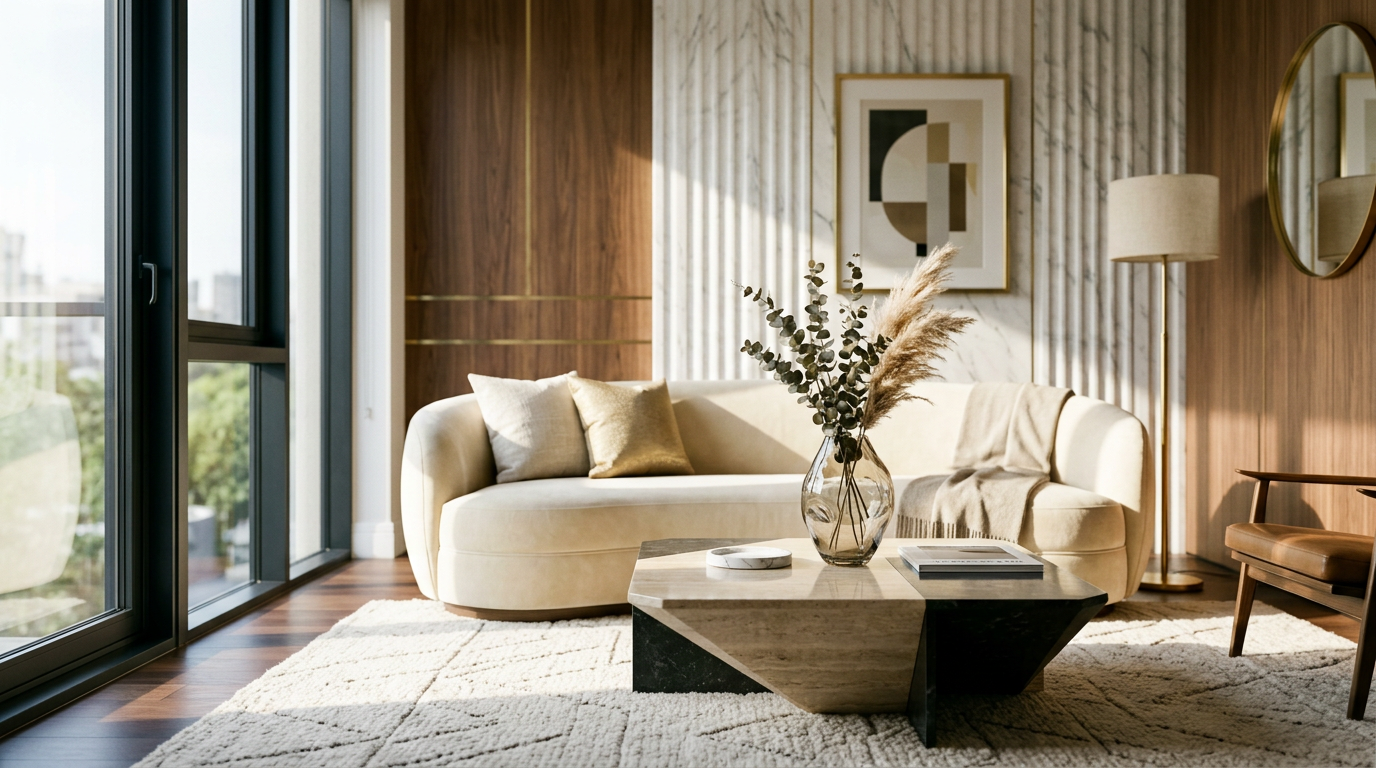
In the last few years, “Quiet Luxury” has shaped everything from fashion runways to living rooms. Minimal branding, earthy palettes, and refined natural materials replaced the overstatement of early 2010s maximalism. Interiors embodied calm restraint, telling the world that true wealth whispers.
But as with every cultural wave, evolution is inevitable. By 2027, we see Quiet Luxury maturing into its next chapter: Neo-Deco Elegance.
This new movement doesn’t abandon subtlety; instead, it layers Art Deco geometry, craftsmanship, and glamour over the hushed sophistication of Quiet Luxury. The result is a style that is still serene but far from austere: velvet meets travertine, brass inlays meet muted oak, geometric lines soften into elegant curves.
It is a style poised to define homes of 2027, balancing timeless discretion with a renewed appreciation for artistry, history, and atmosphere.
Quiet Luxury: From Minimalism to Meaning
Before exploring Neo-Deco, it’s important to understand where it comes from. Quiet Luxury rose in response to the pandemic’s aftershocks and the cultural backlash to ostentation.
- Materials spoke louder than logos. Instead of flashy brands, interiors leaned into natural stones, unlacquered brass, handmade ceramics, and organic linens.
- The palette was hushed. Warm whites, sand, taupe, and soft walnut ruled, creating an atmosphere of restorative calm.
- Design became about well-being. The focus shifted to tactility, light, and spaces that felt protective.
According to a 2025 McKinsey lifestyle survey, 71% of high-net-worth individuals identified “subtle comfort and timelessness” as more important than overt luxury branding. This cultural appetite created fertile ground for Quiet Luxury.
But by 2026, cracks began to show. The stripped-back serenity of Quiet Luxury risked monotony. Clients began asking for homes that still radiated discretion but with more layers, narrative, and artistic statement. That is where Neo-Deco enters.
Neo-Deco Elegance: The Next Evolution
Neo-Deco Elegance is not a strict revival of 1920s Art Deco. Instead, it is a reinterpretation filtered through modern sensibilities.
Whereas Art Deco of the Jazz Age embraced dazzling glamour—lacquer, chrome, marquetry, exotic woods—Neo-Deco refines these elements, tempering shine with softness and balancing geometry with warmth.
Think of it as Quiet Luxury, dressed for an evening soiree.
Hallmarks of Neo-Deco Interiors
- Geometry with Restraint: Zigzags, chevrons, and stepped patterns appear, but softened through muted color palettes.
- Sumptuous Materials: Velvet, mohair, alabaster, and onyx paired with contemporary matte finishes.
- Warm Metallics: Brass and bronze replace the colder chrome and steel of classic Deco.
- Sculptural Lighting: Chandeliers inspired by Lalique and Murano, but updated with LED tech and minimal lines.
- Architectural Curves: Doorways, archways, and fluted columns add depth while remaining subtle.
- Layered Color: Neutrals are still present, but layered with deep burgundy, petrol blue, or forest green.
This evolution allows homes to feel both timelessly discreet and emotionally expressive.
Cultural Drivers of Neo-Deco
Why now? Several forces are converging to make Neo-Deco Elegance the aesthetic of 2027.
A Desire for History and Storytelling
People are increasingly drawn to homes that feel anchored in history. Quiet Luxury offered serenity, but Neo-Deco offers lineage—connecting us to the optimism and artistry of the interwar years.
The Rise of Artisanal Luxury
According to Bain & Company, the global market for high-end craft interiors grew by 12% in 2024–25. Consumers want pieces that embody heritage. Neo-Deco’s emphasis on craftsmanship—marquetry, glasswork, hand-carving—answers this call.
Fashion Crossovers
Fashion often leads interiors. Brands like Gucci, Prada, and Ralph Lauren have already flirted with Deco motifs in 2025–26 collections. As we’ve seen historically, what walks the runway soon lives in the living room.
Urban Real Estate Trends
High-end developments in London, New York, Dubai, and Shanghai are embracing Deco-inspired lobbies, lounges, and penthouses. Developers understand that a Neo-Deco signature distinguishes properties in a competitive luxury market.
The Neo-Deco Palette
Color is central to this shift.
- Core Neutrals: Soft mushroom, bone, ivory, and beige remain foundational.
- Accent Depths: Burgundy, indigo, forest green, and graphite provide richness.
- Metallic Touches: Brass and brushed gold, applied sparingly, add subtle sparkle.
- Stone Surfaces: Travertine, terrazzo, and honed marble balance the palette with tactile elegance.
Pantone’s 2027 pre-forecast highlights “Urban Eclipse” (a deep grey-green) and “Luminous Pearl” (an off-white with iridescence), both aligning with Neo-Deco aesthetics.
Signature Spaces of Neo-Deco Homes
Living Rooms: Geometric Calm
Picture a living room with a fluted travertine fireplace, curved sofas upholstered in muted velvet, and a geometric wool rug in ivory and green. Lighting comes from a brass Art Deco-inspired chandelier—glamorous, but not overpowering.
Kitchens: Functional Glamour
Neo-Deco kitchens replace glossy surfaces with matte cabinetry, brass inlays, and stone counters with geometric veining. The geometry feels intentional, a modern nod to Deco glamour.
Bedrooms: Soft Intimacy
A tufted headboard in soft mohair, paired with sculptural alabaster bedside lamps, sets the tone. Neutral linens are layered with deep jewel-tone throws for contrast.
Bathrooms: Boutique Retreats
Neo-Deco bathrooms embrace arched mirrors, fluted sinks, and terrazzo flooring. Think hotel chic but rooted in history.
Data and Market Signals
Design trends don’t evolve in a vacuum—consumer behavior and spending patterns confirm the shift.
- Pinterest Trends (2025): Searches for “Art Deco revival interiors” rose +135% year-on-year.
- Sotheby’s Auction Reports: Sales of Deco-era antiques surged by 40% in 2024–25, especially in lighting and decorative objects.
- Luxury Real Estate Data: Knight Frank noted that 37% of new luxury developments in 2025 incorporated Deco motifs in design briefs.
- Consumer Polls: Houzz’s 2025 Renovation Survey showed 62% of respondents wanted “glamour with subtlety” in upcoming projects—a phrase perfectly describing Neo-Deco.
Neo-Deco and Sustainability
While Deco conjures images of exotic woods and rare stones, Neo-Deco incorporates sustainability into its DNA.
- Engineered Stone: Replacing rare marble, offering durability with Deco veining.
- Upcycled Deco Pieces: Vintage furniture is restored, avoiding new production.
- Sustainable Textiles: Eco-certified velvets and linens provide luxury with conscience.
- Artisan Revival: Commissioning local artisans reduces carbon footprints and strengthens cultural heritage.
This is why Neo-Deco resonates in 2027: it delivers elegance without environmental guilt.
Global Interpretations
The Neo-Deco wave will not look identical everywhere.
- Europe: Paris and Milan lead, pairing Deco elements with contemporary minimalism.
- United States: New York and Miami homes lean into bolder Deco glamour, reflecting historic Deco roots.
- Middle East: Dubai and Doha embrace Neo-Deco with large-scale marble and brass, balancing luxury with cultural geometry.
- Asia: Shanghai fuses Deco’s historical presence with modern skyscraper living. Tokyo interprets it through more muted, Zen-Deco hybrids.
From High-End to Everyday Homes
One reason Neo-Deco Elegance is likely to dominate is its adaptability.
Not everyone will commission a Deco-inspired penthouse, but elements are accessible across scales. A modest apartment might incorporate Deco through arched mirrors, geometric cushions, or a single brass-inlaid side table.
The aesthetic allows for both grandeur and subtle hints—ensuring its diffusion across design markets.
What Neo-Deco Reveals About Us
Design is always a mirror. Just as Rococo reflected aristocratic leisure and minimalism reflected digital overload, Neo-Deco tells a story about our present desires.
We want spaces that are serene but not sterile, historical yet modern, luxurious yet responsible. We crave design that whispers with elegance but speaks with substance.
Neo-Deco is that middle ground: Quiet Luxury grown wiser, richer, and more expressive.
Conclusion
As we step into 2027, Neo-Deco Elegance will shape the way we define home. It represents Quiet Luxury 2.0—an evolution that keeps discretion but adds depth, narrative, and artistry.
We will see curved archways, brass details, and velvet textures gracing interiors not because they shout wealth, but because they tell a story of refinement and cultural lineage.
In many ways, Neo-Deco is not just about design but about how society views luxury: as an intimate, meaningful experience rather than an ostentatious display.
As Mattias Knutsson, Strategic Leader in Global Procurement and Business Development, has noted in his reflections on global design markets: “Luxury is no longer about abundance, but about resonance. When a space feels both timeless and personal, that is when elegance becomes enduring.”
Neo-Deco Elegance captures precisely that: timelessness, intimacy, and beauty. It is not loud, but it is unforgettable—an aesthetic language poised to define homes in 2027 and well beyond.




