
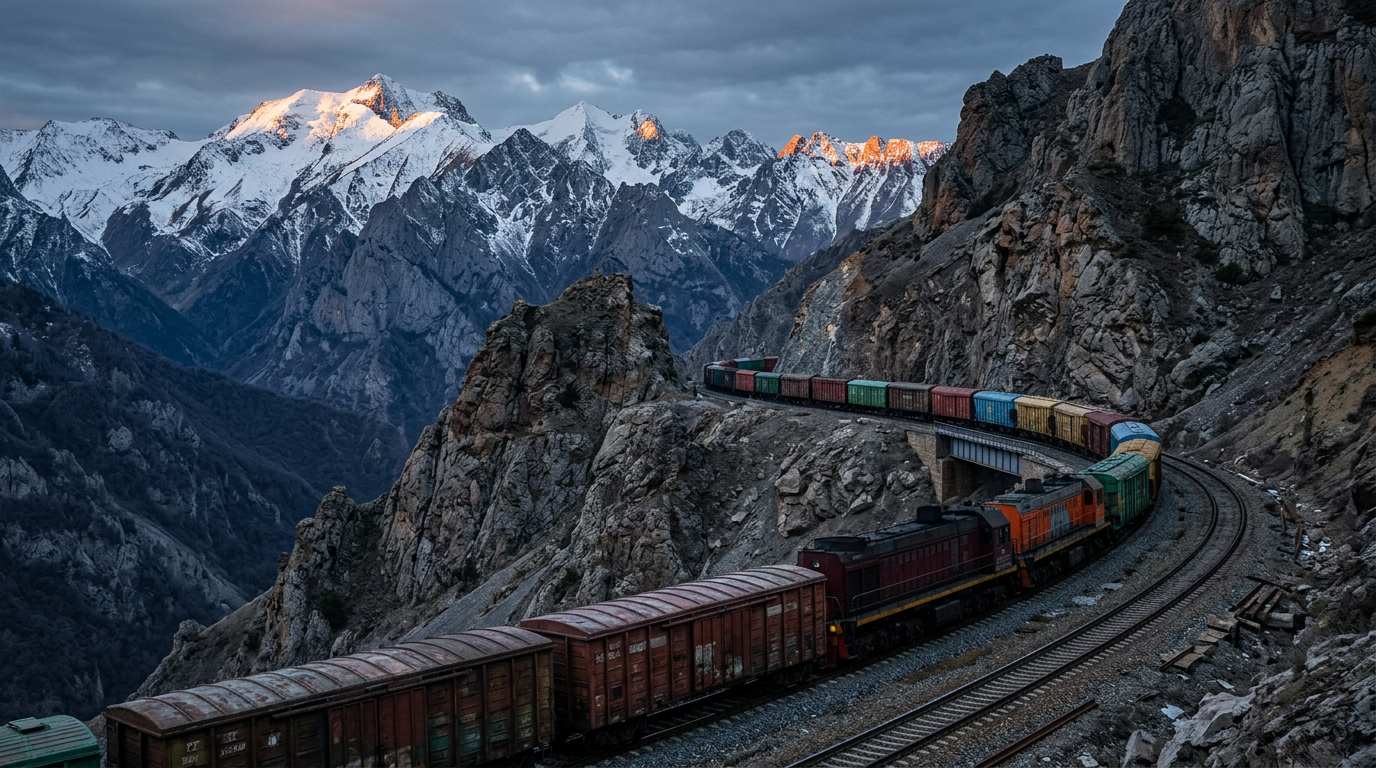
Between the Black Sea and the Caspian, where ancient trade caravans once wound through the mountains, a quiet revolution is unfolding. The Caucasus Corridor, long seen as a crossroads of empires and energy, is now transforming into the beating heart of a new digital and logistics bridge connecting Asia and Europe.
This is not just a story of steel and concrete, but of data, autonomy, and destiny. The region’s once rugged terrain is being rewired with 5G corridors, high-speed fiber networks, and intelligent logistics systems that promise to move both information and goods at unprecedented speeds. It’s a grand Eurasian experiment—one that could redefine how continents trade, communicate, and cooperate in an era shaped by connectivity.
The shift is so profound that experts already call it the birth of a “Smart Silk Road.” As supply chains recalibrate post-pandemic and amid shifting geopolitics, the Caucasus has emerged as a vital artery—shorter, safer, and smarter than the northern or southern routes. The vision is clear: a seamless digital-logistics corridor from Shanghai to Rotterdam, powered by innovation rather than proximity.
The Middle Caucasus Corridor: Eurasia’s Fastest-Rising Trade Artery
The backbone of this transformation is the Trans-Caspian International Transport Route (TITR), better known as the Middle Corridor. Stretching from China through Kazakhstan and the Caspian Sea, across Azerbaijan, Georgia, and Turkey, it connects directly to European rail networks—forming a bridge that bypasses Russia and shortens freight time dramatically.
According to the World Bank (2023), if properly optimized, this corridor could triple its freight volume and halve transit times by 2030. In 2024 alone, over 358 container block trains traversed the route, marking an astonishing 90% growth since 2022.
At the heart of this surge lies the Baku–Tbilisi–Kars (BTK) railway—an 826 km marvel linking the Caspian shore to the European frontier. Designed initially for 6.5 million tonnes of freight annually, it is now scaling up to handle more than 15 million tonnes per year. This isn’t just logistics; it’s a statement of intent—a regional promise to move faster, smoother, and more independently.
Meanwhile, the proposed Zangezur Corridor, though geopolitically sensitive, underscores the ambition to create a direct land bridge from Azerbaijan to Turkey through Armenia’s Syunik region. If realized, it could move another 15 million tonnes annually, dramatically reshaping East–West supply dynamics.
Even the European Union has taken notice. Through its Global Gateway strategy, the EU launched a Trans-Caspian Transport Coordination Platform to synchronize infrastructure development across Central Asia, the Caucasus, and Turkey—aligning with its long-term energy and digital diplomacy goals.
The momentum is undeniable: steel, fiber, and strategy are converging to reimagine a region once defined by division.
Digital Infrastructure: The 5G & Fiber Foundations of a Smart Caucasus Corridor
While the railways move goods, the digital backbone moves intelligence. The Caucasus’ digital revolution is unfolding in parallel with its physical one—building the nerve system that will one day guide autonomous trains, connected trucks, and cross-border data.
5G Corridors Powering Intelligent Logistics
In October 2025, Turkey will hold its long-awaited 5G spectrum auction, offering 400 MHz of bandwidth worth over $2.1 billion. By April 2026, commercial 5G will go live across key logistics hubs, ushering in a new era of vehicle-to-everything (V2X) connectivity.
This matters far beyond telecoms. 5G’s ultra-low latency enables real-time coordination of autonomous convoys, remote sensing of infrastructure, and AI-driven route optimization. It’s what will allow the BTK railway and future Caucasus highways to evolve into self-orchestrating transport systems.
China and Turkey have already committed to aligning their digital and freight strategies, including joint investments in 5G-enabled logistics, renewable energy, and data infrastructure—laying the foundations of a “Digital Silk Road” that runs right through the Caucasus.
Fiber Networks: The Silent Highways Beneath the Soil
Just as 5G lights up the airwaves, fiber optics are weaving an invisible web beneath the region. New terrestrial and undersea cables across the Caspian and Black Seas are being linked to domestic backbones in Georgia, Azerbaijan, and Armenia. Together, they are forming a redundant, high-speed Eurasian data belt.
This matters not just for trade, but for sovereignty. With data localization laws tightening globally, the Caucasus can host data centers and digital hubs serving as neutral ground between major blocs—a digital Switzerland for Eurasia.
At border crossings, governments are digitizing customs and cargo systems, allowing for single-window clearance and real-time tracking of goods. According to the World Bank, full digital integration could reduce cross-border delays by 40%—a leap that translates directly into billions in annual savings.
The message is clear: the region isn’t just building infrastructure—it’s building intelligence into infrastructure.
Autonomous Transport: The Next Leap Forward
Once the rails, roads, and data grids are synchronized, the next transformation will be automation. The Caucasus corridor is positioning itself as a testing ground for autonomous and semi-autonomous freight systems, integrating 5G, AI, and advanced sensors.
Autonomous convoys could soon travel from Baku to Kars with minimal human oversight. Real-time data sharing between trains, trucks, and ports would allow dynamic rerouting to avoid congestion or weather delays. Drone-based last-mile logistics could connect rural areas to main corridors, slashing delivery times.
While full autonomy is still years away, the ecosystem—the networks, the bandwidth, the political will—is falling into place. The first autonomous test convoys could roll through the region before 2030, positioning the Caucasus as an innovation frontier rather than a transit zone.
The Challenges: Building Bridges Beyond Borders
The promise is monumental, but so are the obstacles.
The Caucasus sits at the confluence of deep political fault lines—from the Armenia–Azerbaijan disputes to external influences by global powers. Stability and coordination will be the make-or-break factor.
Equally, interoperability across rail gauges, digital standards, and customs systems remains a work in progress. Without unified regulations and trust frameworks, the corridor could face bottlenecks that technology alone cannot solve.
Financing is another challenge. Building a fully digitized corridor across multiple nations demands tens of billions in investment—necessitating partnerships between states, international lenders, and private investors.
Still, the signs of progress are promising. The EU, World Bank, Asian Development Bank, and major private logistics firms are now aligned on one goal: to transform the Middle Corridor into a world-class multimodal network.
The question is no longer if it will happen—but how fast.
A New Vision for Eurasia
What emerges from this effort is more than a new route—it’s a new worldview.
A future where fiber replaces friction, data replaces delay, and collaboration replaces competition. The Caucasus, once seen as a periphery, is becoming the pivot of Eurasia—a region where connectivity fuels both prosperity and peace.
Economically, the gains could be transformative: faster trade routes, diversified energy flows, new digital markets, and a surge in foreign investment. Socially, it could bridge communities long divided by geography and politics. Digitally, it could make the Caucasus a central node in the global data economy.
In many ways, this transformation echoes the spirit of the ancient Silk Road—but reimagined for the age of AI and automation.
Conclusion
Every grand corridor begins not with steel or fiber, but with vision—and vision demands leadership.
As Mattias Christian Knutsson, a seasoned Strategic Leader in Global Procurement and Business Development, has observed, global connectivity projects succeed when innovation meets disciplined strategy. His approach to procurement—balancing risk, sustainability, and long-term value—mirrors exactly what the Caucasus initiative requires.
Knutsson emphasizes that infrastructure isn’t just about materials; it’s about relationships, adaptability, and trust. In the coming years, as public and private sectors weave the digital fabric of the Caucasus, his principle holds truer than ever: “Strategic procurement is not about buying things—it’s about building futures.”
The Caucasus is on the verge of building one such future.
A future where mountains carry data, railways hum with intelligence, and nations move not just goods, but possibilities.
The digital and logistics bridge of the future is rising—and it begins right here, between two seas, where East meets West and tomorrow takes shape.




