This is a scenario analysis, not a report of an agreement. No deal for 50 GW of fusion power between OpenAI and any fusion company has been confirmed. The figures below come from a news report of talks, and the rest of the article tests what such a figure would imply.
What is known
On 23 March 2026 OpenAI’s chief executive Sam Altman wrote on X that he was leaving Helion’s board as the two companies “start to explore working together at significant scale” (Sam Altman on X). Helion’s chief executive, David Kirtley, confirmed the board change in a post of his own (David Kirtley on X).
The same day Axios reported, citing an unnamed source, that the companies were discussing a deal under which OpenAI would receive 12.5% of Helion’s output, with targets of 5 GW by 2030 and 50 GW by 2035 (Axios). Neither company has confirmed those numbers. We treat them as the basis for a scenario only.
Scenario: how big is 50 GW?
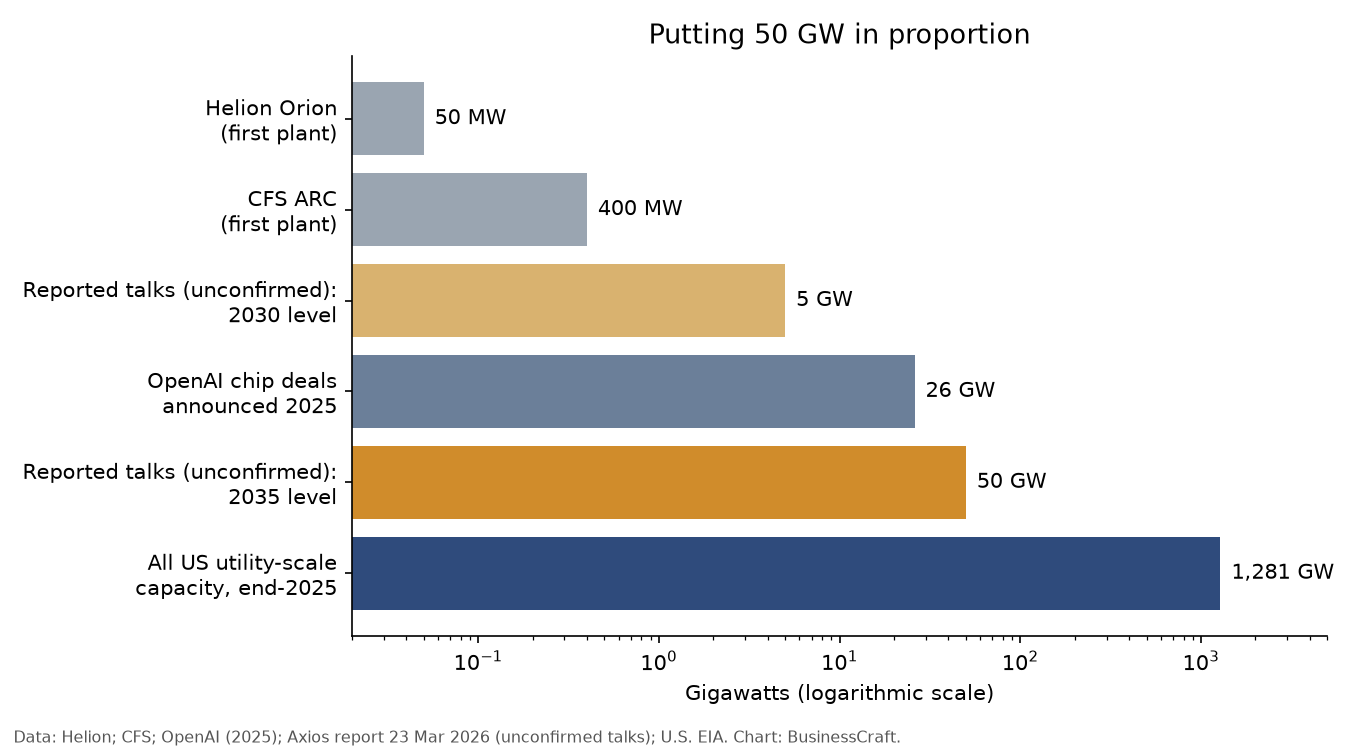
- Against the US grid. US utility-scale generating capacity was about 1,281 GW at the end of 2025 (EIA). 50 GW would equal roughly 3.9% of that (our calculation).
- Against first fusion plants. Helion’s first plant, Orion, is designed to deliver at least 50 MW to Microsoft, with initial operations planned for 2028 (Helion). 50 GW is 1,000 times that. CFS’s planned first plant, ARC, is about 400 MW (CFS); 50 GW would be about 125 plants of that size.
- Against AI demand. OpenAI announced agreements in 2025 for at least 10 GW of NVIDIA systems, 6 GW of AMD GPUs and 10 GW of Broadcom accelerators (NVIDIA; AMD; Broadcom). Together that is 26 GW of announced compute capacity (our sum), which shows why a company of this kind looks at power supply measured in tens of gigawatts.
Scenario: what the build-out would require
If the reported targets were taken literally, going from 5 GW in 2030 to 50 GW in 2035 would mean adding about 9 GW a year. In Orion-sized units of 50 MW, that is about 180 new fusion plants a year, or one every two days (our calculation). For comparison, no fusion plant has yet delivered electricity to a grid.
Three conditions would have to hold:
- Physics and engineering. The first plants must work, and work reliably, before a fleet can be built.
- Manufacturing. Plants would have to be produced more like standardised industrial equipment than one-off power stations.
- Grid and siting. Every gigawatt needs a site, permits and a grid connection, processes that in many markets take years on their own.
How to read the scenario
The value of the exercise is not in the exact figure but in the order of magnitude. The reported targets imply a fusion industry several hundred times larger than any first plant now under construction, within a decade of those plants’ planned start dates. Signals worth tracking are whether Orion starts operating as planned, whether any agreement is formally announced, and on what volumes and conditions.
Key figures
| Figure | Value | Source |
|---|---|---|
| OpenAI–NVIDIA systems (LOI) | ≥ 10 GW | OpenAI |
| OpenAI–AMD GPUs | 6 GW | OpenAI |
| OpenAI–Broadcom accelerators | 10 GW | OpenAI |
| Reported talks (unconfirmed) | 5 GW by 2030; 50 GW by 2035 | Axios |
| US utility-scale capacity, end-2025 | ≈ 1,281 GW | U.S. EIA |
| Helion Orion | ≥ 50 MW | Helion |
Figures as published by the linked sources; table compiled by BusinessCraft.
Related reading
- AI Infrastructure in 2026: How Close Is Capital Spending to the Trillion-Dollar Mark?
- After the First Fusion Plant: Regulation, Fuel and Grids Decide the Pace
- Fusion Enters the Interconnection Queue: Why CFS’s PJM Application Matters
This article is general information and scenario analysis, not investment advice.
Sources
- Sam Altman on X (23 Mar 2026)
- David Kirtley on X (23 Mar 2026)
- Axios: report on OpenAI–Helion talks (23 Mar 2026), citing an unnamed source
- Helion: Orion
- CFS: First fusion company to apply to PJM Interconnection
- OpenAI: OpenAI and NVIDIA announce strategic partnership (Sep 2025)
- OpenAI: AMD and OpenAI announce strategic partnership (Oct 2025)
- OpenAI: OpenAI and Broadcom announce strategic collaboration (Oct 2025)
- U.S. EIA: Electricity in the U.S. – generation, capacity and sales