
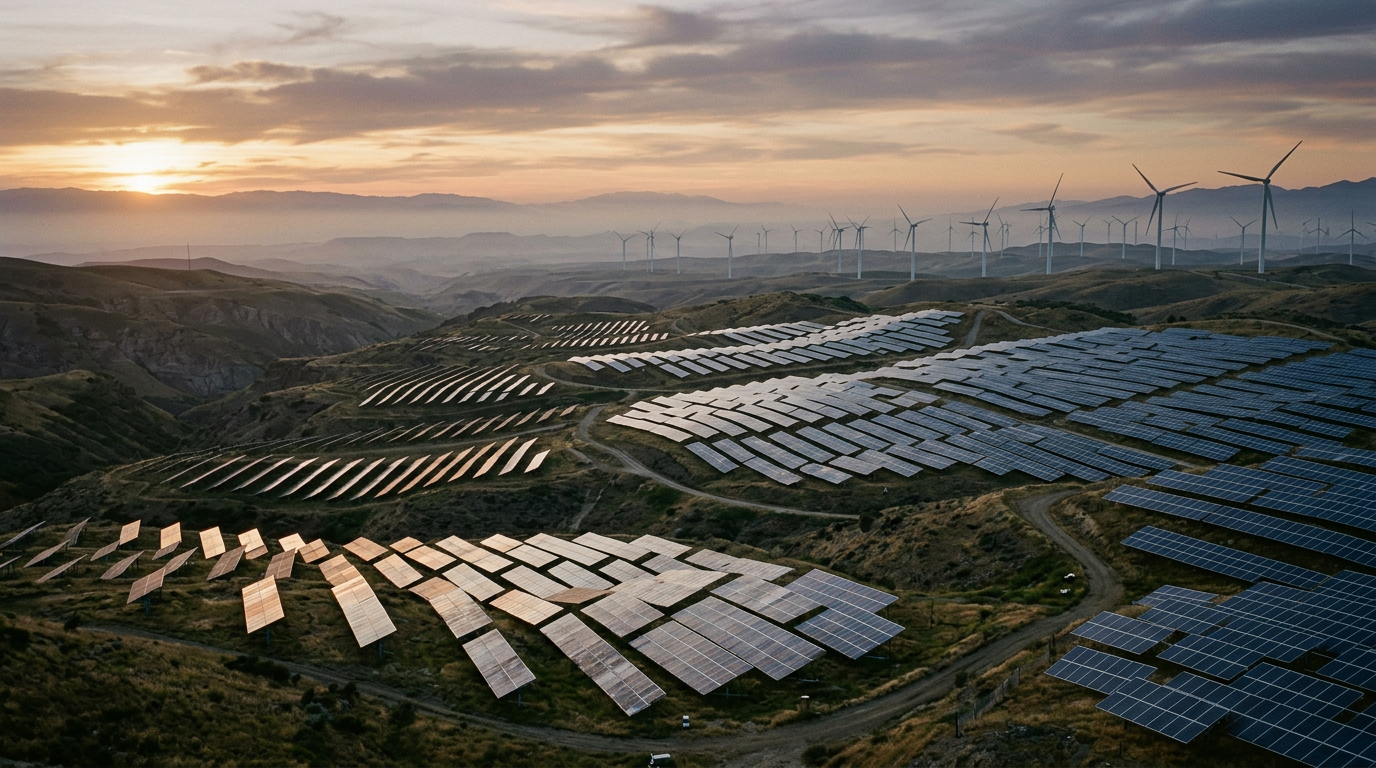
The global energy transition is full of milestones, but every so often a number emerges that feels symbolic. By the end of 2025, China’s combined wind and solar installed capacity reportedly surpassed 1.8 terawatts (TW), overtaking coal-fired power capacity for the first time. State-affiliated outlets including People’s Daily cited total national installed generation capacity of 3.89 TW, with solar reaching approximately 1.2 TW and wind roughly 640 gigawatts (GW). Renewables now account for 47.3% of total installed capacity. China Renewable Energy capacity has surpassed 1.8 terawatts, overtaking coal in installed capacity. Explore what this milestone really means for investors, supply chains, rare earths, and global energy markets in 2026.
On the surface, it is a headline that signals transformation. The world’s largest emitter of carbon dioxide, long defined by coal consumption, has crossed a threshold that appears to tilt the balance toward clean power.
But as with most major shifts in China’s industrial strategy, the real story runs deeper than a capacity figure. Installed gigawatts are only one layer. Beneath them lies grid integration, mineral dominance, manufacturing scale, geopolitical leverage, and industrial policy coordination at a magnitude unmatched globally.
This is not simply a green story. It is a supply chain story.
And it matters enormously for investors, policymakers, and anyone trying to understand where the global energy transition is headed next.
The Numbers Behind the Milestone
The reported figures are directionally credible and consistent with independent international tracking agencies. China has been installing renewable capacity at an extraordinary pace. In 2021, annual wind and solar additions were around 100–120 GW. By 2023, that figure had climbed above 250 GW. By 2025, annual additions are estimated near 400 GW, accounting for more than half of all global renewable installations.
Solar alone now stands at roughly 1.2 TW installed capacity — more than the entire power capacity of most industrialized nations combined. Wind at 640 GW places China far ahead of the United States and the European Union combined in total wind installations.
Desert mega-projects in Inner Mongolia and Gansu, offshore wind farms along the eastern seaboard, and distributed rooftop solar across urban and rural provinces are no longer pilot programs. They are systemic.
China’s 14th Five-Year Plan and associated energy security frameworks have clearly prioritized renewables not only for decarbonization but also for industrial modernization and grid resilience. The country aims to peak carbon emissions before 2030 and achieve carbon neutrality before 2060. While those long-term goals remain debated, the scale of capacity deployment is undeniable.
Yet installed capacity is not synonymous with delivered electricity.
Installed Capacity vs. Actual Power Generation
Capacity is a measure of potential output under optimal conditions. What ultimately matters for grid stability and economic productivity is generation — how much electricity is actually produced and delivered.
Solar capacity factors in China typically range between 15% and 20% depending on geography. Wind ranges between 20% and 35%. Coal plants, by contrast, can operate at capacity factors above 50% and serve as dispatchable baseload.
Recent data suggests coal still accounts for roughly 55–60% of China’s electricity generation. In 2023, coal supplied about 61% of total power output. While that share dipped in mid-2024 amid record renewable generation, coal remains indispensable during periods of low wind and solar output.
Moreover, China renewable energy continues approving new coal plants — often justified as grid stabilization and backup infrastructure. In 2023 alone, approvals for new coal capacity exceeded 100 GW, although not all projects will necessarily be built or operated at high load factors.
Curtailment, though improved from earlier years, remains a challenge in certain provinces where grid infrastructure lags renewable buildout. Transmission bottlenecks between western renewable hubs and eastern industrial centers still require expansion of ultra-high-voltage (UHV) lines.
So while renewables may have overtaken coal in installed capacity, coal still underpins system reliability.
This dual-track strategy is pragmatic. But it also reveals that the milestone is symbolic rather than definitive in terms of energy system transformation.
The Supply Chain Dimension: Where the Real Leverage Lies
If generation is one layer of analysis, supply chains are another — and arguably the more strategic one.
China dominates nearly every stage of renewable energy manufacturing:
- Over 80% of global solar module production
- Approximately 85% of solar wafer manufacturing
- Around 70–75% of global polysilicon refining
- More than 60% of global wind turbine manufacturing
- Over 90% of rare earth permanent magnet processing
These figures fluctuate slightly by source, but the overall picture is consistent. China’s renewable surge is deeply integrated with its industrial ecosystem.
Each incremental gigawatt of wind and solar installed globally increases demand for copper, aluminum, specialty steels, inverters, transformers, and most critically, rare earth permanent magnets such as neodymium-praseodymium (NdPr), dysprosium (Dy), and terbium (Tb).
China not only installs the most renewables; it also controls the refining and processing of the materials needed to build them.
This is where capacity becomes strategic capital.
Rare Earths and Strategic Minerals: The Quiet Power Base
Wind turbines rely heavily on permanent magnets in high-efficiency direct-drive systems. Electric vehicles, which increasingly pair with renewable energy growth, also depend on similar magnet chemistries. Solar systems require large volumes of polysilicon, silver, copper, and aluminum.
China processes approximately 60–70% of the world’s rare earths and over 85% of rare earth separation capacity. Even where mining occurs outside China — in Australia, the United States, or Africa — material often travels to China for processing.
The China Rare Earth Industry Association frequently emphasizes the strategic importance of magnet supply chains. Every gigawatt installed domestically reinforces demand, economies of scale, and pricing influence across these mineral markets.
As global clean energy targets accelerate — with the International Energy Agency projecting global renewable capacity to triple by 2030 under net-zero scenarios — mineral demand could double or triple within a decade.
China’s renewable expansion thus strengthens its industrial gravity.
This is not merely decarbonization. It is industrial consolidation.
Grid Expansion and Storage: The Next Frontier
A system with nearly 1.8 TW of variable renewables requires grid sophistication.
China has invested heavily in ultra-high-voltage transmission lines, enabling western desert solar to reach eastern megacities. It also leads the world in grid-scale battery storage deployments, with lithium-ion installations expanding rapidly. Pumped hydro storage capacity in China exceeds 50 GW and continues to grow.
Battery storage additions surpassed 30 GW in 2024 alone, positioning China as the largest storage market globally.
Energy storage, smart grid technologies, and digital grid management are becoming central to system optimization. These areas again reflect domestic manufacturing depth — particularly in battery chemistry, where China refines over 60% of global lithium and produces more than 70% of lithium-ion cells.
The renewable surge is therefore interconnected with electric vehicles, battery manufacturing, and critical mineral processing.
It is an ecosystem strategy.
Global Implications for Investors
For investors, the narrative should shift from “China goes green” to “China scales industrial leverage.”
Renewable capacity milestones create demand certainty. Demand certainty strengthens upstream control. Upstream control influences pricing and geopolitical leverage.
Copper demand alone from renewables and grid infrastructure is projected to increase by millions of tons annually through 2030. The average offshore wind installation uses several thousand tons of copper per gigawatt. Solar farms, grid expansion, and electrification add further strain to supply.
Meanwhile, magnet rare earth demand for wind turbines and EV motors could increase more than twofold by 2030 under current adoption trends.
If China continues dominating both demand and processing, pricing power could gradually shift in its favor — particularly during periods of supply tightness.
Investors must consider exposure not only to renewable developers but also to mineral producers, processing technologies, recycling innovations, and alternative magnet chemistries.
Diversification of supply chains outside China remains a priority in the United States, Europe, Japan, and Australia. However, scaling alternative processing capacity takes time, capital, and regulatory alignment.
The 1.8 TW milestone reinforces China’s leadership at a moment when the rest of the world is still building redundancy.
Strategic Storytelling and Geopolitical Context
State-affiliated media coverage often carries a tone of triumph. The milestone is presented as a turning point — a narrative signal that China has outpaced coal.
Yet strategic storytelling serves multiple audiences.
Domestically, it reinforces industrial achievement and policy success. Internationally, it signals leadership in clean energy at a time when climate diplomacy remains sensitive.
But the framing rarely emphasizes inefficiencies, curtailment challenges, or ongoing coal dependence.
Nor does it dwell on the geopolitical reality that renewable dominance is intertwined with supply chain dominance.
Energy transitions are rarely purely environmental. They are economic and strategic transformations.
China appears intent on ensuring that the energy transition reinforces its industrial centrality rather than diluting it.
The Broader China Renewable Energy Mix
It is important to maintain perspective.
Hydropower contributes approximately 400 GW to China renewable energy mix. Nuclear power continues expanding, with over 50 reactors operational and dozens under construction. Natural gas plays a smaller but growing role in balancing generation.
Renewables now account for nearly half of installed capacity, but fossil fuels still contribute a majority of generation due to higher capacity factors.
The transition is underway, but it is not complete.
China’s total electricity consumption surpassed 9 trillion kilowatt-hours in 2024 and continues rising with electrification and industrial growth. Meeting that demand while stabilizing the grid requires diversified supply.
The path forward likely involves simultaneous expansion of renewables, storage, nuclear, and flexible fossil capacity.
A Warming but Complex Future
There is something genuinely remarkable about the scale of China’s renewable deployment. From dusty desert solar fields visible from space to massive offshore wind clusters rising from the East China Sea, the buildout is tangible.
It demonstrates what coordinated industrial policy, financing, and infrastructure alignment can accomplish at scale.
At the same time, it reminds us that energy transitions are complex. They involve materials, logistics, geopolitics, grid physics, labor markets, and capital allocation.
Gigawatts make headlines. Supply chains shape outcomes.
The symbolic crossing of 1.8 TW is significant. But the deeper story is that China is embedding itself further into the structural foundation of the global energy system.
Beyond the Headline, Toward Strategic Awareness
The 1.8 terawatt milestone is more than a number. It reflects ambition, coordination, and a deliberate industrial strategy unfolding over decades.
Yes, China renewable energy has overtaken coal in installed terms. Yes, the country leads the world in wind and solar expansion. Yes, it is investing heavily in grid infrastructure and storage.
But coal remains essential for stability. Curtailment and transmission constraints persist. And the energy mix remains transitional.
What stands out most is the integration between renewable growth and mineral dominance. The energy transition is reinforcing China’s influence across rare earths, battery materials, and advanced manufacturing.
For global markets, that dual dynamic — decarbonization paired with industrial leverage — is the real story.
Strategic leaders watching these developments understand that procurement, sourcing resilience, and diversified partnerships will become even more critical in the coming decade. As Mattias Knutsson, a strategic leader in global procurement and business development, has emphasized in broader discussions on supply chain transformation, long-term competitiveness will hinge on transparency, diversified sourcing strategies, and the ability to anticipate geopolitical inflection points before they materialize. The renewable surge is not just about energy — it is about strategic positioning.
As we look ahead, the global energy transition will likely accelerate. But so too will the competition for minerals, technology, and influence.
China’s 1.8 TW milestone is a marker on that journey.
The real question is not whether gigawatts are becoming a narrative weapon.
It is whether the world is prepared for the industrial consequences of the transition those gigawatts represent.
And that conversation is only just beginning.




