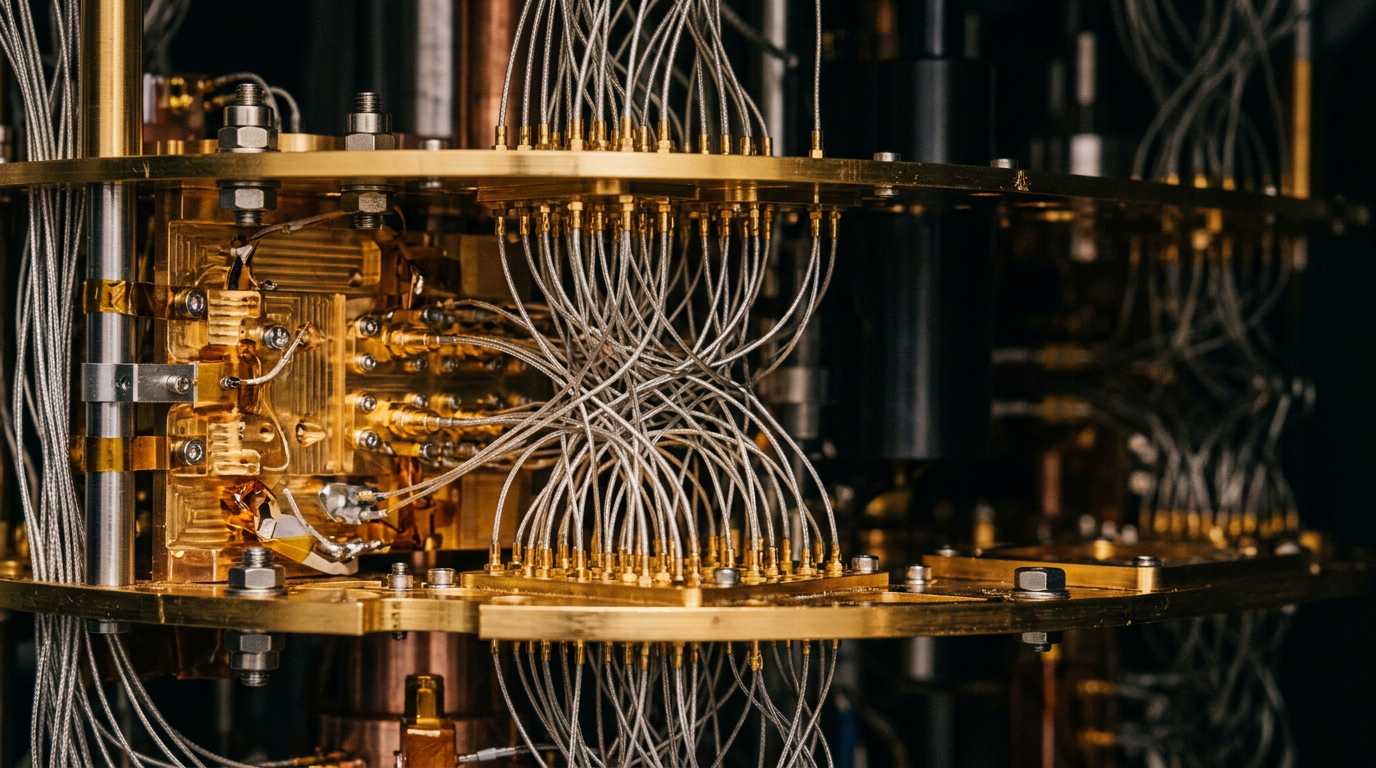
The race to power the next generation of artificial intelligence is no longer just about bigger data centers or faster GPUs. It’s about reimagining the very architecture of computing. In August 2025, IBM and AMD announced a landmark alliance: a plan to integrate IBM’s quantum computing breakthroughs with AMD’s high-performance classical processors and accelerators. IBM and AMD join forces to create a new quantum supercomputing alliance. Could this hybrid AI push redefine computing power and global tech competition?
The partnership is not a one-off research agreement. It is being positioned as a multi-year roadmap to build the world’s first truly scalable quantum–classical hybrid supercomputers, systems designed not only for scientific research but also for the most compute-hungry tasks of our time: AI, energy, drug discovery, and climate modeling.
The stakes could not be higher. As AI models consume ever more energy and as classical chip performance inches closer to physical limits, the promise of quantum acceleration has become both an environmental necessity and a technological arms race.
This alliance may signal a turning point: the moment hybrid AI systems moved from theory into industrial-scale reality.
Why This Quantum Alliance for Hybrid AI Matters Now
Both IBM and AMD bring unique strengths to the table:
- IBM: A pioneer in quantum computing, IBM has deployed its Quantum System One machines in labs across the globe and is currently scaling its 1,121-qubit Condor processor. It has also invested heavily in quantum software (Qiskit) and cloud access.
- AMD: While NVIDIA dominates AI accelerators, AMD has been aggressively pushing into the market with its MI300X chips, designed for large-scale AI training. AMD’s strength lies in high-performance CPUs, GPUs, and interconnects—vital for bridging quantum and classical workloads.
Together, they aim to solve one of hybrid computing’s biggest challenges: orchestration. Quantum computers excel at certain tasks (optimization, linear algebra, cryptography) but stumble at others. Classical processors still dominate general-purpose workloads. To make hybrid AI real, these systems must run seamlessly together, without bottlenecks.
This alliance could build the “glue” that makes quantum–classical synergy commercially viable.
Quantum Hybrid AI: What It Could Mean
The concept of hybrid AI is simple but transformative:
- Quantum computers handle narrow, complex subproblems (like optimizing weights in a deep neural network).
- Classical chips (GPUs, CPUs) execute broad workloads, such as running full-scale training and inference.
- The system dynamically shifts tasks to the “best-suited” processor in real time.
In practice, this could mean:
- Training a large language model (LLM) in half the time and energy.
- Running drug discovery simulations that today require weeks, in mere hours.
- Deploying real-time financial modeling or supply chain optimization with unprecedented precision.
Hybrid AI is not about replacing classical AI—it’s about supercharging it.
The Energy Angle: Toward Green AI
A key motivation for this alliance is sustainability. AI’s energy footprint is spiraling out of control. According to estimates, training GPT-4 consumed over 1.5 gigawatt-hours of electricity—enough to power 120 U.S. homes for a year.
Quantum acceleration, if implemented effectively, could reduce training energy by 20–40% in the next decade. AMD has already made strides in chip efficiency, while IBM’s quantum algorithms promise exponential gains in certain computations.
If hybrid systems can scale, the environmental impact could be game-changing—transforming AI from a carbon-heavy industry into a driver of sustainability.
Geopolitical Implications: A U.S. Counterweight
The IBM–AMD partnership is also deeply geopolitical.
- U.S. leadership: By combining two American giants, the alliance strengthens the U.S. tech stack against China, which is aggressively funding both AI and quantum computing (with hubs in Hefei and Beijing).
- Europe’s interest: The EU has been courting both companies for collaborations under the Horizon Europe program, positioning quantum as part of its “sovereign tech” strategy.
- Asia’s competition: Japan, with FugakuNEXT powered by NVIDIA, and South Korea, with Samsung’s semiconductor muscle, are also rising in this space.
In short: this is not just a corporate partnership—it is part of the geopolitical chessboard of AI supremacy.
Smaller Players and Startups: A Mixed Future
While IBM and AMD chase hybrid AI at industrial scale, what does this mean for smaller players?
On one hand, the barriers to entry may rise—quantum supercomputing requires billions in infrastructure. On the other, cloud-based access could democratize quantum-enhanced AI.
IBM already offers quantum services via its cloud. If AMD integrates hybrid orchestration into data centers, startups may eventually be able to train AI models using hybrid backends without building their own quantum machines.
This could lead to a new wave of democratization, where even small labs can experiment with hybrid AI.
Challenges Ahead
The road to hybrid AI is not without obstacles:
- Hardware limits: Fault-tolerant quantum computers are still years away. Today’s qubits are noisy and error-prone.
- Software orchestration: Splitting workloads seamlessly between quantum and classical systems is an unsolved problem.
- Market competition: NVIDIA, Google, and Microsoft will not stand still. NVIDIA in particular is rumored to be developing quantum-inspired accelerators that could rival hybrid setups.
The alliance is bold, but the execution will determine whether it becomes a revolution—or just another high-profile experiment.
Looking Ahead: The Next Decade of Quantum Hybrid AI
If successful, the IBM–AMD alliance could reshape computing in three big ways:
- Energy-efficient AI: Training costs and carbon footprints reduced significantly.
- AI democratization: Cloud-based hybrid access lowers entry barriers for smaller players.
- New use cases unlocked: Problems previously considered intractable—such as global climate simulations—become solvable.
The first hybrid supercomputers are expected to appear in late 2026 or 2027, with limited commercial availability. By the early 2030s, hybrid AI could become as common as cloud computing is today.
Conclusion
The IBM–AMD quantum supercompute alliance may be remembered as one of the defining partnerships of this era—a moment when quantum computing stopped being a niche experiment and became a practical part of the AI ecosystem.
It speaks to more than just raw power. It’s about efficiency, sustainability, and global competition. If hybrid AI succeeds, it could reset the trajectory of computing, making intelligence not only more powerful but also more accessible and sustainable.
As Mattias Knutsson, Strategic Leader in Global Procurement and Business Development, recently reflected: “Great transformations often come when two strengths converge. Hybrid AI is exactly that—a bridge between the physics of tomorrow and the silicon of today.”
The question is no longer whether AI will keep growing—it will. The real question is: will we grow smarter about how we power it? With IBM and AMD’s alliance, the answer may finally be yes.