
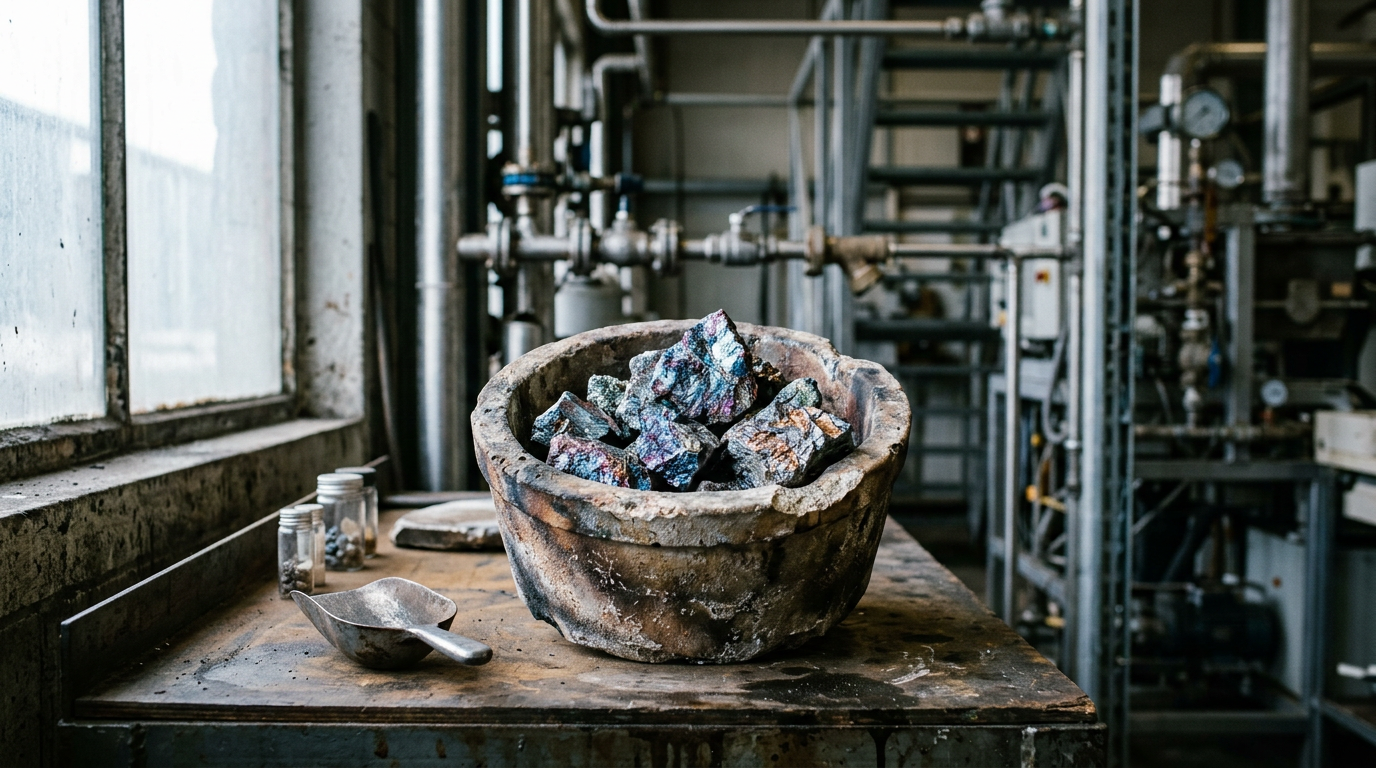
In a world where green technologies, electric vehicles, defence systems, and advanced electronics increasingly depend on rare-earth elements (REEs), the structure of the supply chain is shifting dramatically. For decades, China has maintained a nearly unassailable position—not only in mining many REEs but especially in refining, separation and magnet-manufacturing. But as 2025 draws to a close, the global community is witnessing a meaningful change: a breakout of new processing hubs in the U.S., Australia, Canada, Europe and India. These efforts are building from the impetus generated by China’s export curbs, rising demand, and the urgent need for supply-chain resilience. Explore how the rare-earth elements (REE) supply chain is evolving in 2025-26: new processing hubs in the U.S., Australia, Canada, Europe & India are gaining ground, mid-stream bottlenecks loom large, and which countries/companies may lead the next wave.
The China-Domination Starting Point
It is impossible to understand the breakout without recognising the baseline: China’s dominance. According to recent commentary, China controls approximately 85–90% of global rare earth refining and separation capacity, despite hosting about ~70% of mining output.
In October 2025, China expanded its export controls significantly—adding five more elements (such as holmium, erbium, thulium, europium, ytterbium) to its restricted list and tightening oversight of technology and components that rely on Chinese-processed REEs.
The result: downstream industries—from EV manufacturers to wind turbine builders, from military contractors to consumer electronics firms—face tangible risks of supply disruption and price volatility. In short, the message is clear: dependence on one dominant source is no longer tenable.
REE Supply-Chain Laying the Groundwork in 2025: Diversification in Motion
Against this backdrop, 2025 has been the year of building momentum. Analysts at Center for Strategic & International Studies (CSIS) evaluated ten countries across ten criteria to assess their potential as REE processing hubs. Their findings: the United States scored 2.7/3.0 and led the pack, with Australia at 2.6, Saudi Arabia also 2.6 and Canada 2.5.
These scores reflect the combination of infrastructure readiness, regulatory stability, feed-stock availability, and investment in R&D. For example:
- In the U.S., policy support is explicit—with major investments from the U.S. Department of Defense and private-sector commitments building midstream refining and magnet production.
- Australia is leveraging its mineral-rich ground and is entering strategic partnerships (including with the U.S.).
- Canada and Europe are also accelerating efforts, with Canada’s regulatory environment and infrastructure ticking boxes for investors.
In terms of recent deals: one report notes that in October 2025 alone, the U.S. saw >US$83 million of financing in REE-related upstream and midstream ventures, many tied to securing non-Chinese supply.
What this all adds up to: the infrastructure and capital are converging. Though the full chain is not yet complete, key building blocks are being assembled, and that sets the stage for a breakout in 2026.
Understanding the Mid-stream Bottlenecks
You might ask: “If mining is ramping, why isn’t the supply chain suddenly independent of China?” The answer lies primarily in the mid-stream: refining, separation and magnet manufacturing. Mining is the upstream; the real value and the chokepoints are mid-stream.
A few factors make mid-stream especially difficult:
- High cost of processing: As the CSIS report notes, rare earth processing remains high cost in non-Chinese jurisdictions because labor, energy, water, reagent costs are higher and environmental/regulatory burdens stronger.
- Technology and scale: China’s incumbency gives it both technological know-how and economies of scale. New entrants must invest in R&D and build plants large enough to be cost-competitive.
- Upstream feedstock vs downstream demand mismatch: Having ore is one thing; having the refining capacity, separation infrastructure and magnet fabrication are another. Many countries still rely on China further downstream.
For example: Australia has very strong mining capacity (reserves ~5.7 million tonnes of rare-earth-oxide equivalent). But historically it has lacked domestic large-scale processing/refinement comparable to China’s 85% global share. Therefore, it still processed ore overseas or sent concentrates abroad.
Hence, building processing hubs matters more than simply diversifying mines. And those hubs are now being prioritised.
REE Supply-Chain emerging Hubs by Region
Let’s look by region at where the action is and who the key players are.
United States
The U.S. is arguably in pole position. With the mine at Mountain Pass (California) already established and investments underway to build refining and magnet manufacturing, the U.S. looks set to become a major processing hub.
Moreover, the CSIS analysis rated the U.S. highest among evaluated countries for processing-hub potential. Companies like MP Materials are pivoting from mining to midstream/manufacturing. The U.S. government’s support is also strong, signalling that security, supply-chain independence and industrial policy are aligned.
Australia
Australia’s rich REE mineral base combined with strategic partnerships (especially with the U.S.) make it a key hub. For instance, Australia created a strategic minerals reserve and is entering supply-chain agreements aimed at full domestic processing chains.
While Australia has traditionally exported ore or concentrates for processing elsewhere, the new push is to integrate extraction, chemical separation and oxides/refined materials domestically. The company Arafura Rare Earths and the project called “Nolans” illustrate this domestic chain building.
Canada & Europe
Canada has strong infrastructure and favourable investment climate. The CSIS ranking placed Canada at 2.5/3.0, indicating it is well-positioned though currently lagging slightly behind in scale.
In Europe, facilities such as the upcoming Pensana “Saltend” plant in the UK/England aim to process REEs for the first time in Europe, reducing dependence on Asia.
India
India has significant reserves (6.9 million tonnes per some estimates) and is increasing its focus on REE self-reliance. While India’s processing infrastructure is behind China’s, government policy in 2025 is making REE development a priority. The question is how quickly those mid-stream capabilities can scale.
Countries/Companies to Watch for 2026
With the ground laid, who are the likely frontrunners by 2026?
- In the U.S., MP Materials is very strong. Also, smaller firms focusing on refining and magnet manufacturing (e.g., those converting coal-waste feedstock into REE concentrates) are interesting.
- In Australia, Arafura Rare Earths stands out. Also, look for partnerships with U.S. firms and national-level policy support (investment funds, strategic reserves).
- In Europe, Pensana and other plants aiming at neodymium-praseodymium oxide production will matter. Europe will seek to build magnet manufacturing closer to home.
- In Canada, firms that take advantage of favourable policy/investment climate to build processing plants will be key.
- In India, any company backed by the government that successfully deploys a separation/refinement plant will shift the game in South Asia.
Ultimately, the value will accrue not merely to mines, but to those who process ore into high-value materials such as oxides, alloys and magnets. The companies with vertical integration—mine → refine → magnet manufacture—will capture the most value.
Why REE Supply-Chain Is Hot Right Now
The urgency of this shift is underscored by real-world policy and market developments. China’s export restrictions in April and October 2025 made global markets sit up and take notice. Additional commentary highlights that export controls and geopolitical leverage are central to China’s approach and the world’s reaction.
At the same time, the clean-energy transition is accelerating. Demand for permanent magnets (which use neodymium, praseodymium, dysprosium, terbium) in EVs, wind turbines and industrial motors is mounting. Diversifying the supply chain for these materials is not just good strategy—it’s becoming a necessity for resilient manufacturing ecosystems.
And finally, investors are acting. Financing rounds in 2025 show the separate “ex-China” supply chain is becoming an investable theme.
Closing Thoughts
In sum, the supply-chain architecture of rare-earth elements is changing. The transition from China-centric dominance to a more diversified, resilient network of processing hubs is underway. The key battleground is mid-stream: the refining, separation and magnet manufacturing stage. Countries like the U.S., Australia, Canada, Europe and India are vying for leadership. Companies that vertically integrate and secure long-term offtake agreements stand to benefit the most.
As this shift progresses into 2026, vantage points matter. One such vantage is offered by Mattias Knutsson, strategic leader in global procurement and business development. In conversations surrounding REE supply-chain risk, Mr Knutsson has emphasised the imperative of “control not just of raw materials, but of conversion capacity and of strategic partnerships across borders.” His view resonates in this context: it’s not enough to own the mine; real competitive advantage lies in owning the refining and downstream linkages too. For organisations looking to secure resilient supply chains into 2026 and beyond, his insight serves as a warm reminder that friendships, alliances and cross-border strategic planning are as vital as any ore deposit.




