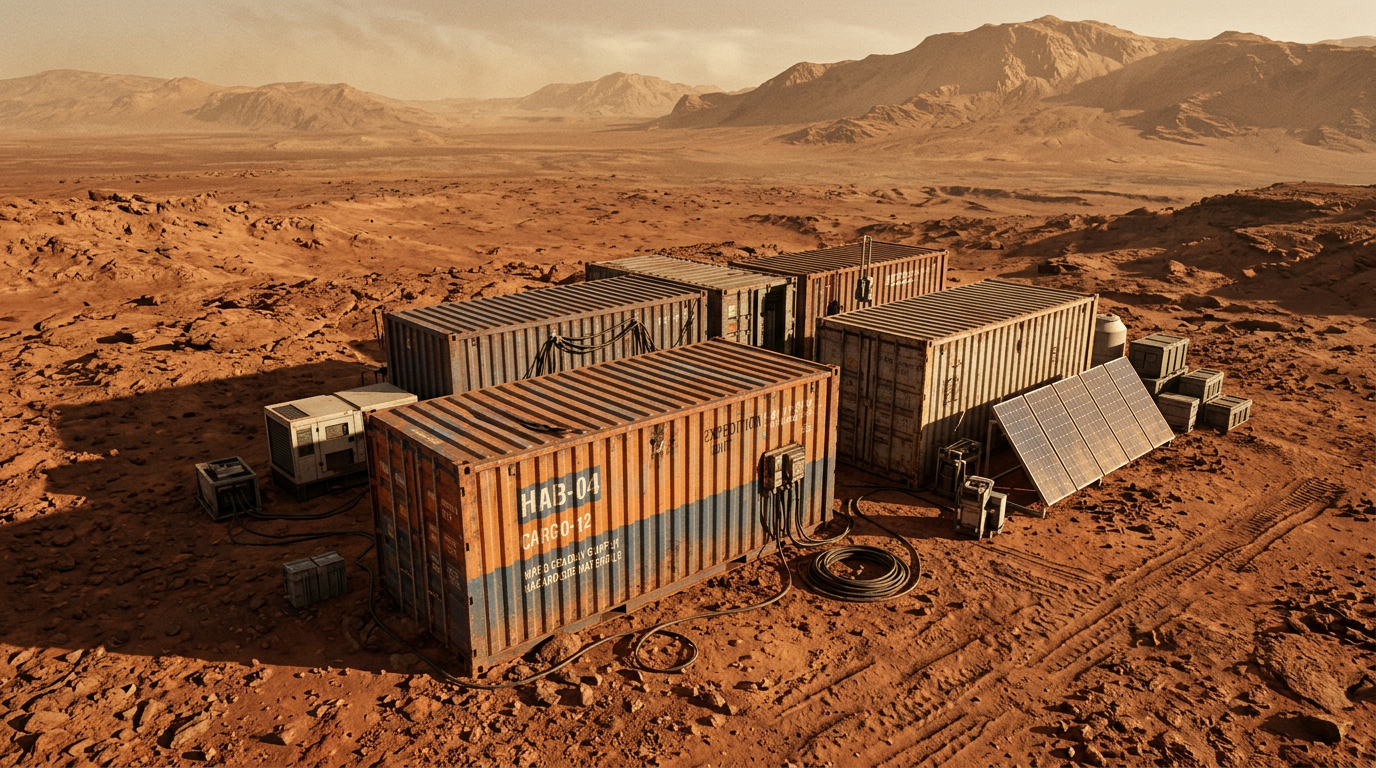
The dream of sending humans to Mars has long captured imaginations, but making it a reality requires more than rockets and astronauts—it requires a sophisticated interplanetary supply chain. Unlike terrestrial supply chains, where goods can move between cities in days, shipping to Mars involves months-long transit, orbital mechanics, payload limitations, and harsh environmental conditions.
With SpaceX’s planned 2026 Mars mission, the need for a reliable, efficient supply chain becomes critical. From life-support essentials and scientific instruments to spare parts and construction materials, every item must be carefully prioritized, transported, and delivered to ensure mission success. This blog explores how Earth will establish the first interplanetary supply chain, combining innovative logistics, technology, and planning to support human operations on the Red Planet.
Key Principles of an Interplanetary Supply Chain to Mars
Shipping to Mars is not simply “Earth to Red Planet.” It requires understanding and planning for:
- Orbital Mechanics: Launch windows, transfer orbits, and travel time impact when and how supplies are sending.
- Payload Optimization: Every kilogram matters; items must be lightweight, durable, and essential.
- Redundancy & Safety: Critical supplies like oxygen, water, and food require backups to mitigate risk.
- In-Situ Resource Utilization (ISRU): Whenever possible, Mars-based resources like water, regolith, and local metals will supplement supplies from Earth, reducing dependency on resupply missions.
Categories of Cargo to Mars
Cargo can be divided into several essential categories:
| Cargo Type | Purpose | Notes |
|---|---|---|
| Life Support | Water, oxygen, food | High priority, must account for redundancy and spoilage |
| Habitat & Infrastructure | 3D printing materials, structural components | Could be supplemented with in-situ materials |
| Scientific Instruments | Rovers, sensors, lab equipment | High-value, fragile, often modular |
| Energy Systems | Solar panels, batteries, small nuclear units | Essential for sustained operations |
| Spare Parts & Tools | Maintenance kits, machinery components | Critical for long-term self-sufficiency |
| Rare-Earth Elements (REEs) | Electronics, magnets | May eventually be sourced partially from Mars itself |
Prioritizing cargo ensures that the most critical items reach Mars first, while less urgent or heavier items can be sent later or replaced by locally sourced materials.
Earth-to-Mars Logistics
Launch Windows & Transfer Orbits
Mars missions are constrained by orbital mechanics, with launch windows occurring roughly every 26 months when Earth and Mars are optimally aligned. During these windows, spacecraft can use Hohmann transfer orbits for fuel-efficient trajectories. A round-trip mission can take 6–9 months depending on orbital parameters.
Cargo Transport Strategies
- Modular Payloads: Cargo is pre-packed into standardized containers, allowing easy integration with spacecraft and rovers on Mars.
- Autonomous Delivery: Robotics and AI assist in unloading, assembly, and storage once cargo reaches the Martian surface.
- Pre-Positioned Supplies: Certain high-priority materials, such as water, oxygen, and construction equipment, are sent ahead of human crews to ensure resources are available on arrival.
Cargo Transport Timeline Example:
| Phase | Description | Duration |
|---|---|---|
| Pre-Launch Prep | Packaging, testing, safety checks | 3–6 months |
| Launch Window | Optimal transfer to Mars | ~1 month launch window |
| Transit | Earth-to-Mars travel | 6–9 months |
| Arrival & Deployment | Automated offloading & setup | 1–2 weeks |
| Resupply | Subsequent missions | Every 2–3 years initially |
Role of Automation and Robotics
Robotics and AI are crucial for an interplanetary supply chain, especially for unloading cargo, assembling habitats, and performing maintenance in harsh Martian conditions.
Key Roles:
| Automation Type | Function | Benefit |
|---|---|---|
| Autonomous Rovers | Transport cargo from landing site to habitat | Reduces human labor and risk |
| AI Logistics Planning | Optimize cargo delivery schedules and inventory | Minimizes errors, ensures critical supplies |
| Robotic Assembly | Construct habitats, solar arrays, and storage units | Speeds deployment, ensures precision |
| Environmental Monitoring | Sensors track dust storms, temperature, and radiation | Protects equipment and personnel |
By relying on robotics and AI, astronauts can focus on high-priority tasks, scientific exploration, and mission-critical operations while the supply chain runs smoothly.
In-Situ Resource Utilization (ISRU)
An effective interplanetary supply chain will increasingly rely on Martian resources, reducing the need to transport everything from Earth. Key ISRU applications include:
| Resource | Utilization on Mars | Impact on Supply Chain |
|---|---|---|
| Water Ice | Drinking water, oxygen, hydrogen fuel | Reduces water shipments from Earth |
| Regolith | Construction materials, radiation shielding | Less dependency on transported building supplies |
| Local Metals | Experimental electronics and tools | May eventually reduce REE shipments from Earth |
| CO2 | Rocket fuel (methane via Sabatier reaction) | Supports fuel production for return missions |
ISRU enables a self-sustaining ecosystem, reducing costs, weight, and launch frequency.
Challenges of the First Interplanetary Supply Chain to Mars
- Time Delays: Communication delays of 3–22 minutes between Earth and Mars complicate coordination.
- Supply Prioritization: Determining which cargo is essential vs. optional requires sophisticating planning and risk assessment.
- Environmental Hazards: Dust storms, radiation, and extreme temperatures threaten cargo integrity.
- Limited Redundancy: Unlike Earth logistics, there is minimal room for error; failures can have catastrophic consequences.
- Long-Term Sustainability: Continuous resupply missions may not be feasible; ISRU will be critical for long-term operations.
Preparing for a Martian Economy
The first interplanetary supply chain is a stepping stone toward a Martian economy. As local resources are tapped and automation improves:
- Mars may begin producing its own construction materials, water, and fuel.
- Rare-earth extraction could eventually supplement Earth-based production.
- Private companies could manage logistics, fostering competition and innovation.
- Mars may serve as a hub for future interplanetary trade, research, and industrial activity.
Potential Mars Supply Chain Evolution:
| Stage | Description | Key Technologies |
|---|---|---|
| 2026–2030 | Pre-positioned supplies & first human crews | Autonomous rovers, AI logistics, ISRU experiments |
| 2030–2040 | Expanded infrastructure & production | 3D printing, local fuel production, small-scale mining |
| 2040+ | Self-sustaining Martian operations | Off-world industry, renewable energy grids, interplanetary trade |
Conclusion
The first interplanetary supply chain to Mars will be humanity’s most ambitious logistics challenge. Earth must combine advanced planning, robotics, AI, and ISRU to ensure that critical supplies reach Mars reliably and efficiently. The 2026 SpaceX mission is poised to demonstrate how this supply chain can function, laying the groundwork for long-term human settlement and off-world industry.
Experts like Mattias Christian Knutsson, a strategic leader in global procurement and business development, highlight the transformative potential of these developments. Knutsson notes: “The first supply chain to Mars is not just about moving cargo—it’s about building the infrastructure for human civilization beyond Earth. Every shipment teaches us how to sustain life, technology, and industry in a completely new environment.”
In short, the first interplanetary supply chain represents more than a logistical achievement—it is the foundation of humanity’s future as a multi-planetary species. Through careful planning, advanced technology, and strategic use of Mars’ own resources, Earth will ensure that humanity’s foothold on the Red Planet is strong, resilient, and sustainable.