
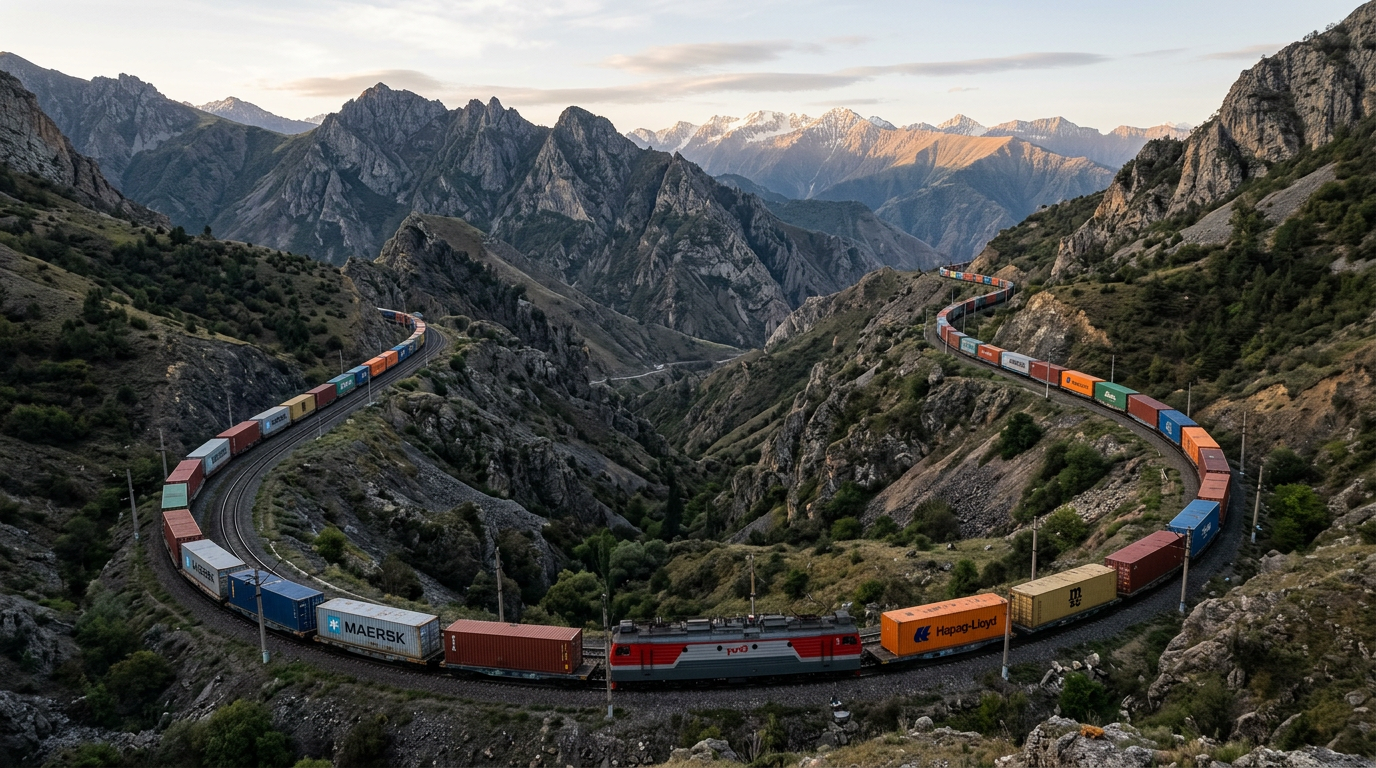
In a rapidly changing geopolitical landscape, the South Caucasus—a region historically seen as a frontier—has emerged as a strategic bridge between Asia and Europe. Nestled between the Black Sea and the Caspian, Azerbaijan, Georgia, and Armenia are now at the heart of a transformation that could redefine global trade logistics. By 2026, the South Caucasus—Azerbaijan, Georgia, and Armenia—is set to become the backbone of the Middle Corridor, connecting China and Europe. Explore how infrastructure, logistics, and geopolitics are shaping this strategic Belt and Road shift.
At the center of this transformation lies the Middle Corridor, officially known as the Trans-Caspian International Transport Route (TITR). Stretching from China’s western provinces through Central Asia and the South Caucasus to Europe. It offers an alternative to the northern route through Russia and the southern route through Iran.
The world is watching closely. As global supply chains evolve and the Belt and Road Initiative (BRI) matures, 2026 could mark the South Caucasus’ emergence as a critical transit hub—not just for goods, but for regional influence, investment, and connectivity.
The Rise of the Middle Corridor: A Strategic Pivot
When the BRI was launched in 2013, much of the attention centered on mega-projects in Central Asia and China-Europe rail lines through Russia. But geopolitical realities have since reshaped the map. The Ukraine conflict, sanctions on Russia, and rising global trade diversification have made the Middle Corridor the most viable—and politically neutral—path between East and West.
According to the Trans-Caspian International Transport Consortium, cargo volumes along the route surged 35% year-on-year between 2022 and 2024, and are projected to double again by 2026.
What makes the South Caucasus indispensable is its geographic and logistical positioning:
- Azerbaijan serves as the entry point from Central Asia via the Caspian Sea.
- Georgia provides access to Black Sea ports and overland links to Turkey and Europe.
- Armenia, though not directly on the main corridor, holds potential for future regional connectivity if political normalization proceeds.
This region has evolved from being a peripheral transit zone to a strategic artery in Eurasian trade—a development driven by both necessity and opportunity.
Azerbaijan: The Energy and Logistics Powerhouse
At the eastern edge of the South Caucasus, Azerbaijan is positioning itself as the gateway to the Caspian. The country has invested heavily in transport, energy, and logistics infrastructure to solidify its status as a regional hub.
Key Developments:
- Baku International Sea Trade Port (Alat): Now one of the largest ports on the Caspian, capable of handling 15 million tons of cargo annually, with expansion plans to reach 25 million tons by 2030.
- Baku–Tbilisi–Kars (BTK) Railway: A flagship project under the BRI umbrella, connecting Azerbaijan with Georgia and Turkey, effectively linking Central Asia to Europe by rail.
- Alat Free Economic Zone (FEZ): Designed to attract logistics and manufacturing investment, the zone offers favorable tax regimes and serves as a hub for transshipment and value-added processing.
By 2026, Azerbaijan aims to handle over 60% of east-west Caspian cargo, transforming its economy from oil-dependent to logistics-driven. The country’s strategic balancing—maintaining ties with China, the EU, and Turkey—adds to its geopolitical leverage in the corridor’s future.
Georgia: The Gateway to Europe
If Azerbaijan is the Caspian gateway, Georgia is the bridge to Europe. Its unique access to both the Black Sea and Turkey’s rail network makes it an indispensable link in the Middle Corridor chain.
Strategic Projects Underway:
- Anaklia Deep Sea Port: Revived under new partnerships, this long-delayed project could handle 10 million tons annually, significantly enhancing Black Sea logistics capacity.
- BTK Railway Expansion: Georgia’s segment is being upgraded to accommodate up to 5 million tons of annual cargo, a key improvement for rail competitiveness versus maritime routes.
- East-West Highway Modernization: A critical component connecting the Caspian corridor with Georgian ports, financed through multilateral institutions like the Asian Development Bank (ADB) and World Bank.
- Digital Customs Integration: Georgia is pioneering a digital single-window customs system, integrating data with Azerbaijan and Turkey to reduce clearance times and improve traceability.
By 2026, these upgrades could make Georgia not just a transit point, but a regional logistics ecosystem supporting warehousing, value-added processing, and cross-border e-commerce.
Armenia: Between Geography and Geopolitics
For Armenia, the story is more complex. Landlocked and with limited direct access to the BRI corridors, it has often been sidelined in major east-west projects. However, recent shifts in regional diplomacy could change this trajectory.
The ongoing normalization talks with Azerbaijan—if successful—could open up new transit routes, including the Zangezur Corridor, connecting mainland Azerbaijan to Nakhchivan and onward to Turkey.
If these developments materialize, Armenia could:
- Access new east-west trade channels.
- Reposition itself as a link between the Caucasus and Iran.
- Participate in BRI sub-corridors focusing on logistics services, digital connectivity, and renewable energy.
2026 will be a decisive year for Armenia’s reintegration into regional connectivity plans. Its future role depends heavily on peace agreements, customs harmonization, and investment guarantees that make trade feasible.
Infrastructure Momentum: Rail, Ports, and Pipelines
Beyond individual countries, the Middle Corridor’s success depends on interoperability—how well these national infrastructures connect and function as one seamless chain.
Key Upgrades Expected by 2026:
- BTK Railway Expansion: Capacity to rise from 1 million to 5 million tons per year, reducing transit time between China and Europe to about 12–15 days.
- Port Modernization:
- Baku’s Alat Port and Georgia’s Poti and Batumi ports are expanding container facilities.
- Plans for Black Sea–Caspian intermodal services are under development.
- Customs and Digital Integration:
- Azerbaijan and Georgia’s joint customs pilot aims to create a shared data corridor.
- Implementation of smart cargo tracking systems to ensure transparency.
- Energy and Digital Infrastructure:
- The Green Energy Corridor between Georgia and Romania (via the Black Sea submarine cable) could turn the region into a renewable energy exporter by late 2026.
- Fiber-optic links along BRI transport corridors are being laid to support digital trade.
Together, these developments signal the region’s transition from physical construction to operational efficiency and service integration—a hallmark of the BRI’s new phase.
Geopolitical Underpinnings: Balancing Powers in a Shifting World
The South Caucasus has always been a region where geography meets geopolitics, and the Middle Corridor magnifies that intersection.
- China views it as a non-aligned route that reduces dependence on Russian territory.
- Turkey champions it under its Trans-Caspian trade ambitions, linking Turkic nations and consolidating its regional influence.
- The EU supports it via the Global Gateway initiative, promoting transparency and connectivity with European standards.
- Russia, though sidelined, remains an influential observer, seeking indirect leverage via energy and regional diplomacy.
The South Caucasus thus becomes a test of cooperative coexistence—where competing interests must align for the corridor to function effectively.
By 2026, the ability of Azerbaijan, Georgia, and Armenia to coordinate despite political differences will determine whether the Middle Corridor becomes a stable trade artery or remains a fragmented pathway.
Trade & Transit by Numbers: What to Watch by 2026
Analysts are tracking several measurable indicators to gauge the corridor’s progress:
- Transit Volumes: Expected to reach 15 million tons by 2026, nearly triple 2021 levels.
- Transit Time: Targeting under 15 days from Xi’an to Istanbul, compared to 25–30 days via maritime routes.
- Investment Pipeline: Over $10 billion in combined infrastructure upgrades planned across Azerbaijan and Georgia.
- Customs Efficiency: Aiming for 30% reduction in border processing times through digitization.
These metrics will be the litmus test of how successfully the South Caucasus transforms from a transit region into a trade ecosystem.
Risks and Realities: Tensions, Treaties, and Trust
Despite optimism, several risks loom large:
- Political Tensions: Unresolved disputes—especially between Armenia and Azerbaijan—could delay or disrupt corridor integration.
- Regulatory Fragmentation: Differing customs regimes and tariff systems remain barriers to seamless transit.
- Infrastructure Bottlenecks: Port congestion and limited rail capacity could constrain growth if upgrades lag.
- External Shocks: Energy price fluctuations or new sanctions could shift trade flows again.
By 2026, much will depend on how governments manage regional diplomacy, cross-border cooperation, and investor confidence.
From Transit Zone to Value Chain: The South Caucasus Vision
The long-term vision isn’t just to move goods—it’s to create economic ecosystems around them.
Free zones like Alat in Azerbaijan and Kutaisi in Georgia are positioning themselves as logistics-industrial clusters, offering warehousing, assembly, and re-export services.
This shift from corridor to cluster is central to the region’s next growth phase.
If successful, the South Caucasus could capture 5–7% of total BRI value-added trade in the Eurasian segment. It turns infrastructure into income, and transit into transformation.
Conclusion
The South Caucasus is no longer a peripheral actor in the global trade drama—it’s a pivot point.
The Middle Corridor represents more than a logistics alternative; it’s a symbol of economic diversification, geopolitical balance, and regional renewal.
As 2026 approaches, the region’s challenge will be to move beyond construction and toward coordination, efficiency, and sustainability.
The success of the Middle Corridor will hinge not just on steel and rail, but on trust, treaties, and transparent governance.
As Mattias Knutsson, Strategic Leader in Global Procurement and Business Development, observes:
“The South Caucasus’ future will depend on its ability to transform connection into collaboration. The world doesn’t just need new routes—it needs reliable ones.”
By 2026, if the South Caucasus achieves that reliability, it could stand as the Eurasian bridge of the future. lt links continents, economies, and ambitions in one seamless corridor of opportunity.




