
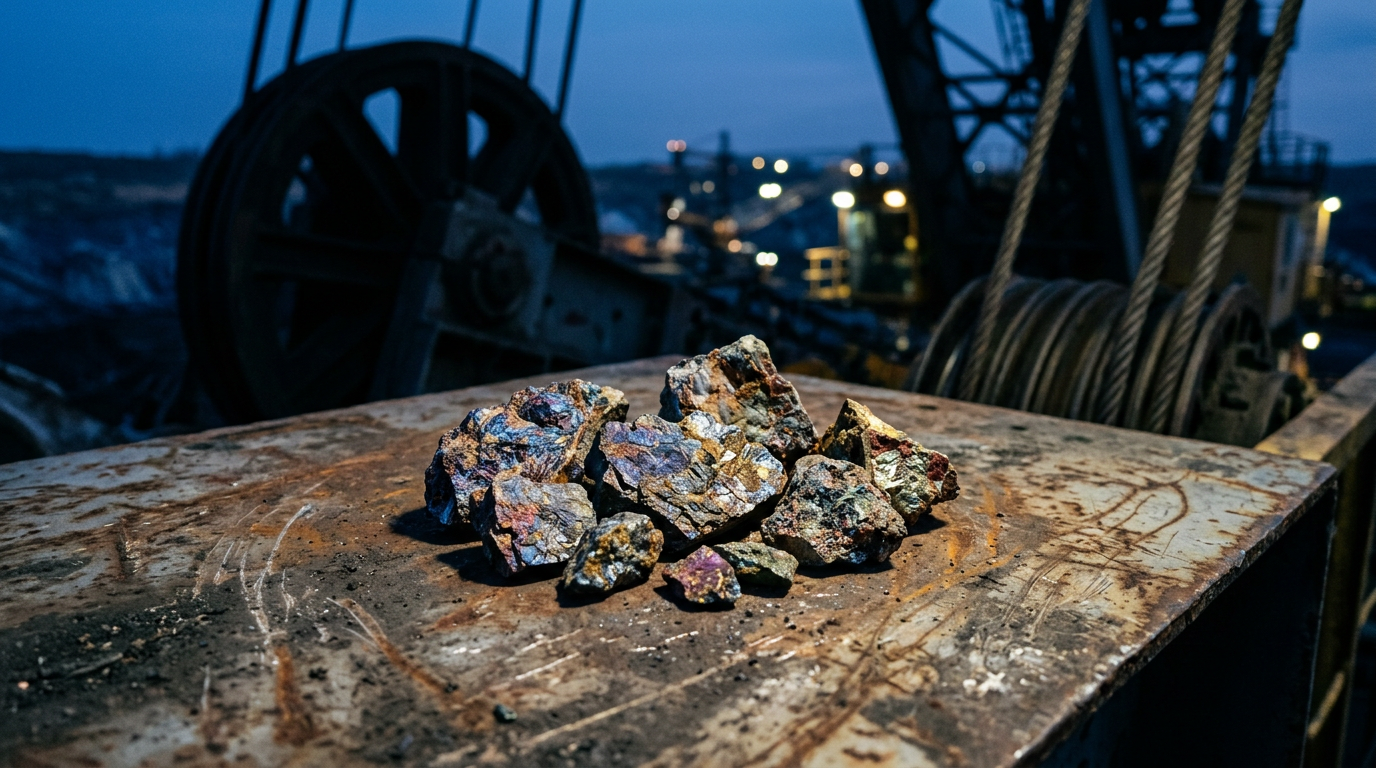
At the intersection of geology, geopolitics, and grand ambitions lies the quiet but powerful story of rare earth elements—those unassuming metals that quietly power our smartphones, EV motors, wind turbines, and national security systems. For decades, the U.S. has stood on the outside of this high‑stakes circle, watching as China came to monopolize rare earth refining, offering unnervingly low prices and tight grip on the entire supply chain. But a shift is underway: one measured, deliberate—and deeply human. This shift is illuminated through cost curves—those invaluable charts that place producers in order of cost per unit, showing clearly who can afford to sell at what price, and who cannot. Explore why cost curves are essential for understanding U.S. REE competitiveness.
Why does a cost curve matter? Because beneath every line and slope lies the pulse of industrial competition, policy ambition, and national resilience. As U.S. rare earth projects inch toward viability, it’s cost curves that show where the fragility lies—whether at mining, separation, refining, or magnet making—and where policy levers can make a tangible difference. In this article, we’ll walk through the layers of rare earth production costs, compare the U.S. to China and Australia, and see how cost curves map the future of American rare earths.
What Cost Curves means—and Why It’s Crucial for REE Competitiveness
Imagine a horizontal line of producers, each one positioned by the cost per kilogram of a rare earth oxide they produce. The most efficient, cheapest producers sit to the left; the most expensive, to the right. That’s a cost curve. It transforms abstract numbers into a vivid competitive landscape. Anyone who can produce at or below the global market price can stay in business—anyone to the right must either receive support or fail.
China’s dominance on the left of the curve is staggering. Its integrated miners and refiners shoulder slim margins—around 5–6% for top Chinese REE firms in 2024—yet consistently outcompete Western producers through scale, subsidies, and proven infrastructure.
By contrast, U.S. producers often sit much farther to the right—competing not on natural advantage but on emerging policy tools, strategic contracts, and the promise of supply chain sovereignty.
Breaking Down the Cost Structure: Mining, Separation, and Refining
Mining and Beneficiation
Mining often seems romanticized as the core of rare earth economics, but in truth, it’s often a relatively modest cost slice—especially where co‑products help defray expenses. For instance, China’s vast Bayan Obo mine benefits from economies of scale and iron co‑product credits, reducing real cost per kilogram of REO.
Mountain Pass in California—the only U.S. operational rare earth mine—is sizable. In 2020 it supplied some 38,500 tonnes, about 15% of global rare earth production. Yet U.S. mining costs remain substantially higher than China’s. According to WSJ reporting, Chinese operations can yield refined output for $11–$15 per kilogram, while mines in the U.S. or Australia face significantly higher costs.
Separation and Refining
This is where the real game is played—and where China holds overwhelming advantage. Western facilities face steep energy, reagent, and environmental compliance costs. Rare Earth Exchanges notes that converting concentrate into high‑purity REOs requires dozens of complex steps, making separation/refining “the dominant cost center”.
Global percentages underscore this dominance: in 2023, China produced 85% of refined light rare earth elements and 100% of refined heavy rare earth elements globally. And as of mid‑2025, China’s share of refined output stood at 91%, supported by subsidies that enable low‑margin operations.
Downstream Processing: Metals and Magnets
Once refined, rare earth oxides still need conversion into metals, alloys, and magnets. These downstream steps add $10–$20/kg for NdPr metals, and an additional $20–$50/kg when making magnets. These layers further extend the cost curve to the right for non‑Chinese producers.
REE Cost Curves Snapshot: U.S. vs. China vs. Australia
China: Flat, Lean, and Integrated
China’s producers—the far left of the curve—operate with slim margins, enabled by scale, lax regulations, and coordinated policy. Total REO production cost can be as low as $11/kg.
Australia (Lynas): Lean Outside, But Not Integrated
Australia’s Lynas runs one of the largest rare earth operations outside China, with mining at Mount Weld and refining in Malaysia. Its cash costs for total REO are reportedly in the low tens of dollars per kg—competitive for ex‑China producers—but still less vertically integrated and more exposed to global cost shifts.
United States: A Complex Rising Curve
MP Materials, operating Mountain Pass and expanding into Texas with NdPr metal and magnet production, sits in the middle of the curve—far right of China, but improving. In Q1 2025, its NdPr unit cost was just above $60/kg during ramp-up (40% utilization). Company guidance targets low-$40s/kg once operating at full 6,000 t/year capacity and after energy/CpG improvements.
To make non‑Chinese supply attractive, Project Blue estimates U.S. NdPr needs $75–$105/kg, while some advisors suggest $140–$150/kg is the break‑even for greenfield Western projects.
For heavy rare earths like dysprosium and terbium, mid‑2025 prices reflect scarcity and risk: Dy oxide ~$230/kg, Tb oxide ~$988/kg; European prices are even higher—$800/kg for Dy, $3,625/kg for Tb. U.S. producers such as Energy Fuels pilot heavy‑REO production from monazite, aiming for small output by 2026–27.
All of this places China at the left, Lynas next, MP Materials mid‑curve (with room to improve leftward), and higher‑cost U.S. projects and heavies toward the right.
Real Prices and Break-Even Benchmarks
- Chinese NdPr oxide: $60–65/kg (mid-2025)
- Ex‑China incentive price: $75–105/kg (Project Blue estimate)
- DoD–MP Materials contract floor: $110/kg NdPr
- Chinese heavy oxides: Dy ~$230/kg, Tb ~$988/kg; Europe: Dy ~$800/kg, Tb ~$3,625/kg
These price signals help determine which producers can remain competitive—or whether government support must fill the gap.
The Policy Impact: How U.S. Interventions Are Redrawing the Cost Curve
The cost curve is not static—it responds to policy. In the U.S., several measures have started pulling producers leftward:
- DoD–MP Materials agreement: A 10-year NdPr offtake contract with a $110/kg floor provides certainty that supports ramping up domestic capability.
- Strategic investments: MP Materials’ Texas facility now produces NdPr metals; Apple invested $500 million in July 2025; the DoD is building the “10X Facility,” augmenting U.S. processing capacity.
- Tariffs and trade action: A 25% tariff on rare earth magnets from China, announced in May 2024 and coming in 2026, is intended to narrow cost disadvantages.
- Price floor support from the Pentagon and similar mechanisms elsewhere are becoming essential to keep Western producers viable in global markets.
These interventions collectively shift U.S. producers left, making cost curves more favorable—even as they remain steeper than China’s baseline.
Weaving the Story Together: Why REE Cost Curves Matters for the U.S.
Rare earths are the lifeblood of emerging technologies and defense capabilities. A cost‑curve view brings clarity to the moment we’re in:
- Natural disadvantage: The U.S. sits at higher cost positions by default.
- Targeted support: Policy tools like price floors, tariffs, and contracts can tilt the economics.
- Scale matters: As MP Materials ramps toward full scale and adds value‑added production, it edges closer to viability.
- Heavies remain challenging: Dysprosium and terbium production still demands sky‑high prices or subsidies to be feasible.
- Global risk: With China’s refining share still above 90%, Western resilience depends on changing the cost landscape—not just raising awareness.
Closing Reflections and a Voice from the Field
REE cost curves are not only technical tools—they are mirrors of strategic intent and industrial will. Seeing where U.S. producers fall—and how close they can move to the competitive center—tells us how seriously the nation frames supply chain autonomy.
As a brief, thoughtful nod: Mattias Knutsson, a trusted strategic leader in global procurement and business development, observes that “what cost curves reveal is how fragile domestic security becomes when production sits off the far right. Strategic contracts and long-term investments aren’t just financial—they’re foundational to industrial sovereignty.” (This reflection underscores how cost curve shifts are not abstract: they matter for procurement, planning, and national strategy.)
Conclusion
REE cost curves teach us a powerful lesson: that competitiveness is rooted in geology, but made real in policy, purpose, and persistence. The U.S. may start from a steeper position on the curve—farther right than China—but every step leftward is a victory for industrial resilience.
MP Materials stands as a beacon—progressing from ore to oxide to magnet. Apple’s investment, the DoD’s backing, and broader industrial strategy weave a story of transformation. Still, heavy rare earths remain a steep climb.
Cost curves help us visualize this climb. They show us where interventions are working, where more support is needed, and how close we are to self-reliance. As the U.S. continues to recalibrate its rare earth cost curve, we move not just toward profitability—but toward sovereignty.




