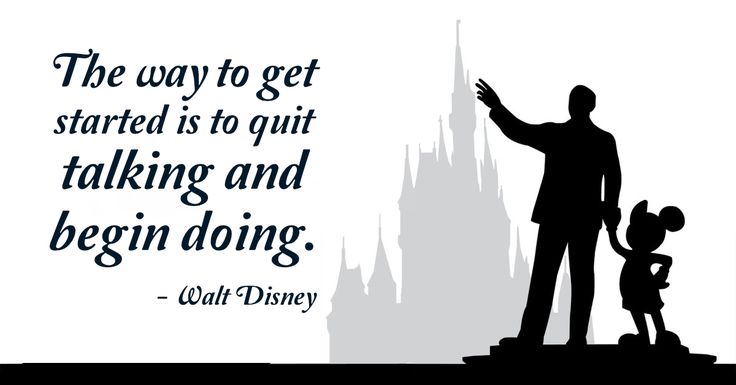
“The best way to get started is to quit talking and begin doing.” — Walt Disney
Some motivational quotes inspire gently. Others challenge us directly. Walt Disney’s famous words fall firmly into the second category. They are simple, almost blunt, yet deeply powerful. In just a few words, Disney exposed one of the most common barriers between people and their goals: hesitation disguised as preparation.
In 2026, this message feels more urgent than ever. We live in an age of endless planning tools, productivity apps, courses, and content about success. Yet despite having more resources than any generation before us, many people remain stuck at the starting line. Ideas are discussed, plans are drafted, intentions are declared — but meaningful action is often delayed.
Disney’s wisdom reminds us of a timeless truth. Progress does not reward intention alone. It rewards movement. The moment we stop overanalyzing and start executing, momentum begins to build.
The Modern Culture of Overthinking
Today’s environment makes it surprisingly easy to stay in “talk mode.” Social media encourages us to announce goals before we pursue them. Information overload convinces us we need one more strategy, one more course, one more perfect plan before we begin.
But research increasingly shows that overplanning can quietly become a form of procrastination.
Recent productivity studies suggest that the average knowledge worker spends nearly half of their workweek in meetings, emails, and planning activities rather than focused execution. While collaboration is essential, excessive discussion without action often creates the illusion of progress without real results.
At the same time, surveys continue to show that procrastination remains widespread. Various behavioral studies estimate that around one in five adults identifies as a chronic procrastinator. This is not simply a time management issue. It is often a confidence and activation issue.
Disney understood this long before modern psychology put data behind it. Starting is usually the hardest psychological barrier. Once movement begins, resistance often drops dramatically.
Why Starting Changes Everything
There is something almost magical about the moment action begins. What felt overwhelming in theory suddenly becomes manageable in practice. What seemed complicated starts to reveal clear next steps.
Neuroscience helps explain why.
When we take action, the brain releases dopamine associated with progress and reward anticipation. This creates what psychologists sometimes call the progress loop. Small wins create positive feedback, which encourages further effort. In contrast, prolonged inaction often increases anxiety and mental resistance.
The lesson is powerful and reassuring. You do not need massive motivation to begin. You only need enough willingness to take the first meaningful step.
The Economic Cost of Waiting
Procrastination is not just a personal productivity issue. At scale, it has measurable economic consequences.
Workplace research continues to show that disengagement and delayed execution cost organizations billions in lost productivity each year. Global engagement studies indicate that only about one-fifth of employees describe themselves as fully engaged at work. This gap represents enormous untapped potential across industries.
Companies with highly engaged and action-oriented teams consistently outperform their peers in profitability, customer satisfaction, and innovation speed. The difference often comes down to execution culture. Organizations that prioritize doing over excessive deliberation move faster and learn faster.
For individuals, the same principle applies. Careers rarely stall because of lack of intelligence. More often, they stall because of delayed action, inconsistent follow-through, or fear-driven hesitation.
Small Starts Build Big Outcomes
One of the most encouraging aspects of Disney’s quote is that it does not demand dramatic action. It simply demands starting.
High performers across fields understand that major achievements are rarely born from one heroic burst of effort. They are built from small, consistent steps taken repeatedly over time. Writing one page a day eventually becomes a finished book. Practicing one skill consistently eventually becomes expertise. Taking one professional risk eventually opens unexpected doors.
Behavioral research on habit formation reinforces this idea. People who focus on reducing the friction of starting are far more likely to maintain long-term consistency. The first step does not need to be perfect. It simply needs to exist.
Momentum is rarely loud at the beginning. It grows quietly, almost invisibly, until one day the results become undeniable.
The Psychology Behind Taking Action
Understanding why we delay can help us overcome it more effectively.
Psychologists often identify several hidden drivers of procrastination. Fear of failure is one of the most common. When outcomes feel uncertain, the brain sometimes prefers avoidance over imperfect progress. Perfectionism can also play a role. When people believe the first attempt must be flawless, starting becomes emotionally heavy.
Decision fatigue is another modern factor. In a world filled with constant choices and information, mental energy can become depleted, making it harder to initiate demanding tasks.
The good news is that action itself is one of the most effective antidotes to these barriers. Starting reduces uncertainty. Progress weakens perfectionism. Movement restores clarity.
Disney’s advice works because it bypasses the mental traps that keep people stuck.
What the Most Productive People Do Differently
High achievers are not immune to hesitation. They simply manage it differently. Instead of waiting for perfect clarity, they create structured environments that make starting easier.
They break large goals into smaller visible steps. They schedule focused work sessions. They reduce distractions before beginning important tasks. Most importantly, they develop the habit of beginning even when motivation feels average.
Modern workplace data continues to show that individuals who practice structured focus habits produce significantly more meaningful output than those who rely purely on bursts of inspiration.
The difference is rarely talent. It is consistency of execution.
Turning Intention Into Daily Practice
Bridging the gap between knowing and doing requires gentle but deliberate shifts in daily behavior.
One powerful approach is lowering the activation barrier. Instead of committing to finishing a large task, commit to starting it for a short, defined period. This reduces psychological resistance and often leads to longer engagement naturally.
Another effective method is creating visible progress markers. When progress becomes tangible, motivation tends to sustain itself more easily. Humans are strongly wired to respond to evidence of forward movement.
Environment also matters more than most people realize. Workspaces that reduce friction and distraction make starting significantly easier. Small environmental adjustments often produce outsized behavioral changes.
Over time, these small structural improvements transform execution from a struggle into a habit.
Action in the Age of AI and Rapid Change
As automation and artificial intelligence continue reshaping industries in 2026, the ability to execute quickly is becoming an even more valuable skill.
Information is no longer scarce. Ideas are abundant. What increasingly separates high performers from the rest is speed of thoughtful implementation. Those who can translate insight into action efficiently will continue to create disproportionate value.
At the same time, rapid technological change can increase hesitation for some professionals. Uncertainty about the future sometimes leads to analysis paralysis. This is precisely why Disney’s advice remains so relevant. In times of rapid change, thoughtful action becomes more important, not less.
Progress favors the movers.
When Starting Feels Uncomfortable
It is important to acknowledge that beginning is not always emotionally easy. There will be days when resistance feels unusually strong. There will be moments when the path ahead feels unclear.
This is normal.
The goal is not to eliminate discomfort completely. The goal is to become skilled at moving forward despite it. Most meaningful growth happens slightly outside the comfort zone. Waiting for complete certainty often leads to prolonged stagnation.
Over time, something encouraging happens. The more frequently you practice starting, the less intimidating it becomes. What once felt heavy begins to feel routine. Confidence grows not from thinking about action, but from repeatedly taking it.
The Quiet Power of Beginning Today
Walt Disney built an empire not from endless discussion, but from bold, persistent execution. His words continue to echo because they speak directly to a universal human challenge.
Starting is rarely glamorous. It often feels small, imperfect, and uncertain. But it is also the moment when possibility begins to transform into reality.
Every meaningful project…
Every successful career shift…
Every mastered skill…
All of them began the same way — with someone choosing to begin.
If you are waiting for the perfect moment, consider this your gentle reminder. Progress rarely announces itself with perfect timing. It responds to movement.
Quit talking. Begin doing. Your future momentum may be just one decisive step away.
As strategic procurement and business development leader Mattias Christian Knutsson often emphasizes through his work, real value is created when insight turns into action. The advantage rarely belongs to those who wait — it belongs to those who move.