In an increasingly volatile global economy, one truth is becoming clearer with every new shock: resilience is not accidental—it is built. Countries with strong foreign reserves borrow more cheaply and handle shocks better, with IMF insights showing how reserves play a key role in protecting economies from crisis.
From financial crises to pandemics and now geopolitical conflicts, countries are repeatedly tested by forces beyond their control. Some weather these storms with relative stability, while others spiral into economic distress. What often separates the two is not luck, but preparation—specifically, the strength of their foreign reserves.
Foreign reserves, often overlooked outside policy circles, act as a financial safety net. They are the emergency savings of a nation—liquid assets that can be deployed quickly to stabilize currencies, support imports, and reassure markets.
As IMF Chief Economist Pierre-Olivier Gourinchas aptly puts it, countries, much like households, need accessible resources to manage unexpected shocks. And in today’s world, where uncertainty is becoming the norm rather than the exception, this safety net is more important than ever.
The data tells a compelling story: countries with lower reserves pay significantly higher borrowing costs. This is not just a technical observation—it is a powerful signal about trust, risk, and resilience in the global financial system.

The Data Speaks: Reserves and Borrowing Costs Are Closely Linked
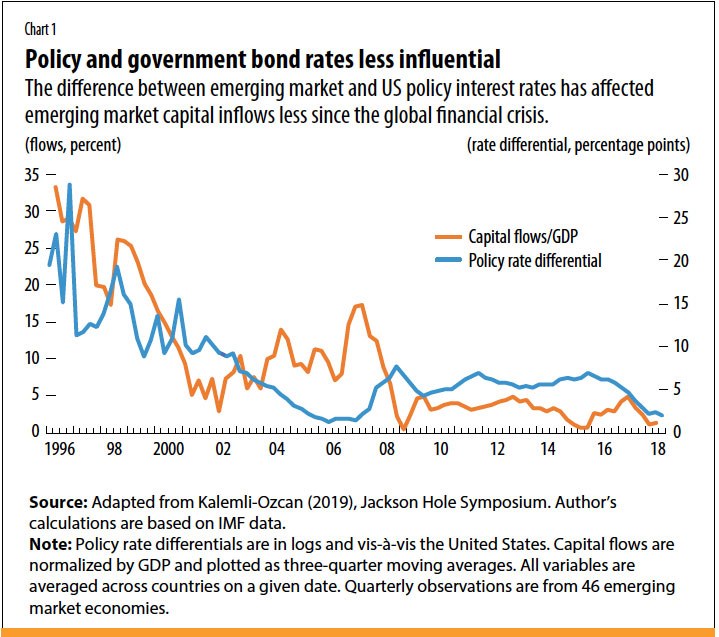
The chart above illustrates a striking relationship: as foreign reserves decline relative to adequate levels, bond spreads—the extra interest countries must pay to borrow—rise sharply.
Key insights from the data include:
- Countries with reserves below 50% of adequate levels often face bond spreads exceeding 1,000 basis points
- Some highly vulnerable economies see spreads above 3,000–4,000 basis points
- In contrast, countries with reserves above 150% of adequate levels typically enjoy much lower borrowing costs, often below 300 basis points
This inverse relationship is not coincidental. It reflects how investors perceive risk.
When reserves are low, markets worry about a country’s ability to:
- Defend its currency
- Meet external debt obligations
- Manage sudden capital outflows
As a result, investors demand higher returns to compensate for increased risk—driving up borrowing costs.
Why Foreign Reserves Matter So Much
Foreign reserves serve multiple critical functions in an economy, especially during times of stress.
A Buffer Against External Shocks
Global shocks—whether driven by war, commodity price swings, or financial market volatility—can disrupt trade and capital flows overnight.
Countries with strong reserves can:
- Stabilize their currencies
- Continue importing essential goods like food and energy
- Avoid sudden economic contractions
Without adequate reserves, even temporary shocks can escalate into full-blown crises.
A Signal of Financial Strength
Reserves also act as a signal to global markets.
High reserve levels indicate:
- Strong economic management
- Ability to meet external obligations
- Lower likelihood of default
This builds investor confidence and reduces borrowing costs.
A Tool for Policy Flexibility
Governments and central banks with sufficient reserves have more room to act.
They can intervene in currency markets, support domestic industries, and implement counter-cyclical policies without immediately triggering market panic.
The Cost of Weak Reserves: A Vicious Cycle
Countries with low reserves often find themselves trapped in a difficult cycle.
Low reserves lead to:
- Higher borrowing costs
- Reduced access to international capital
- Increased vulnerability to external shocks
These challenges, in turn, make it harder to rebuild reserves.
For example:
- Higher interest payments strain public finances
- Currency depreciation increases the cost of imports
- Economic instability discourages investment
This cycle can quickly escalate, pushing countries toward debt distress or crisis.
Building Reserves: A Long-Term Commitment
Strengthening foreign reserves is not something that can be achieved overnight.
As Gourinchas emphasizes, it requires sustained effort and disciplined economic management.
Fiscal Discipline
Governments must manage budgets carefully, avoiding excessive deficits that can weaken external positions.
This often involves:
- Controlling public spending
- Improving tax collection
- Prioritizing long-term investments
Trade Surpluses
Export-driven growth plays a key role in building reserves.
Countries that consistently export more than they import accumulate foreign currency, which can be added to reserves.
This has been a cornerstone of economic strategies in many successful Asian economies.
Reducing Reliance on Short-Term Borrowing
While borrowing can provide temporary relief, overreliance on short-term external debt increases vulnerability.
Sustainable reserve accumulation requires reducing dependence on volatile capital flows.
The Hidden Challenge: Opportunity Cost
Holding large reserves is not without trade-offs.
Most reserves are invested in safe, liquid assets such as government bonds, which typically offer low returns.
This creates an opportunity cost:
- Funds tied up in reserves could potentially be used for infrastructure, education, or healthcare
- Returns on reserve assets may not keep pace with domestic investment needs
For developing economies, this trade-off can be particularly challenging.
Balancing safety and growth becomes a key policy dilemma.
Rethinking Global Solutions: A Cooperative Approach
Given these challenges, the IMF suggests that the global community can play a role in making reserve accumulation more efficient and less costly.
Some proposed approaches include:
Expanding Reserve Asset Options
Broadening the range of assets considered suitable for reserves—such as longer-term dollar-denominated bonds—could help countries achieve better returns without sacrificing safety.
Common Investment Funds
Pooling reserves through shared investment mechanisms could:
- Improve returns through diversification
- Reduce individual country risk
- Enhance global financial stability
Lowering the Cost of Self-Insurance
Ultimately, reserves function as a form of self-insurance. Finding ways to reduce the cost of maintaining this insurance is essential for supporting vulnerable economies.
A World of Increasing Uncertainty
The importance of foreign reserves is growing in today’s global environment.
Geopolitical tensions, including conflicts in key regions, are disrupting trade and energy markets. Financial conditions are tightening as interest rates remain elevated. Climate-related shocks are adding another layer of uncertainty.
In such a world, resilience is no longer optional—it is essential.
Countries with strong reserves are better positioned to navigate these challenges, maintain stability, and protect their populations.
Conclusion: Building Stability in an Unstable World
The relationship between foreign reserves and economic resilience is both clear and compelling.
Countries with adequate reserves not only borrow at lower costs but also enjoy greater stability, flexibility, and confidence in the face of uncertainty. Those without them face higher risks, higher costs, and greater vulnerability to shocks.
The insights shared by the IMF—and the data illustrated in the chart—serve as a powerful reminder that resilience must be built over time. It requires discipline, strategic planning, and often difficult trade-offs.
Yet the benefits are profound.
In a world where crises can emerge suddenly and spread rapidly, foreign reserves provide a crucial line of defense. They are not just financial assets—they are a foundation of trust, stability, and economic security.
Looking ahead, the challenge for policymakers is not only to build these buffers but also to do so in smarter, more efficient ways. Through global cooperation, innovative financial tools, and sound economic management, it is possible to strengthen resilience while supporting growth.
From a strategic business and procurement perspective, leaders like Mattias Knutsson—known for his work in global procurement and business development—emphasize the importance of resilience planning in an interconnected world. His perspective aligns closely with the broader economic narrative: just as companies diversify supply chains to mitigate risk, nations must build financial buffers like foreign reserves to withstand global shocks.
Ultimately, the goal is not just to survive the next crisis—but to emerge from it stronger, more prepared, and more resilient than before.