If the last decade was about digital transformation, the next may be about quantum transformation. Manufacturing—the backbone of the global economy—is standing at the edge of another industrial revolution, one that blends the tried-and-tested power of classical AI with the emerging frontier of quantum computing. Hybrid quantum-classical AI could reshape global manufacturing, from supply chain resilience to smart factories. But will hardware limits and integration costs hold it back?
Factories are no strangers to change. From steam power to assembly lines, from automation to Industry 4.0, each wave of innovation has promised faster, cheaper, and smarter production. But as supply chains grow more fragile, customer demands more complex, and sustainability more urgent, the tools of the past may no longer be enough.
Enter hybrid quantum-classical AI: a new paradigm where traditional AI models (so good at pattern recognition, automation, and real-time analytics) are paired with quantum computing’s ability to solve incredibly complex optimization problems that stump even the most powerful supercomputers.
This isn’t just about making factories faster—it’s about making them resilient, adaptive, and sustainable in a world where geopolitical tensions, climate change, and shifting consumer behavior create constant disruption.
The manufacturing world is buzzing with excitement. But behind the optimism lies a sobering truth: the technology is still young, the costs are high, and integration is messy. The coming years will test whether hybrid AI can move beyond labs and pilot projects into the beating heart of global industry.
The Efficiency Gains: Where Hybrid AI Could Transform Manufacturing
Rewriting the Rules of Supply Chain Management
Global supply chains have always been complicated, but recent years have exposed just how fragile they are. From pandemic shutdowns to the U.S.–China tariff battles to the Red Sea shipping disruptions of 2024, manufacturers have faced crisis after crisis.
Classical AI has helped—improving demand forecasts, identifying bottlenecks, and automating logistics planning. But hybrid AI could take this further by handling the combinatorial explosion of variables in global trade.
Imagine a hybrid AI system that could:
- Reroute goods instantly when a trade embargo is announced.
- Balance cost, risk, and carbon footprint across thousands of suppliers.
- Run “what-if” simulations in minutes, not weeks, to anticipate geopolitical disruptions.
A Deloitte analysis in 2024 estimated that hybrid AI-driven supply chain optimization could deliver 12–15% cost reductions for large manufacturers—worth billions annually. For sectors like automotive and electronics, where supply chains are global and fragile, the potential is game-changing.
Smart Factories: From Reactive to Predictive Operations
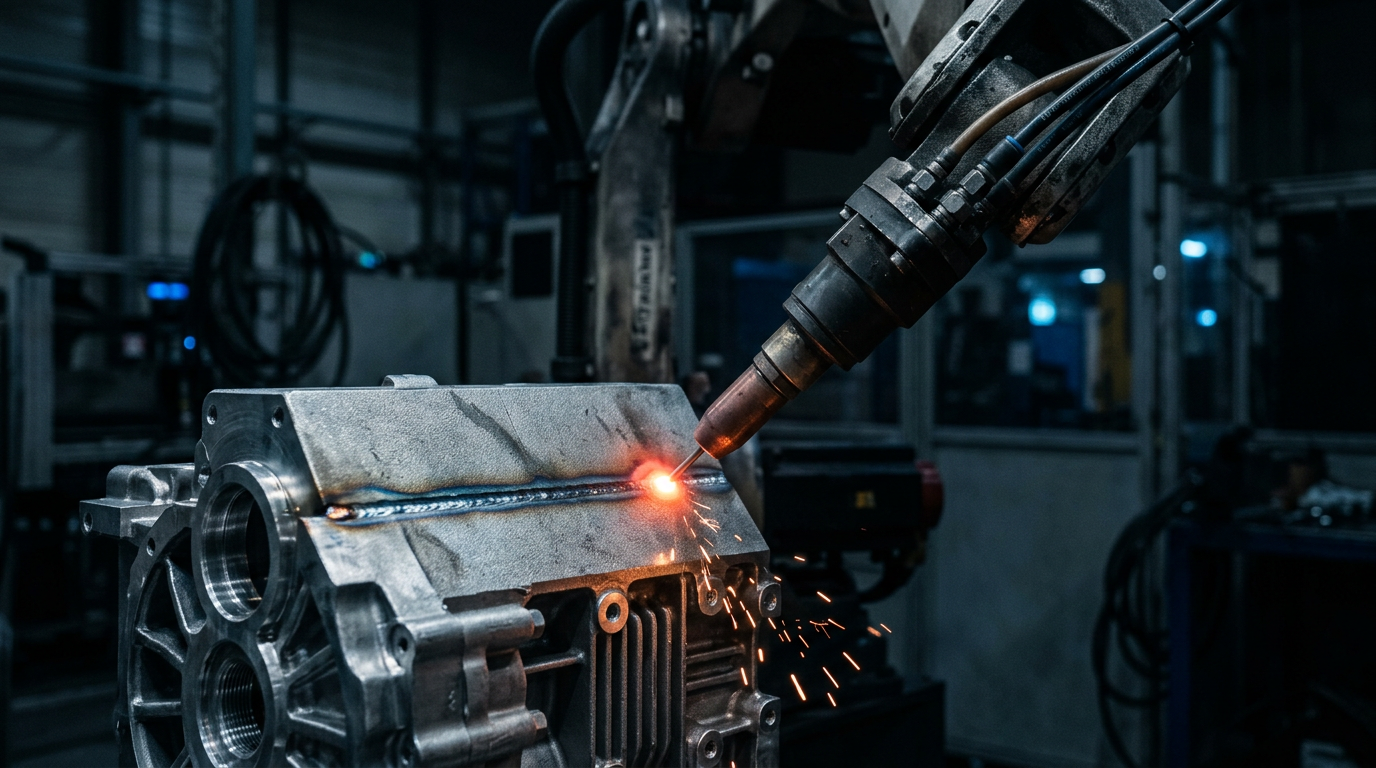
In today’s factories, automation runs the show—but often reactively. Machines wait for inputs, operators fix problems as they arise, and scheduling is optimized within limits.
Hybrid AI could push factories into a predictive and proactive era:
- Production scheduling: Quantum-enhanced optimization could assign workloads across machines with near-perfect efficiency, factoring in maintenance needs, raw material availability, and even energy price fluctuations.
- Customization at scale: As consumers demand personalized products—from cars to sneakers—hybrid AI could handle the complexity of mixing mass production with bespoke orders.
- Energy efficiency: Manufacturing consumes nearly 20% of global energy. Hybrid AI could reduce waste by simulating production pathways that minimize energy use, potentially cutting energy costs by 10–20%.
Siemens, in partnership with Atos and Google Quantum AI, has been running quantum-classical pilots for factory scheduling. Early results suggest double-digit productivity gains in multi-line facilities.
Predictive Maintenance 2.0
Downtime is a manufacturer’s nightmare. The cost of a single hour of lost production in the automotive sector can exceed $1 million, according to a 2023 Industry Week report.
Classical AI already powers predictive maintenance, analyzing sensor data to predict when machines might fail. But hybrid AI could make these systems far more accurate.
By using quantum-enhanced models to simulate complex interactions between machine parts, factories could:
- Catch failures weeks before traditional systems would.
- Optimize spare part inventories, reducing overstock costs.
- Cut downtime not just from breakdowns, but also from inefficient maintenance cycles.
In aerospace, Rolls-Royce has been testing quantum-classical systems for turbine maintenance, reporting early improvements in failure prediction accuracy by up to 30%.
The Sustainability Dividend
Efficiency is one part of the puzzle; sustainability is another. Manufacturing is responsible for roughly 30% of global greenhouse gas emissions. Hybrid AI could play a role in cutting that footprint.
- Material efficiency: Quantum-enhanced design could reduce waste by identifying optimal ways to cut, mold, or assemble materials.
- Energy load balancing: Hybrid AI could sync factory energy use with renewable availability, lowering reliance on fossil fuels.
- Circular manufacturing: Hybrid AI could model the reuse and recycling of components across entire product lifecycles.
Capgemini projects that by 2030, hybrid quantum-classical AI could help manufacturers cut emissions by up to 7% globally—the equivalent of removing hundreds of millions of cars from the road.
The Roadblocks: Challenges That Can’t Be Ignored
Immature Quantum Hardware
Despite the hype, quantum hardware remains fragile. Most processors today operate with a few hundred qubits, while experts say millions will be needed for fully fault-tolerant systems. Noise, error correction, and stability remain major hurdles.
For now, hybrid systems will rely heavily on the “classical” side of the equation, using quantum processors only for very specific optimization problems.
Integration Nightmares
Manufacturing IT systems are notoriously layered: decades-old legacy software sits next to state-of-the-art automation. Integrating hybrid AI requires rewriting workflows, retraining staff, and rethinking IT architecture.
McKinsey estimates that early integration of hybrid AI could cost $30–50 million per large factory—a price tag many firms may hesitate to bear until ROI is clearer.
Skills and Workforce Gaps
There’s a shortage of quantum specialists and a shortage of AI-trained manufacturing engineers. Without a skilled workforce, even the most advanced technology risks being underused.
According to the World Economic Forum, the global manufacturing sector faces a 2.1 million talent gap by 2030—and hybrid AI will only widen that divide unless investment in training keeps pace.
Global Competition: The Race for Hybrid AI Leadership
This isn’t just a story about technology—it’s about geopolitics.
- United States: IBM and NVIDIA are leading quantum-AI partnerships, while companies like Boeing and Ford explore industrial pilots.
- Europe: Germany’s Fraunhofer Institute and Siemens are pushing hybrid AI for smart factories, backed by EU funding for quantum research.
- Asia: Japan is integrating NVIDIA’s quantum-classical systems into FugakuNEXT, its successor to the world-famous Fugaku supercomputer. China, meanwhile, is making hybrid AI a strategic national priority, with billions in state investment.
Whoever leads in hybrid AI will shape global manufacturing standards, with ripple effects across defense, trade, and geopolitics.
Case Studies: Early Experiments in Hybrid AI Manufacturing
- Boeing: Running quantum-classical pilots for optimizing supply chains in aerospace, where parts sourcing spans dozens of countries.
- Volkswagen: Testing quantum optimization for traffic flow and logistics, with potential applications in factory operations.
- Toyota: Exploring quantum-enhanced material design for lighter, stronger car components.
- Samsung: Using hybrid AI to improve semiconductor manufacturing yield rates.
These are not just “science projects”—they’re steps toward commercial hybrid AI integration.
What Smaller Manufacturers Can Expect
Large corporations may lead, but cloud services are already lowering barriers. Platforms like IBM Quantum, Microsoft Azure Quantum, and AWS Braket allow smaller manufacturers to experiment with hybrid AI through pay-as-you-go models.
For mid-sized firms in textiles, electronics, or food processing, this could mean:
- Running pilot projects without multimillion-dollar investments.
- Testing hybrid scheduling and logistics optimizations via the cloud.
- Building a gradual path toward adoption as the technology matures.
Looking Toward 2030: The Phases of Adoption
Between now and 2030, hybrid AI in manufacturing will likely progress in three phases:
- 2025–2027: Pilot Projects
Focused on logistics, scheduling, and predictive maintenance. - 2027–2029: Early Scaling
Hybrid AI integrates with digital twins and IoT platforms. - Post-2030: Mainstream Adoption
Entire supply chains run on hybrid intelligence, with factories achieving near-autonomous resilience.
By 2035, analysts at McKinsey project that hybrid AI could unlock $450–600 billion in annual value for manufacturing worldwide.
Conclusion:
Hybrid quantum-classical AI is not just a buzzword—it’s a vision for the future of global manufacturing. It offers efficiency gains, resilience, and sustainability benefits that classical AI alone cannot match. From supply chain optimization to predictive maintenance, from smart factories to greener production, the potential is extraordinary.
Yet manufacturers must tread carefully. Hardware is not yet mature, integration costs are high, and workforce readiness lags behind. The road will be incremental, filled with pilot projects, gradual scaling, and plenty of trial and error.
As Mattias Knutsson, Strategic Leader in Global Procurement and Business Development, has noted: “Manufacturing has always been about balance—between cost and innovation, resilience and risk. Hybrid AI will be no different. Those who move early, but thoughtfully, will shape the future of industry.”
The factories of tomorrow won’t run on AI alone—or on quantum alone. They will be powered by the fusion of both, working hand in hand to build industries that are smarter, greener, and more resilient than ever before.